
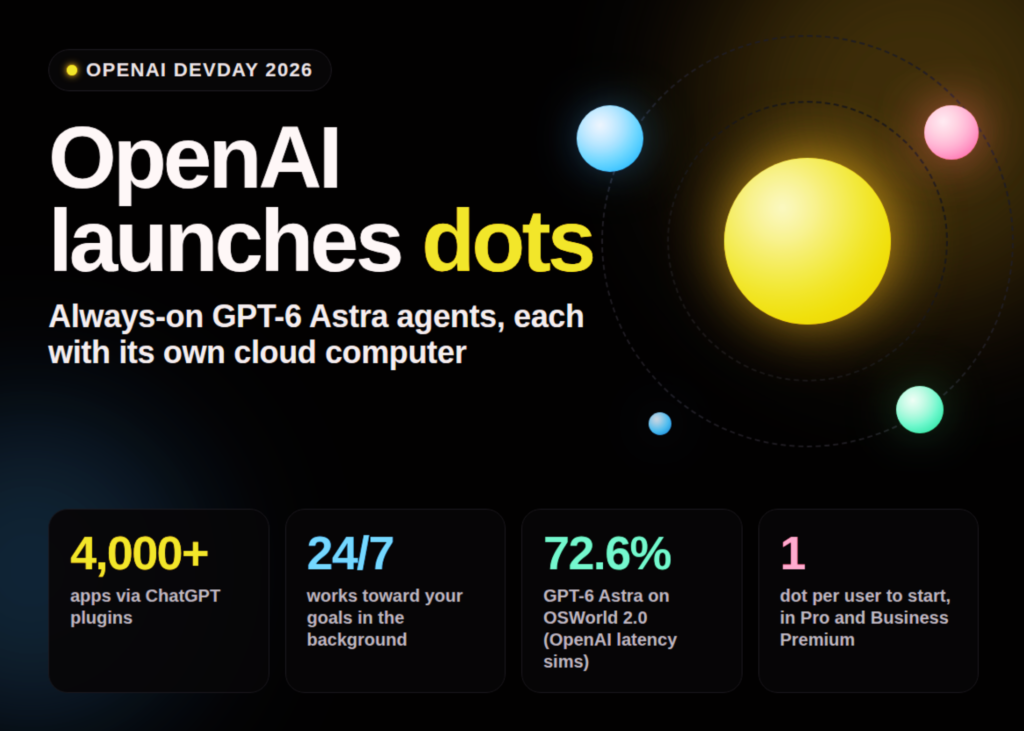
OpenAI announced dots at its DevDay today. This product launches persistent AI agents powered by GPT-6 Astra. Each dot runs on its own cloud computer with a browser. It operates across more than 4,000 apps via ChatGPT plugins and continues working after you log off.
The service is available now as a managed product. ChatGPT Pro and Business Premium users in eligible markets can access it. Enterprise, education, and healthcare workspaces receive a beta once an administrator enables it. There is no option for self-hosting or open weights.
What is a dot
A dot changes the interaction from a request-and-response loop into a standing assignment. You provide a goal, a name, and boundaries. The agent then pursues that goal around the clock and learns from feedback. Every user receives one primary dot.
To be honest, much of this capability existed previously with Codex and similar agent harnesses. The change here is packaging: one persistent agent, one identity, and one dedicated machine.
How a dot works
- Own computer: Each dot runs on a separate cloud computer with a browser. Your laptop stays isolated unless you connect it. You can open the dot’s computer at any time to inspect its work.
- Tools: It uses the plugins you connect across 4,000+ apps. It can also start tasks in Codex and ChatGPT Work for research, analysis, documents, and software.
- Surfaces: You can message or call your dot in ChatGPT on web, desktop, and mobile. Slack and Teams are supported, and texting is coming soon.
- Proactive research: When you are not working with it, the dot looks for ways to help. In this background mode, connected apps are read-only, so it cannot send messages or change content.
The model underneath is also important to know. In OpenAI’s latency simulations, GPT-6 Astra scores 72.6% on OSWorld 2.0 at roughly 40 minutes per task. GPT-5.6 Sol scored 65.7% at roughly 75 minutes.
Control and safety layer
- Built-in rules decide when a dot acts alone and when it asks for approval.
- Custom Rules let you allow, block, or require approval for specific actions.
- Auto-review checks any action that could affect your accounts or share information.
- Activity View shows progress, including background work, so you can redirect the dot.
- Credential handling: Dots sign in with saved passwords without exposing them to the model. Sensitive tasks, such as changing a password, stay with you.
- Monitoring can pause or stop a dot if it detects a safety concern.
OpenAI details this in a separate safety post. It also states that dots can still make mistakes, so consequential work needs review. The caution is timely. A day before launch, an OpenAI team stated that its agents had posted users’ images online, affecting 53 ChatGPT users.
Specialist dots for organizations
OpenAI is also previewing specialist dots. Each gets its own identity, credentials, and access to company systems for a fixed role. OpenAI tested them internally across procurement, invoice processing, email marketing, customer support, and commercial contracting. Rollout starts with enterprise pilots. OpenAI is working with Microsoft to bring specialist dots to Agent 365.
Pricing and usage limits
The first dot is included in Pro and Business Premium plans at no extra cost. Conversations with a dot do not count toward ChatGPT usage limits. Tasks it starts in Codex or ChatGPT Work do count. OpenAI also added a $500 paid tier the same day. Check the ChatGPT pricing page for current plan limits.
Dots vs Meta Muse vs Instinct: Feature Comparison
| Feature | OpenAI dots | Meta Muse | Instinct |
|---|---|---|---|
| Launch | Sep 29, 2026 | Sep 8, 2026 | Invite-only since Aug 2026 |
| Underlying model | GPT-6 Astra | Muse Spark | Not disclosed |
| Where the agent runs | Own cloud computer and browser | Muse Secure VM, a dedicated cloud computer | Own computer and phone number |
| Action gate | Custom Rules, auto-review, safety monitor | Separate Sentinel agent approves outbound actions | No public details found |
| Interfaces | ChatGPT web, desktop, mobile; Slack; Teams; texting soon | iOS, Android, muse.ai, WhatsApp | SMS and texting; no mobile app yet |
| Standout feature | Read-only proactive research; 4,000+ apps | Deep ties to Meta apps | Concierge phone calls; agent-to-agent plans with friends |
| Org or team agents | Specialist dots; Agent 365 work with Microsoft | Consumer launch; Axios reports a shift toward work use | Consumer-focused personal assistant |
| Availability | Pro and Business Premium, eligible markets | US only | Invite-only |
| Price | Included in Pro and Business Premium | Free, $20 or $100 per month | No public pricing found |
The split is clear. Muse chases mass consumer reach. Instinct lives in text messages. Dots start with high-end subscribers, mostly developers.