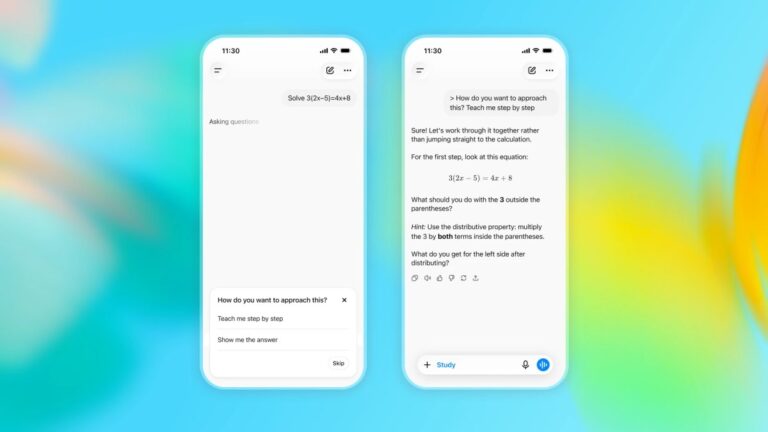
OpenAI has hired a product manager in San Francisco to build features for families, caregivers, and older adults.
The role appears in a job posting that asks for experience building products for parents and other trust-sensitive consumer experiences.
OpenAI did not comment on the posting.
The numbers
ChatGPT is reaching older users faster than younger ones. Sensor Tower estimates show the share of global users aged 35 and older rose to 31% in the second quarter from 26% a year earlier.
The share of users aged 18 to 24 fell to 29% from 34% in the same period.
In the U.S., nearly one in four smartphone users who are parents used ChatGPT during the quarter, up from 16% a year earlier.
Why this matters for households
Ben Bajarin, chief executive of technology consultancy Creative Strategies, said the hiring signals that OpenAI is thinking less about individual productivity and more about technology designed for households.
He told TechCrunch that the move follows a similar path taken by Google, Apple, and Meta as their platforms became embedded in everyday life.
He added that AI raises the stakes because the assistant is not just mediating content or devices.
Stephen Balkam, chief executive of the Family Online Safety Institute, said the hiring reflects both the maturation of OpenAI and a growing recognition that AI products used by children and teenagers require different safeguards than those designed for adults.
Balkam told TechCrunch that he sees this as safety by redesign.
He said companies take an initial product or service released without kids in mind, then need a much-needed reaction and response.
Parents do not see how much their children use AI
New research published this week by the Family Online Safety Institute found that parents are underestimating how often their children use generative AI.
While 27% of U.S. parents said their child had used generative AI in the past week, 38% of children reported doing so themselves.
The survey covered more than 4,000 families in the United States and Australia.
Balkam told TechCrunch that AI companies should build products differently for younger users.
He called for stronger content controls, age-appropriate experiences, parental oversight, and reminders to inform users that they are interacting with an AI and not a human.
Safety measures and legal pressure
OpenAI faces multiple lawsuits from parents alleging that ChatGPT contributed to harm suffered by their children, including in cases involving suicide.
In response to some of those concerns, OpenAI has introduced a series of safety measures over the past year.
These include parental controls for teen accounts, routing sensitive conversations to reasoning models designed to better handle signs of distress, and an optional Trusted Contact feature that can alert a family member or caregiver in cases of potential self-harm.
Balkam said AI companies have an opportunity to avoid the mistakes made by social media platforms, which for years treated children much like adults before adding stronger safeguards amid mounting public pressure and regulatory scrutiny.
OpenAI’s family work
The hiring aligns with OpenAI’s broader efforts around families.
In a recent workshop organized with the San Antonio Spurs Community Impact organization and the Positive Coaching Alliance, the company said it aimed to explore AI’s role in learning, coaching, and youth engagement.
How ChatGPT compares
Sensor Tower estimates that users aged 25 to 34 account for 40% of the global app audiences for Anthropic‘s Claude and Google’s Gemini, matching ChatGPT.
That compares with 33% for Microsoft’s Copilot.
Copilot skews older, with 20% of its users aged 45 and above.
That compares with 14% for Claude, 12% for Gemini, and 11% for ChatGPT.
While ChatGPT remains relatively underpenetrated among older users, it is adding them faster than its rivals.
The share of users aged 45 and above rose three percentage points year-over-year in the second quarter.
Copilot saw a two-point increase, while Claude and Gemini saw declines.
Among U.S. smartphone users who are parents, Gemini had the widest reach at 32% in Q2.
ChatGPT followed at 24%, Claude at 4%, and Copilot at 2%.
What comes next
Bajarin expects consumer AI to roll out family plans, child and teen profiles, caregiver tools, shared household memory, AI tutoring, and stronger safety controls as the technology becomes shared across generations.