Nvidia is promoting its new Vera Rubin chip system this week, revealing performance benchmarks for the GPU and CPU combination ahead of rival AMD’s annual product event in San Francisco on Thursday.
From graphics cards to central processors
During a lengthy technical workshop last week at the company’s headquarters in Santa Clara, California, Nvidia executives told a small group of journalists about the chip system’s increased power and efficiency. The main point: Nvidia, which has long specialised in making GPUs, is increasingly trying to position itself as a supplier of CPUs that can power AI agents.
While GPUs remain the main hardware that companies use to train and run their AI models, the industry’s shift toward more complex, agentic systems has increased demand for CPUs. These processors can orchestrate data flows, networking, and other software tasks. That is likely one reason Nvidia has been eager to promote itself as a supplier of complete AI systems, rather than just AI chips.
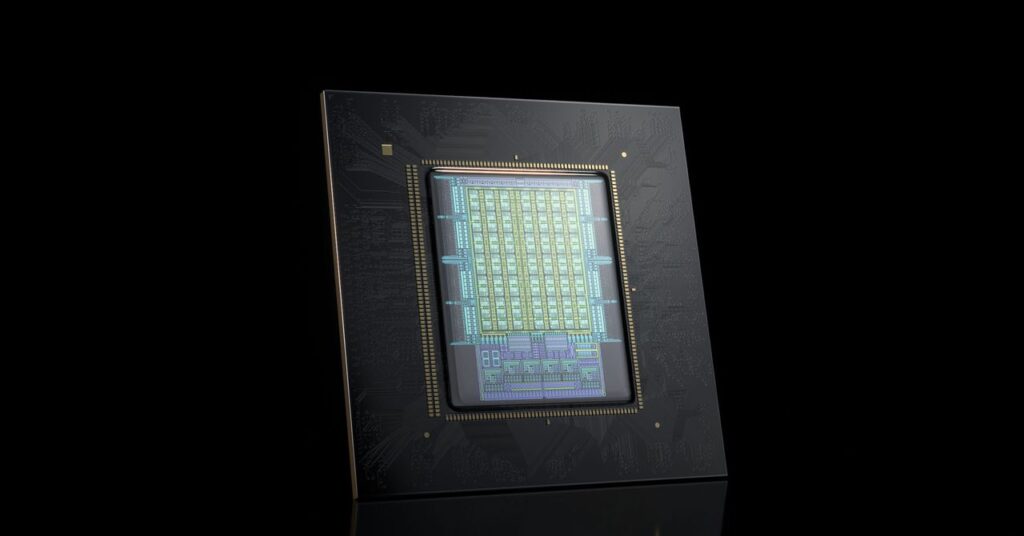
Vera Rubin is Nvidia’s successor to its hybrid superchip system Grace Blackwell. It represents the linchpin of its near-term future powering the AI industry. It is designed to offer one CPU for every two GPUs. In a single Vera Rubin NVL 72 super chip system, there are 36 Vera CPUs for every 72 Rubin GPUs. Nvidia is also selling the Vera CPU as a standalone product. It has reportedly told Chinese customers these could be ready as soon as August.
Nvidia executives emphasised that its new Vera Rubin NVL72 racks—a stack of chips packed into a single liquid-cooled platform—are much more “plug-and-play” than some of its earlier products. During a brief tour of a Nvidia data center lab in Silicon Valley, Nvidia executives shared that OpenAI already has one Vera Rubin rack in use.
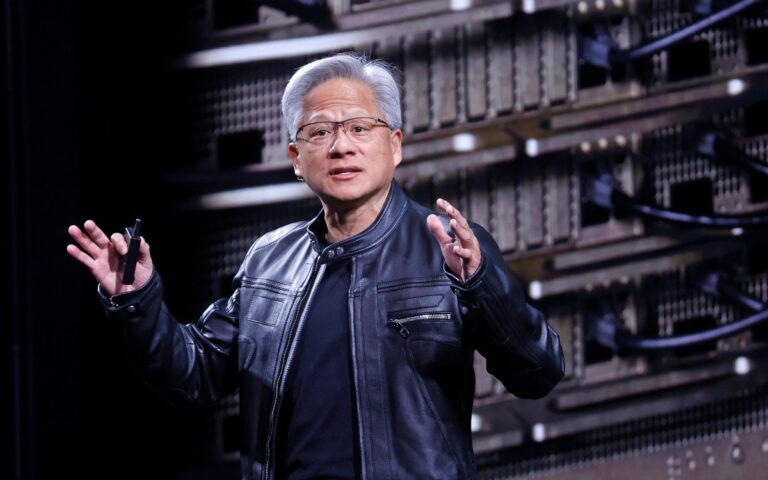
Nvidia CEO Jensen Huang did not make an appearance at the workshop in Santa Clara last week. He was in Japan announcing the chipmaker’s new partnerships with a number of Japanese firms to develop AI for robotics. The briefings were instead led by Ian Buck, Nvidia’s longtime vice president of accelerated computing and the architect behind the company’s CUDA software.
“We’re on a roadmap to crank out new architectures, not just GPUs but CPUs,” Buck told reporters. “We’re going to keep innovating, because it’s do this or die in Silicon Valley.”
The meetings were held in Huang’s executive briefing center. Multiple desks nearby were piled with bags of Taiwanese snacks that the CEO brought back from his recent trip to Computex, a massive annual semiconductor trade show in Taipei, an Nvidia spokesperson told WIRED.
Nvidia claims that the Vera Rubin NVL72 system will process ten times as many tokens per watt as the company’s Grace Blackwell super chip. The company says that its Vera CPU is also faster at processing agentic AI tasks compared to rival CPUs from AMD and Intel. The tests it ran to support those benchmarks appear to have used slightly older generations of its competitors’ CPUs. Localised memory subsystems on the new chips will also offer nearly three times as much memory bandwidth as Blackwell. This is likely to be an appealing feature to many companies amid an ongoing shortage of high bandwidth memory.
Nvidia says it has also significantly reduced the number of cables needed to connect its chips to racks in multi-rack server systems. The company is touting Vera Rubin as “cable-free compute” and “hot-swappable.” This means customers can theoretically reduce the amount of time it takes to install each rack from a couple of hours to a few minutes. Andrew Bell, Nvidia’s senior vice president of hardware engineering, brought this point up alongside Buck. The new chip system is 100 percent liquid-cooled. This can reduce the amount of energy needed to cool the chips, since air-cooling is more energy intensive.
Ever since Nvidia unveiled Vera Rubin in the spring of 2025, the company has been slowly dribbling out more details about the chip system while insisting it will be released on schedule. Huang has repeatedly said Vera Rubin is ramping to “full production” and will ship in the second half of this year. Early customers include Microsoft, OpenAI, and Oracle.
Nvidia is particularly sensitive to any suggestion of delays after its previous-generation Blackwell chips reportedly overheated when connected together in the company’s customised server racks. This forced it to make design changes and push back shipments.
Nvidia’s marketing push for Vera Rubin is happening just ahead of rival AMD’s annual conference. Executives are expected to tout its next-generation AI and data center chips. On Sunday, AMD revealed more details about its Helios AI chip rack, which is designed to compete with Nvidia’s new wares. Both AMD and Nvidia have been vying for large-scale, multi-year contracts to supply AI hyperscalers like Meta and Amazon and AI labs like OpenAI, Anthropic, and SpaceXAI with chips.
Over the past two years, AMD has significantly grown its share of the market for CPUs used in data centers. The company has long been recognised as a pioneer of the modern chiplet architecture used in x86 processors. These still account for the vast majority of data center CPU revenue. Nvidia, by contrast, builds its data center CPUs on ARM. This is an alternative chip architecture known for its power efficiency.
Nvidia executives Buck and Hannah Coutand, who runs product marketing for Nvidia DGX Cloud, both emphasised that Vera Rubin abandons the chiplet architecture used by many modern processors in favour of a single, monolithic chip. Coutand argued that stitching together multiple chiplets imposes “a heavy tax on memory bandwidth and data movement.” The monolithic design of Vera Rubin allows data to move more quickly across a single integrated circuit.
What it means
For people building and running AI, the shift means less time waiting for racks to be installed. The reduction in cabling and the ability to swap chips while the system runs hot means maintenance and upgrades happen in minutes rather than hours. Liquid cooling also lowers the energy bill for keeping these systems running.