NVIDIA launches Kumo Forecast
NVIDIA has released Kumo Forecast, a new tool for predicting time-series data. The system combines a pre-trained Transformer backbone with a retrieval mechanism that searches historical records for similar patterns. It also offers built-in explanations for its predictions. The model runs on the MOMENT-1-large encoder, which uses roughly 340 million parameters in its base layer.
How the system operates
The library uses a DataFrame-first API. Users can set forecast horizons and choose whether to include historical context for pattern matching. The interpretability framework generates explanations for specific time periods without altering the core forecasting engine. The software is available under the Apache 2.0 license.
Model code: NVIDIA/Kumo-TS
Model weights: nvidia/Kumo-Forecast
Merging pre-trained knowledge with past data
Forecasting relies on two inputs: representations learned during pre-training and historical observations relevant to the current task. Kumo-Forecast merges these through a pre-trained model and an optional retrieval path.
In direct forecasting mode, the system uses a MOMENT-based Transformer and a trained head to predict future values. Domain-Aware Representation and Retrieval (DARR) mode adds a nearest-neighbor search to historical data. This retrieves related patterns and blends them with the direct forecast.
This setup separates the model’s input window from its retrieval context. The input window holds recent observations for the immediate forecast. A separate historical DataFrame supplies extra context for pattern matching. Developers can adjust the library’s configuration to change how much weight the final prediction gives to each pathway.
Further information on DARR mode can be found in this published paper, Memory-Augmented Forecasting: Scalability and Generalization Across Temporal Domains
Technical components
Kumo-Forecast combines four main parts: a pre-trained temporal encoder, a trainable forecasting head, a historical-pattern retrieval mechanism, and an interpretability framework.
Pretrained Temporal Representations: The model uses the MOMENT-1-large Transformer encoder as its backbone. The architecture keeps encoder and embedder weights frozen while training the forecasting head. This separates the pre-trained representation model from the task-specific prediction layer.
Direct Forecasting: The forecasting head maps the model’s representations to future values for the requested horizon. For horizons beyond the model’s native capability, there is support for autoregressive extension. This distinguishes a directly generated forecast from a longer forecast that extends predictions recursively.
Domain-Aware Representation and Retrieval: DARR augments direct forecasting with k-nearest-neighbor retrieval from historical context data. This process combines direct forecasts with historical-pattern retrieval, while the SDK accepts the historical context through a separate context_df argument.
Interpretability: Kumo-Forecasting also includes a model-agnostic interpretability framework. When enabled, it produces an explanation bundle containing lag and feature attributions per forecast horizon, semantic-flow diagnostics, trajectory-stability diagnostics, and optional embedding Integrated Gradients. These outputs accompany the forecast rather than requiring a different forecasting architecture.
Further details on interpretability can be found in this paper, NVExplain: Explaining Time Series Forecasting with Latent Trajectory Analysis and Structure-Preserving Surrogates
Constraints
Data must be numeric and temporal. Supported input sequence lengths include 256, 512, 1024, and 2048 observations. Inputs consist of a timestamp column and one or more numeric value columns, represented as a pandas DataFrame or a CSV/JSON input. When using DARR mode, the dimensions of the context must be similar to the input context.
Use cases
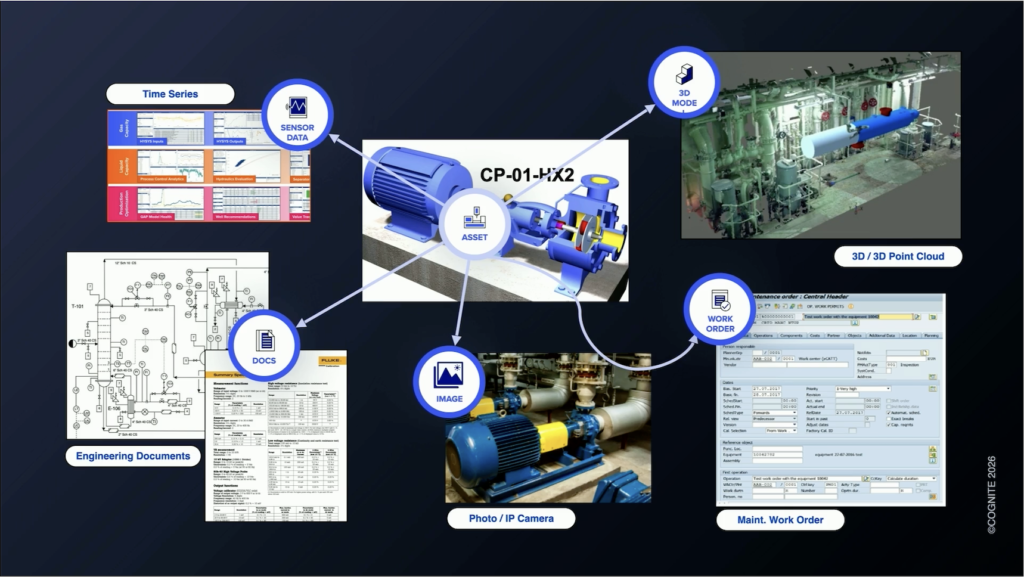
The Factory Operations (FOX) Blueprint includes Early Access to the Predictive Maintenance module. This tool uses Kumo Anomaly and Kumo Forecast to analyse real-time data and predict future anomalies.
Please click on the image below to access the session from GTC San Jose 2026
Getting started
For an application-specific evaluation, compare the direct and retrieval-enhanced configurations on the same held-out forecasting windows. Validate forecast quality across the intended horizons and operating conditions, consistent with NVIDIA’s requirement for use-case-specific testing.
Model code: NVIDIA/Kumo-TS
Model weights: nvidia/Kumo-Forecast
The Kumo-TS repository additionally provides an example for fine-tuning Kumo-Forecast on a user-supplied CSV. Developers therefore have both a pre-trained inference workflow and a documented starting point for adapting the model to their own data.