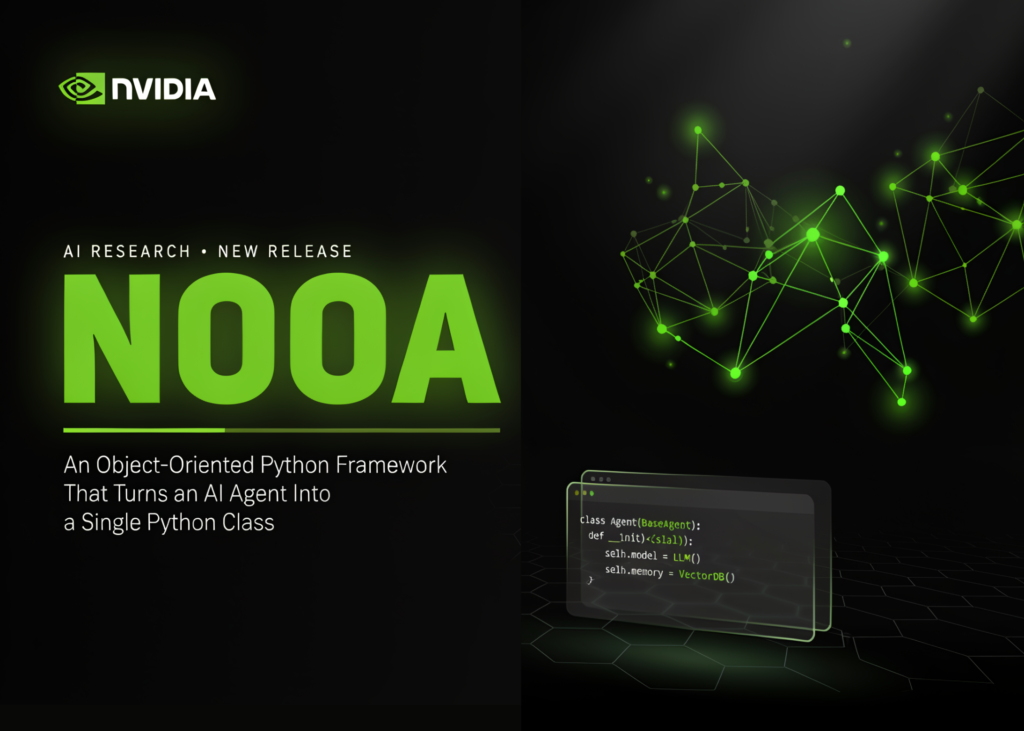
NVIDIA Labs has open-sourced NOOA, an object-oriented Python framework that consolidates prompt templates, tool schemas, and workflow graphs into a single Python class.
How the framework works
The system treats an agent as a standard Python object. Methods define actions available to the model, while fields store agent state. Docstrings act as prompts, and type annotations serve as runtime contracts. A method body containing ... triggers an LLM-driven loop to complete the task, whereas a method with a standard body executes as deterministic Python code.
Two strategies are currently available. PredictStrategy performs a single typed LLM call with local retries if validation fails. CodeActStrategy runs an iterative Python REPL where the model invokes execute_python(...) until it submits return_result(...) for validation against the return annotation.
Six capabilities on one surface
The research team claims NOOA is the first to combine six specific features: typed input and output, pass-by-reference over live objects, code as action, programmable loop engineering, explicit object state, and model-callable harness APIs.
Pass by reference is the critical feature. Arguments arrive as live Python objects. The model sees only a bounded preview containing the concrete type, true length, and head or tail samples. For example, a hundred-element list renders in about thirty tokens while the full variable remains in the REPL. Context splits into a cacheable static prefix, an append-only typed event history, and dynamic blocks at the tail to preserve KV-cache reuse across turns.
An optional memory subsystem attaches to an unmodified agent. Seven model-callable tools write and recall records ranked by ACT-R activation, stored in a single human-inspectable SQLite file.
Performance and benchmarks
Tests ran 88 scenarios five times across ten models. 4,309 of 4,400 records passed, a 97.9% success rate. A stress subset covering batching, error recovery, and decomposition passed 84.7%, with the gap between small and frontier models widening from 3.2 to 23 points.
On SWE-bench Verified, a benchmark-agnostic 253-line agent reached 82.2% using GPT-5.5 at xhigh effort. This compares to 78.6% for OpenCode, 78.2% for PI, and 79.8% with Opus 4.6. On Terminal-Bench 2.0, the agent reached 73.0% at high effort versus 60.7% and 68.5%, though PI led at xhigh with 75.3%.
CyberGym L1 results show the agent solving 86.8% of tasks with network access blocked, the top open-source result reported. On ARC-AGI-3, one agent with a one-page world-model skill reached 50.2% mean RHAE with GPT-5.5 and 85.1% with GPT-5.6-sol, costing under $20 per game.
Efficiency is the notable result. NOOA achieved 82.2% at roughly 1.1M tokens and ~28 model calls per task. PI reached 78.2% using 2.2M tokens and 66 calls. Trace analysis attributes this to validated termination; OpenCode stops when the model replies without a tool call, while NOOA requires a typed TaskResult carrying evidence and a verification command.
Deployment and limitations
NOOA is Apache 2.0 licensed and installs via pip install nooa (v0.0.8, released July 30, 2026). It requires Python 3.12 to 3.13. PyPI classifies the software as alpha, and NVIDIA describes it as a research preview.
Agents can execute LLM-generated code, but NVIDIA states directly that its AST checks and module deny-lists are defense-in-depth guardrails, not a containment boundary. The containment boundary is a container, a VM, or NVIDIA OpenShell. Models are pluggable through LiteLLM, so hosted APIs, Ollama, and vLLM endpoints all work.
At the company level, AI-native startups and mid-market platform teams building internal agents are the primary audience. Enterprise AI platform and applied-research groups running evaluations or pilots may also use it. Regulated production workloads should wait for a stable release.
Industries include developer tooling, cybersecurity, cloud and DevOps, data analytics, financial services operations, and customer support. Applications range from repository issue triage and patching to terminal and infrastructure automation, vulnerability validation pipelines, large-batch classification and extraction over in-memory data, and typed multi-agent orchestration.
What it means
The change offers practical benefits for developers. Writing agent logic becomes standard software engineering. Developers can test, trace, refactor, and version-control agent behavior like ordinary code. The system reduces the token cost for tasks while maintaining high performance on complex benchmarks, making the technology viable for internal tooling without requiring a full production release.