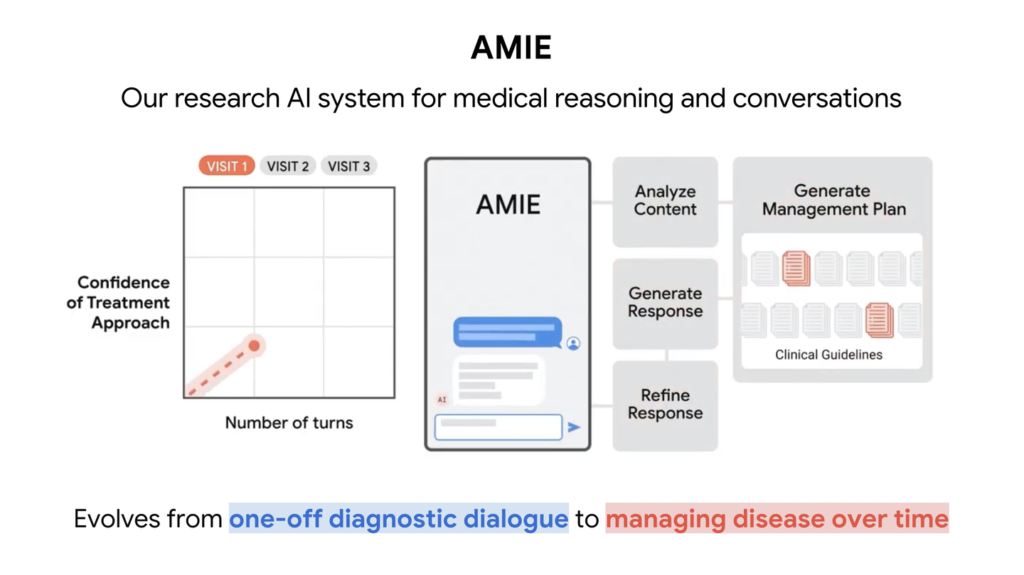
Giving a diagnosis is the first step in treating a patient. Once a diagnosis is established, the challenge becomes managing a health condition over time, tracking symptoms across multiple appointments, parsing guidelines as they’re updated and fine-tuning medications.
Research published today in “Nature” shows the capabilities of the Articulate Medical Intelligence Explorer (AMIE), our best-in-class research AI system for medical reasoning and conversations, evolving from one-off diagnostic conversations to long-term disease management using drug formularies and clinical guidelines.
Using the long-context capabilities of Gemini models, AMIE for disease management features an empathetic dialogue agent for real-time patient conversations and a deep-thinking management reasoning agent that cross-references hundreds of pages of authoritative clinical knowledge. In this blinded study with patient actors, specialist physicians compared AMIE with 21 primary care doctors. AMIE matched clinicians in overall management reasoning and scored significantly higher in plan preciseness and guideline alignment, which suggests AI could someday support medical care, giving physicians more time to spend with patients.
Next up: We’re exploring how AMIE could work in clinical settings, and we launched a nationwide study to assess AI in real-world virtual care.
Google’s new research on medical AI for disease management was published in “Nature” today. (Credit: Google, with permission from “Nature.”)