Simon Willison has released version 0.32 of his LLM CLI tool. This update brings support for reasoning traces, server-side tools, redesigned logging, and new features enabled by the OpenAI Responses API. He also pushed new versions of the llm-anthropic, llm-gemini, llm-openrouter, and llm-mistral plugins.
Headline features for LLM CLI users
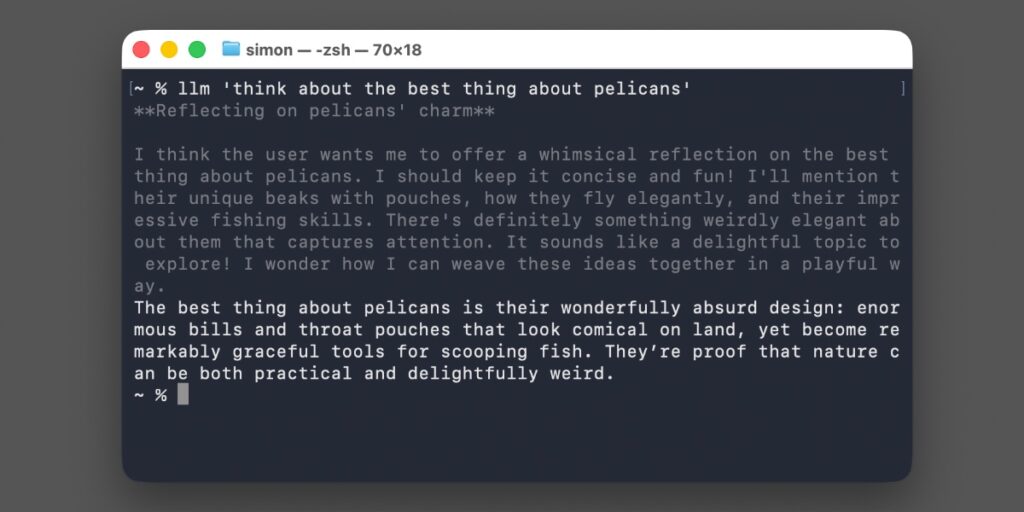
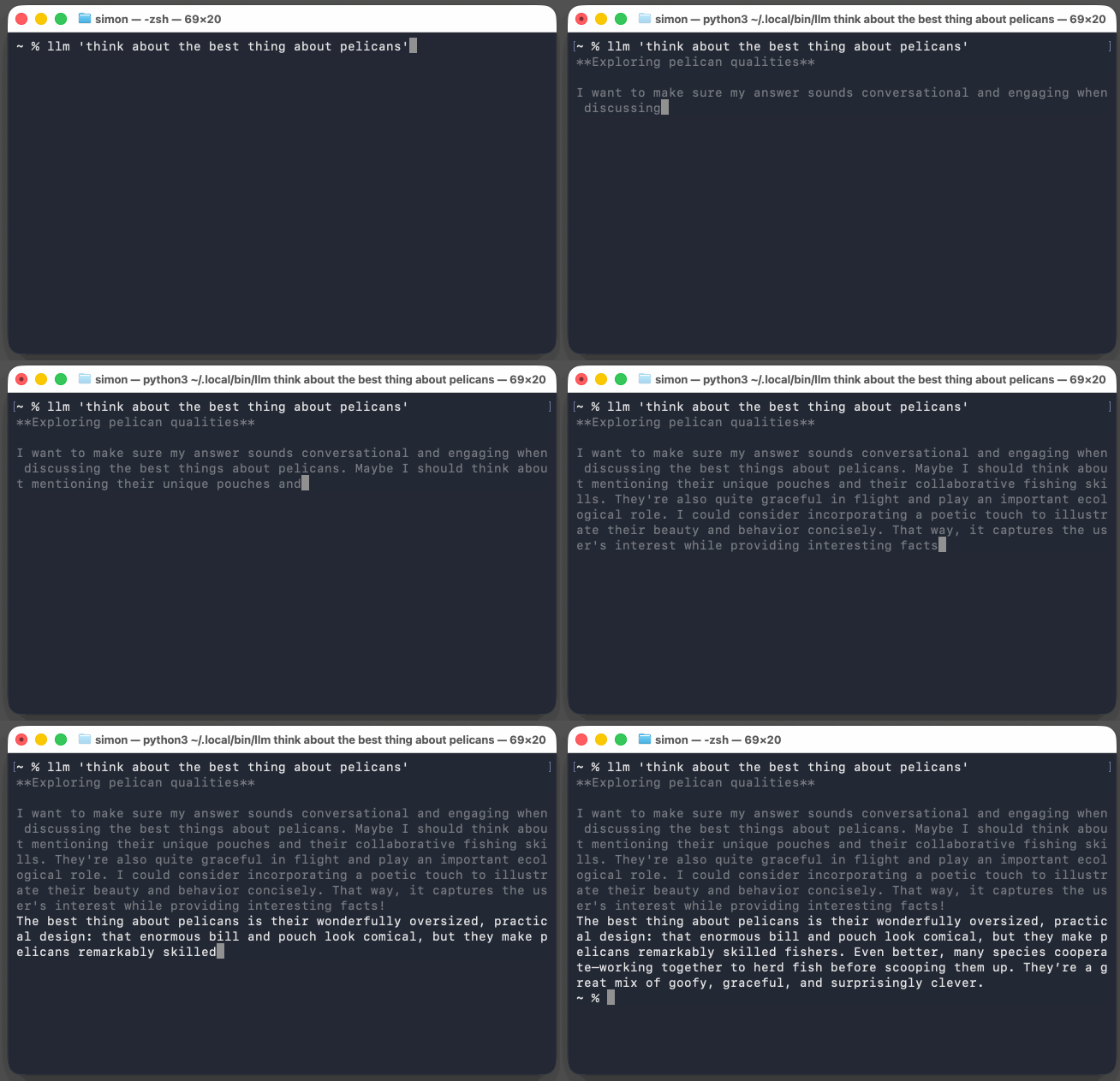
Running LLM against reasoning models now displays their reasoning traces to standard error. You can see what they are “thinking” without that information being included in the standard output that you might pipe to another tool. Add -R/--hide-reasoning to turn this off.
LLM includes support out-of-the-box for the GPT-5.6 model family, and the new default model used with llm "prompt" is now the inexpensive but capable GPT-5.6 Luna.
LLM calls can now use server-side tools from various providers. OpenAI provide a code execution environment as a server-side tool; LLM can now run prompts that benefit from that like so:
llm --tool CodeInterpreter 'Show current python and SQLite versions'OpenAI also gets a WebSearch tool.
The llm-anthropic plugin adds WebSearch, WebFetch, CodeExecution, and AnthropicMCP, which looks like this:
llm -m claude-sonnet-5 -T 'AnthropicMCP("https://datasette.simonwillison.net/-/mcp")' \
  'how many rows in the blog_blogmark table?'
That causes Anthropic to execute MCP calls against his new datasette-mcp plugin as part of a single request/response interaction with their API.
The new llm openai endpoint command provides a tool for executing prompts against any OpenAI compatible endpoint as a one-liner. These aren’t logged, which makes this a handy tool for running one-off prompts against anything that speaks the lingua franca of the LLM API world.
Here’s how he uses that to run prompts against Gemma 4 12B running in his localhost LM Studio API, via uvx (no LLM installation required) and mixing in the llm-tools-quickjs tool plugin for good measure:
uvx --with llm-tools-quickjs \
  llm openai endpoint http://localhost:1234/v1 -m google/gemma-4-12b \
  -T QuickJS 'Use QuickJS to multiply 3434 * 2434' --td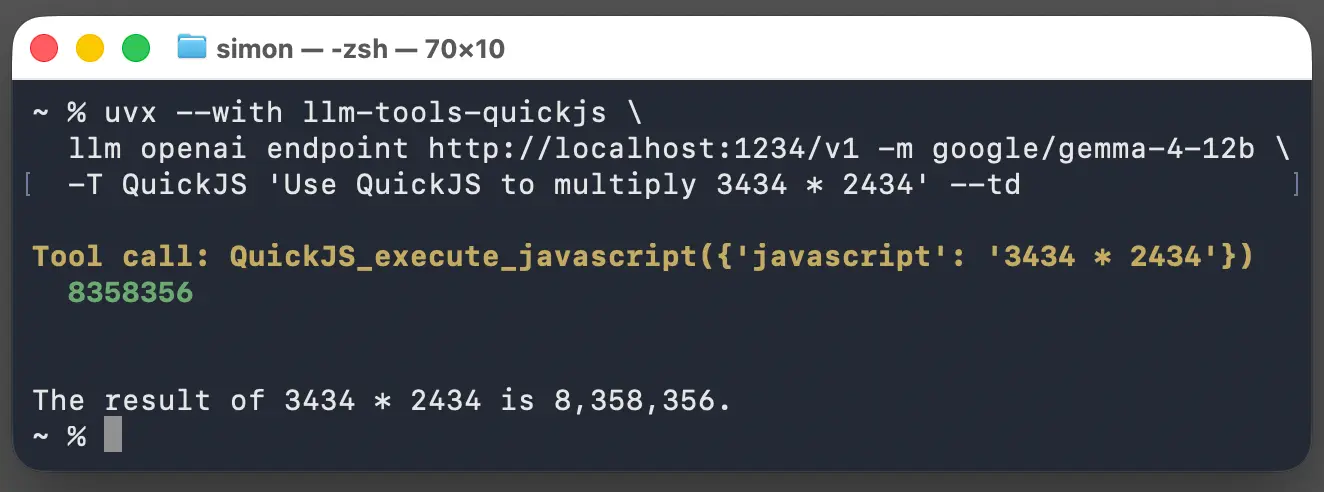
New features in the Python API
LLM’s Python API previously required you to create a conversation and then send messages to it one at a time. This was an abstraction over the true nature of LLMs, where each request carries a complete history of the messages that came before it. That abstraction started to get in the way for some more advanced cases, so the new release introduces a model.prompt(messages=[]) parameter that can be used like this:
import llm
from llm import user, assistant, system

model = llm.get_model("gpt-5.6-luna")

response = model.prompt(messages=[
    system("You are a helpful pirate."),
    user("What is the capital of France?"),
    assistant("Paris, matey."),
    user("And Germany?"),
])
print(response.text())
LLM previously returned an iterable sequence of strings from each prompt. This worked great when models returned a string response, but failed to predict the weird shape that models would evolve towards. Today many models return a mix of reasoning text, output strings, tool calls, and even image attachments. With LLM 0.32 you can do this instead:
for event in model.prompt("Explain cats").stream_events():
    if event.type == "reasoning":
        print(f"[thinking] {event.chunk}", end="", flush=True)
    elif event.type == "text":
        print(event.chunk, end="", flush=True)
    else:
        print(f"Other event: {event}")