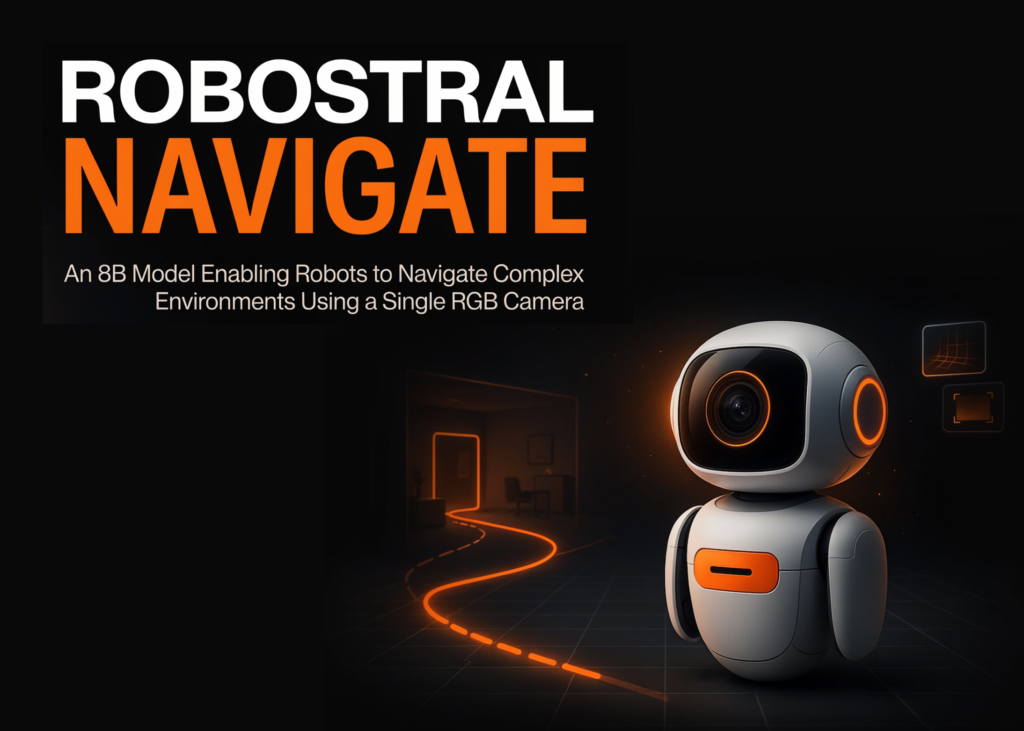
Mistral AI has launched Robostral Navigate, an 8B-parameter model designed to guide robots through complex spaces using only a single RGB camera. On the R2R-CE benchmark, the system achieved a 76.6% success rate on unseen validation environments without relying on depth sensors or LiDAR.
What is Robostral Navigate
Robostral Navigate processes plain-language instructions to move a robot autonomously. It operates in offices, residential areas, commercial buildings, and outdoors. For instance, a command like “Leave the lobby, walk through the corridor, enter the supply room, and stop to face the second shelf” triggers a full sequence of actions.
Crucially, the model functions in live spaces populated by people and obstacles that were not present during training. Most navigation systems depend on depth sensors or multiple cameras to build a 3D map. Robostral Navigate differs by using one standard RGB camera, which reduces hardware requirements and improves efficiency compared to multi-sensor setups.
Navigation via Pointing
The model determines movement through a technique called pointing. It predicts the specific image coordinates where the robot should move next and the desired orientation upon arrival. This approach is robust against changes in camera settings and world scale, unlike metric displacement commands.
The method has a limitation: if the target is outside the current field of view, the model switches to local displacements. In these cases, it issues commands such as “Move 2 meters forward, 1.5 meters to the left, and turn 25 degrees left.”
Built From the Ground Up
Robostral Navigate does not rely on existing open-source vision-language models. It originates from Mistral’s internal model built for grounding tasks, which includes pointing, counting, and object localisation. Navigation is treated as an extension of grounding; once the model identifies where objects are, it learns how to move toward them.
Mistral generated training data entirely within a simulation environment. The pipeline produced approximately 400,000 trajectories collected across 6,000 distinct scenes.
Efficient Training and Online Reinforcement Learning
Training efficiency was central to the design. The system uses prefix-caching and a tree-based attention-masking strategy to compress an entire episode into a single sequence. This allows the model to train on all time steps in one forward pass while preventing information leakage between steps.
Consequently, the approach reduces training tokens by a factor of 22. Runs that previously took months now complete in days. Following supervised training, Mistral applied CISPO, an online reinforcement learning algorithm. This stage enables the model to learn from trial and error, recover from failures, and develop exploratory behaviours. It also addresses distribution shift issues common in standard behaviour cloning, raising the success rate by an additional 3.2%.
Benchmark and Performance
Robostral Navigate achieves state-of-the-art results on R2R-CE, a standard instruction-following benchmark for Room-to-Room navigation in continuous environments. The test is built on Matterport3D, where an agent follows language instructions in a continuous 3D space. The ‘validation unseen’ split excludes specific environments to measure generalisation capabilities.
Evaluation metrics include Success Rate, Oracle Success Rate, Success weighted by Path Length, and Navigation Error. The model scores 79.4% on validation seen and 76.6% on validation unseen. It outperforms the best single-camera approach by 9.7 percentage points and beats the best depth or multi-camera system by 4.5 percentage points.
Comparison Table
The table below contrasts Robostral Navigate with typical multi-sensor systems.
| Attribute | Robostral Navigate | Typical multi-sensor VLN systems |
|---|---|---|
| Sensors | Single RGB camera | Depth sensors, LiDAR, or multiple cameras |
| Model size | 8B, built in-house | Varies by approach |
| Base model | In-house grounding VLM | Often built on open-source VLMs |
| Training data | ~400,000 sim trajectories, 6,000 scenes | Mix of simulation and real data |
| Decision method | Pointing + local-displacement fallback | Metric displacements or map-based planning |
| R2R-CE val-unseen | 76.6% | 4.5 pts lower (best depth/multi-camera) |
| Robot support | Wheeled, legged, flying; multiple sizes | Frequently platform-specific |
The right column describes common practice in vision-and-language navigation, not a specific named system.
Use Cases With Examples
These traits enable several practical applications. In manufacturing, a robot can transport parts between stations from a single instruction. In delivery and logistics, a wheeled robot moves packages across a warehouse. In hospitality, a robot guides a guest from the lobby to a room.
Because the model supports wheeled, legged, and flying robots, a single fleet can share the software. It also remains robust to differences in camera intrinsics across different robot platforms.
A Simplified Code View
The following pseudo-code illustrates the decision path for the pointing loop. It is illustrative, not the official API.
obs_history = []      # past RGB frames
instruction = "Leave the lobby, walk to the second shelf, stop."
done = False

while not done:
    frame = camera.read()          # single RGB image
    obs_history.append(frame)
    action = model.predict(instruction, obs_history)

    if action.type == "point":     # target visible in view
        robot.move_to_pixel(action.x, action.y, action.heading)
    else:                          # target out of field of view
        robot.move_local(action.forward_m, action.left_m, action.turn_deg)

    done = action.stop
What it means
For developers and robotics teams, this release removes the need to integrate expensive depth sensors or LiDAR for basic navigation tasks. The shift to a single RGB camera lowers the barrier to entry for deploying mobile robots in dynamic environments like warehouses or hospitals. However, the model’s reliance on simulation for training means teams must still validate performance in real-world conditions before full deployment.
Related articles