Meta is set to begin manufacturing its new AI processors in September, Reuters reported after accessing an internal company memo.
Testing for at least one of the units wrapped up in roughly six weeks. The hardware is designed in partnership with Broadcom but built by Taiwan Semiconductor Manufacturing Company. The company has also placed orders for memory from Samsung, storage from Sandisk, and fibre-optic gear from Sumitomo Electric.
The MTIA plan
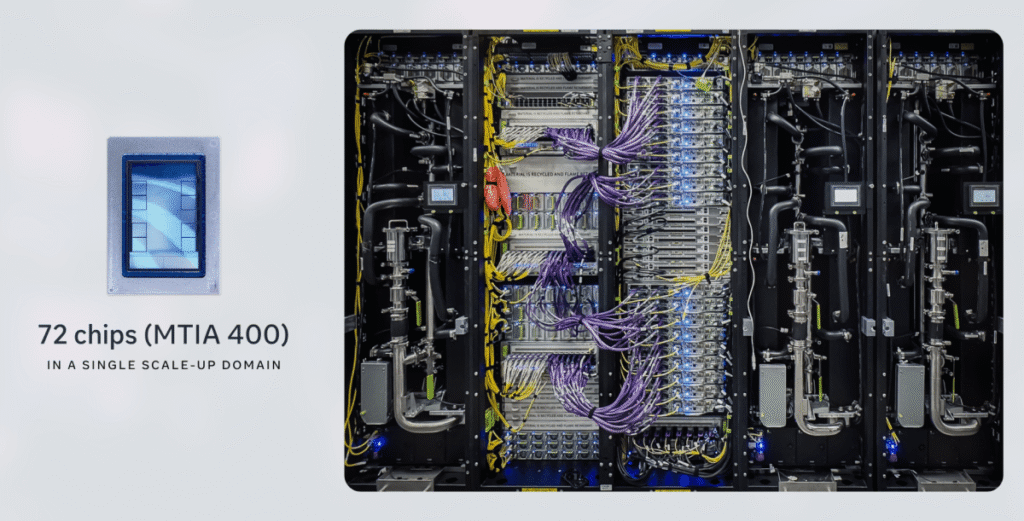
Four new chips were announced in March under the Meta Training and Inference Accelerator (MTIA) programme. Some are already in use or scheduled for deployment this year and the next. The design uses modular chiplets to allow for updates as requirements shift. Each generation builds on the previous one by adding new workload insights and hardware capabilities.
Meta intends to use these processors for training ranking and recommendation models, general AI tasks, and inference for its applications. The move aims to reduce reliance on Nvidia and AMD GPUs, though the company expects to continue buying those chips in large volumes.
The social media giant has been making its own silicon since 2023. Capital spending on compute capacity is the primary driver, with April figures showing expected capital expenditures between $125 billion and $145 billion for the year.
Infrastructure and deals
Meta is securing data centre space and power deals globally to support the Muse Spark series of AI models. The company plans to deploy 7 gigawatts of compute this year and double that amount next year.
Other major agreements include a deal with ARM for recommendation systems, a multibillion-dollar purchase of AMD Instinct GPUs, and a similar deal with Amazon to use the cloud giant’s own CPUs.
Meta is not alone in trying to reduce spending on Nvidia hardware. OpenAI recently revealed an inference processor built with Broadcom. Anthropic is reportedly considering making its own chips with Samsung. Amazon and Google already develop their own silicon for training and inference, while many startups are entering the market to meet demand.
Meta declined to comment on the report.
What it means
For the teams building models, this shift means a new supply chain layer. Instead of relying solely on Nvidia cards, engineers will have to adapt their training pipelines to Meta’s custom MTIA architecture. The modular design suggests updates will come faster, but it also introduces complexity in integrating different chip components. The massive infrastructure investment indicates that compute capacity is now a fixed cost for major players, not a variable one.