Meta launches Muse Spark 1.1 API at $4.25 per million output tokens
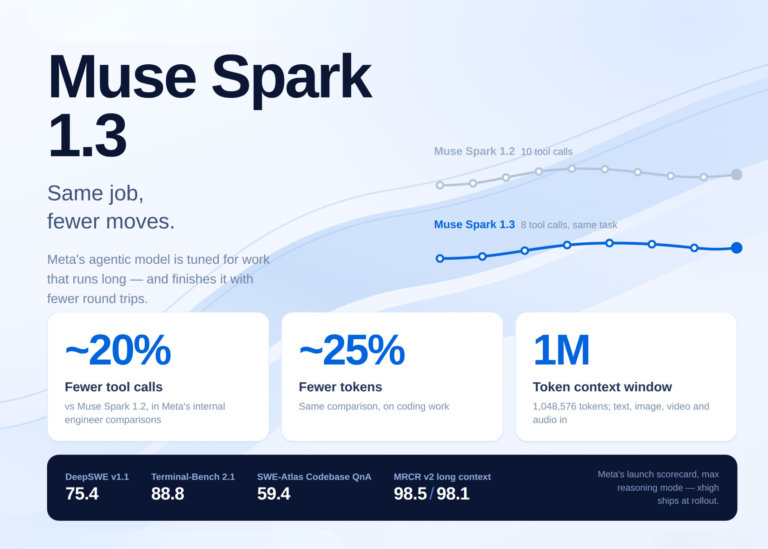
Meta has released Muse Spark 1.1, a multimodal reasoning model designed for agent-based tasks, programming, and computer use. The new model can orchestrate multi-agent systems and handle a context window of one million tokens.
The developer API is priced at $4.25 per million output tokens. This undercut established competitors like OpenAI and Anthropic while also coming in below the just-released xAI Grok 4.5.
This aggressive pricing strategy could put serious pressure on pure-play AI labs like OpenAI and Anthropic. Both depend on high margins but now find themselves squeezed between well-funded tech conglomerates on one side and low-cost Chinese models on the other.
Meta unveils new API access and model capabilities
Meta Superintelligence Labs has unveiled Muse Spark 1.1. It is built for agent-based tasks, coding, computer use, and multimodal understanding.
Meta calls it a “significant upgrade” over the original Muse Spark, which shipped in early April 2026. The model is available in “Thinking” mode in the Meta AI app and on meta.ai.
Like its predecessor, Muse Spark 1.1 ships without open weights. This suggests Meta has moved on from the open-source Llama strategy that once made it a hero in the AI community.
Alongside the model, Meta is launching a public preview of the new Meta Model API. This gives developers direct access for the first time. The move puts Meta squarely in a market previously held by OpenAI, Anthropic, Google, and several Chinese providers.
The new image model, Muse Image, isn’t available through the API yet.
Multi-agent orchestration aims to speed up complex projects
Meta says Muse Spark 1.1 is trained to orchestrate multi-agent systems. As the main agent, the model gathers context, builds a plan, and delegates execution to parallel subagents.
As a subagent, it stays on task and knows when to escalate back. The model generalizes to new native tools, MCP servers, and custom skills without specific training.
It actively manages its one-million-token context window. It remembers actions, retrieves and compresses information from earlier work without losing critical steps, according to Meta.
Meta says coding performance has also improved significantly on real-world tasks involving large codebases. The model can now diagnose complex bugs, add new features to enterprise systems, and handle large-scale code migrations.
In the independent VALS-AI benchmark, Muse Spark 1.1 ranks fourth overall while being particularly fast and cost-effective. On the “Vibe Code Bench” coding benchmark alone, it jumped 36 places over its predecessor.
Meta also highlights multimodal strengths in perception, reasoning, and tool use. The model can interact with real-world environments and produce outputs based on actual observations, especially in computer-use workflows spanning multiple applications.
Instead of clicking through each desktop step individually, the model decides when automation makes sense. It writes scripts when that is faster, clicks when direct interaction is easier, and generates batches of actions per step.
Meta says it ran extensive security evaluations in line with the Advanced AI Scaling Framework before deployment. Across all frontier risk categories, including chemical and biological risks, cybersecurity, and loss of control, Muse Spark 1.1 operates within safe parameters. A detailed security analysis is available here.
Meta’s pricing puts pure-play AI labs on notice
Muse Spark 1.1 alone likely would not turn many heads. The Meta Model API and its pricing will, at least at OpenAI’s and Anthropic’s HQs.
Meta charges $1.25 per million input tokens, $4.25 per million output tokens, and $0.15 for cached input. Web Search Grounding runs $2.50 per 1,000 queries.
There is no Instagram or Facebook search feature yet, but Meta could add one down the line as a differentiator, similar to what Grok does on X.
Those prices undercut even xAI’s Grok 4.5, which launched just yesterday and held the title of cheapest near-frontier model for a few hours.
Anthropic’s Opus 4.8, OpenAI’s GPT-5.5, and Fable 5 charge between $25 and $50 per million output tokens. Many times Meta’s $4.25 is the comparison point.
Chinese models like GLM 5.2 are also much cheaper, but Meta’s API sets a new price floor among major U.S. providers.
The AI price war is accelerating
The price war could hit OpenAI and Anthropic hardest. Both are burning through billions and depend on high token margins and rapid growth to cover losses and justify their valuations.
Meta, a company with more than $60 billion in annual profit, is now offering a competitive model at a fraction of those prices.
Both Meta and Google can run their APIs as gateways to their ecosystems without needing to turn a profit on them soon.
Chinese open-source models are pushing prices down from the other direction. Snowflake has shown that GLM 5.2 costs a fraction of what Opus 4.8 charges while delivering comparable coding performance.
Companies like Coinbase and Lindy have cut their AI spending significantly by switching to Chinese models.
So frontier AI labs are getting squeezed from both sides: Google and Meta press down with corporate resources. Chinese open-source models press up with rock-bottom prices.
Whether Meta’s price advantage holds in practice also depends on token efficiency. The number of tokens a model burns per task can shift real-world costs significantly, as Databricks recently showed in its own benchmark.
And the performance Meta’s benchmarks promise still has to hold up in production. If it does not, even the lowest prices are wasted money.