Meta AI has released Muse Spark 1.3, a coding model designed for long-horizon agent work rather than single-turn generation. The model aims to sustain complex threads, collaborate with users, and identify when it is stuck.
Availability and limits
The model is available now via Muse Code and the Meta Model API. You can call it in production immediately. Self-hosting is not an option because the weights are closed. The maximum reasoning mode remains gated behind further safety testing.
Changes to agent behaviour
Meta trained Muse Spark 1.3 across multiple agent harnesses so the model generalises beyond a single environment. It is built to hold several workflows inside a single long thread. Given an open-ended objective, it gathers its own context from messy and conflicting sources, then patches gaps in its plan.
The collaboration features are the most practical part. Muse Spark 1.3 asks clarifying questions on ambiguous prompts, pulls the user in when it stalls, and confirms before consequential actions. On long runs it adapts to preference: frequent status updates, or silent background execution. Meta also reports better calibration on the model’s own limits, so it flags hurdles instead of hallucinating an outcome.
Multitasking improved too. Meta says the model maps an incoming prompt to the correct task inside a cluttered single thread, whether the user is steering or interrupting.
Coding and efficiency
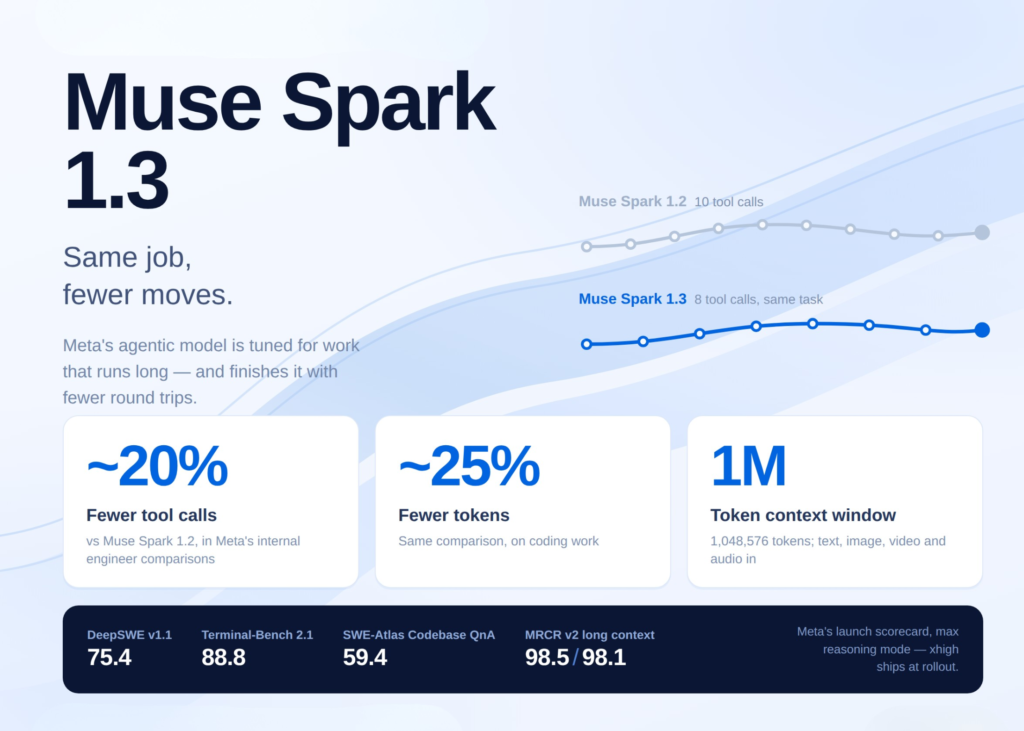
Muse Spark 1.3 was trained on more long-horizon coding tasks. Relative to Muse Spark 1.2, Meta describes fewer unnecessary turns, less verbosity, and a cleaner code style. In internal comparisons by Meta engineers, it used approximately 20% fewer tool calls and approximately 25% fewer tokens. For agentic workloads, that is the number that maps to cost: fewer round trips and fewer billed tokens per completed task.
Benchmarks
On Meta’s own numbers, Muse Spark 1.3 posts 75.4 on DeepSWE v1.1, ahead of Claude Opus 5 at 74.0 and GPT-5.6 Sol at 72.7. It reaches 59.4 on SWE-Atlas Codebase QnA and ties GPT-5.6 Sol at 88.8 on Terminal-Bench 2.1, with Opus 5 at 86.7. Long-context retrieval is the widest gap: MRCR v2 scores of 98.5 (256K–512K) and 98.1 (512K–1M), against 91.5 and 73.8 for GPT-5.6 Sol.
The mode split matters on agentic rows. Meta reports OSWorld 2.0 at 66.9 for max versus 57.2 for xhigh, GDPval-AA v2 Elo at 1,754 versus 1,709, and JobBench at 64.9 versus 61.2. DeepSearchQA ties at 89.4 for both. Since Muse Spark 1.2 was evaluated at xhigh, part of the generational jump is a reasoning-tier change.
Artificial Analysis scores the shipping xhigh variant at 61 on its Intelligence Index and the preview max variant at 62. That places xhigh level with GPT-5.6 Sol (max) and Grok 4.6 (high), behind Claude Opus 5 (max, 63) and Claude Fable 5.1 (max, 66). Artificial Analysis also measured Tau3-Bench Banking at 47% for xhigh and 52% for max, the top score it has recorded on that evaluation.
Key Takeaways
- Muse Spark 1.3 is live in Muse Code and the Meta Model API, with a 1M-token context window.
- Meta engineers measured ~20% fewer tool calls and ~25% fewer tokens versus Muse Spark 1.2.
- Meta’s launch scorecard uses the
maxmode, which is not the mode developers can call today. - Pricing is unchanged at $1.25/M input and $4.25/M output, with a $0.10/$0.20 contributor tier.
- Weights stay closed, though Meta lists a Muse Spark open weights release on its roadmap.
What it means
Developers using these tools will see fewer interruptions and lower bills. The model stops making unnecessary API calls and sends fewer tokens for the same work. It also handles long-running projects better by asking for clarification when needed and confirming actions before they happen.