“`html
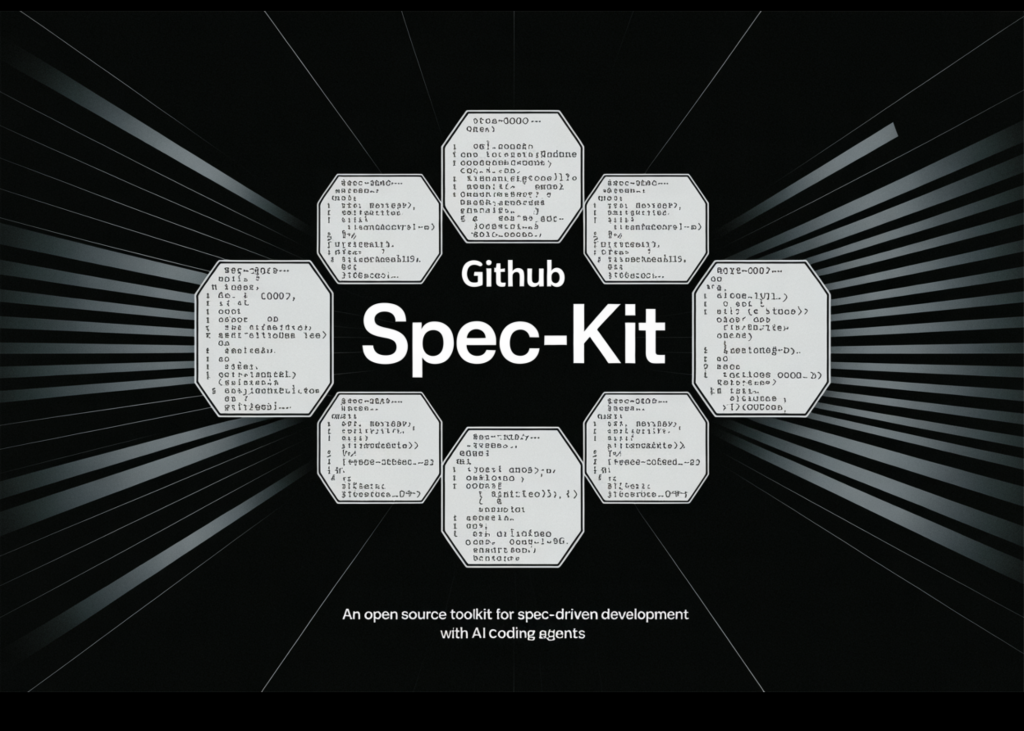
GitHub Spec-Kit: An Open Source Toolkit for Spec-Driven Development with AI Coding Agents
If you have used AI coding agents like GitHub Copilot, Claude Code, or Gemini CLI, you might have encountered situations where the agent generated code that looked correct but failed to capture your actual intent. This “vibe-coding” approach works well for quick prototypes but falls short when building mission-critical applications or working with existing codebases. The issue is not in the coding agent’s ability but rather in how developers interact with them – treating them like search engines instead of literal-minded pair programmers.
To address this, GitHub has open-sourced Spec-Kit, a toolkit designed to bring Spec-Driven Development (SDD) to AI coding workflows. The project currently boasts 90k+ stars and 8k+ forks on GitHub, making it one of the fastest-growing developer tooling repositories in recent memory.
What is Spec-Driven Development?
Spec-Driven Development flips the traditional power structure of software development. Specifications do not serve code; instead, they are the source that generates implementation. In practice, this means writing a structured specification first-describing what you want to build and why without specifying the tech stack-and then feeding that into an AI coding agent as a grounding document. The spec becomes the source of truth used by tools and agents for generating, testing, and validating code.
This is distinct from “documentation-first” practices. SDD isn’t about creating exhaustive, dry requirements documents no one reads. It’s not about waterfall planning or predicting the future through extensive planning exercises. Instead, it allows developers to focus on writing a living artifact-updated as requirements evolve rather than being filed away after project kickoff.
What does Spec-Kit include?
Spec-Kit consists of two key components: the Specify CLI, a helper command-line tool that bootstraps projects for SDD by downloading official templates for the coding agent and platform of your choice; and a set of templates and helper scripts that establish the foundation for the SDD experience-defining what a spec looks like, what a technical plan encompasses, and how it breaks down into individual tasks that an AI agent can execute.
The CLI is written in Python and requires Python 3.11+. Installation via uv is recommended:
uv tool install specify-cli --from git+https://github.com/github/spec-kit.git@vX.Y.Z
specify init <PROJECT_NAME>
Once initialized, the agent has access to a set of slash commands that map directly to the SDD workflow. The core commands are:
/speckit.constitution: Establishes project’s non-negotiable governing principles./speckit.specify: Captures what you want to build, focusing on “what” and “why” without tech stack details./speckit.plan: Generates the technical implementation plan given your chosen stack./speckit.tasks: Breaks the plan into an actionable, dependency-ordered task list./speckit.taskstoissues: Converts the generated task list into GitHub issues for tracking and execution./speckit.implement: Executes those tasks using the AI coding agent.
There are also three optional commands for enhanced quality and validation:
/speckit.clarify: Surfaces underspecified areas through structured, sequential questioning before a technical plan is created (recommended before/speckit.planto reduce rework downstream)./speckit.analyze: Runs cross-artifact consistency and coverage analysis after/speckit.tasksand before/speckit.implement./speckit.checklist: Generates custom quality checklists that validate requirements completeness, clarity, and consistency.
An important addition is the constitution.md. In the SDD context, a constitution document establishes a set of non-negotiable principles for a project-such as testing conventions, CLI-first requirements, or organizational design system standards. These are captured once and referenced throughout every subsequent development phase.
Key Takeaways
- Spec-Kit is an open-source toolkit designed to bring Spec-Driven Development (SDD) to AI coding workflows.
- The Specify CLI provides a way to bootstrap projects for SDD, downloading official templates for the chosen coding agent and platform.
- The core commands of
/speckit.constitution,/speckit.specify,/speckit.plan,/speckit.tasks,/speckit.taskstoissues, and/speckit.implementfacilitate the SDD workflow, ensuring that specifications guide the coding process. - The optional commands like
/speckit.clarifyand/speckit.analyzehelp in validating the correctness of the specification and plan, reducing errors and improving code quality.
“`