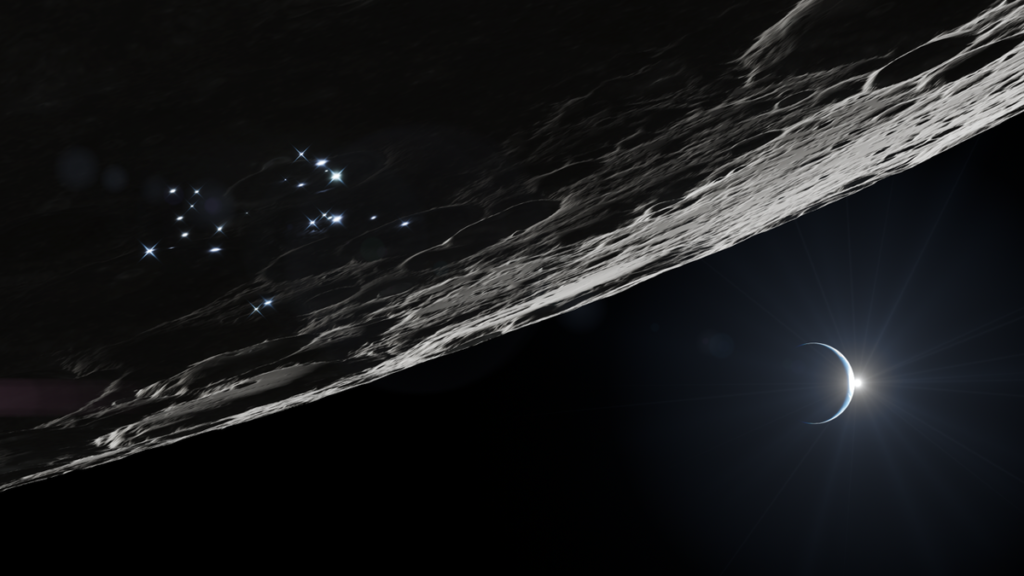
Microbes from Earth can survive on parts of the Moon for at least seven days, a finding published Wednesday in Science Advances that suggests the lunar surface is less hostile than previously thought.
Astronauts have not walked on the Moon since the Apollo era, but that may change soon. The US-led Artemis program and a Chinese-Russian space partnership both aim to land crews on the lunar south pole during the 2030s. This polar region has been selected because it contains water ice in permanently shadowed areas, which is an essential resource for life support and other mission operations.
Survival in the dark
Most of the Moon appears to be inhospitable due to extreme temperatures and intense radiation. However, these shady polar spots are sheltered from harmful ultraviolet light. To assess how long life could survive there, a team analyzed the region’s topography and surface conditions and compared it with the survival bounds of common earthly microbes. The results revealed that significant lunar polar areas likely have surface conditions amenable to microbial survival.
“Recent studies have shown how unique the conditions are on the surface of the lunar poles and we realized that it was worth studying how amenable those might be to survival for certain microbes, particularly in the context of recent work on how hardy some bacteria and fungi are when exposed to space conditions,” said Prabal Saxena, a research space scientist at NASA Goddard Space Flight Center who led the study.
Saxena noted that the team was able to bring together experts on lunar surface evolution, biochemistry, clean room microbiology, lunar surface topography, lighting and planetary protection to explore the question.
With this interdisciplinary approach, the team modeled conditions at various sites that are under consideration for crewed Artemis landings using remote-sensing observations from NASA’s Lunar Reconnaissance Orbiter. They then selected bacteria and fungi that are abundant on spacecraft, and would be most likely to be transported to the lunar surface during future missions, and assessed whether they could survive in any of those regions.
In regions known as the Nobile Rim and Connecting Ridge, there are significant places where microbes may be able to survive, the team said in the study. In particular, the fungus Aspergillus proved to be extremely resilient in the models, persisting for up to seven Earth days in some shadowed regions.
“Aspergillus was our champion, and possesses characteristics (thick walls and dark pigments that protect them from X-rays, cosmic radiation, and UV-C radiation) that make it especially well suited to survive in regions of the lunar poles,” Saxena said.
These organisms would likely enter a dormant cryptobiotic state, rather than flourishing and growing across the lunar surface. Still, the fact that they can endure long periods at all is a reality that should be factored into mission planning in order to prevent contamination of the lunar surface and potential health risks to a crew.
“I think we suspected some microbes might survive for a very small amount of time in places like permanently shadowed regions—that’s pretty intuitive since those regions only receive indirect light and radiation, and are persistently very cold,” said Saxena. “However, after modeling the conditions, the spatial regions and extent in time of survival was definitely surprising.”
“While we’re only looking at survival in this study—and not growth or reproduction—this makes us think it’s worth thinking about certain regions of the Moon in a different way scientifically and operationally with respect to microbial life,” he added.
The team also noted that microbial life from Earth could potentially arrive on the Moon through meteoric exchanges of rocks across space, raising the possibility that microbes have already survived, even for short periods, on the lunar surface.
“We know that the Earth ‘talks’ to the Moon through particle and meteorite transfer, and that meteorites from other sources constantly slam into the Moon, so it is a possibility” Saxena said. “In many ways, the Moon is a potential time capsule of the Earth, Sun and space environment over time. We should go explore it to see what secrets are waiting to be discovered!”
What it means
For the crews heading to the Moon, the main concern is contamination. If dormant fungi from Earth can survive in the shadows for a week, they could potentially wake up or spread if disturbed by human activity. Mission planners must now account for this biological risk when designing landing sites and sterilisation protocols.