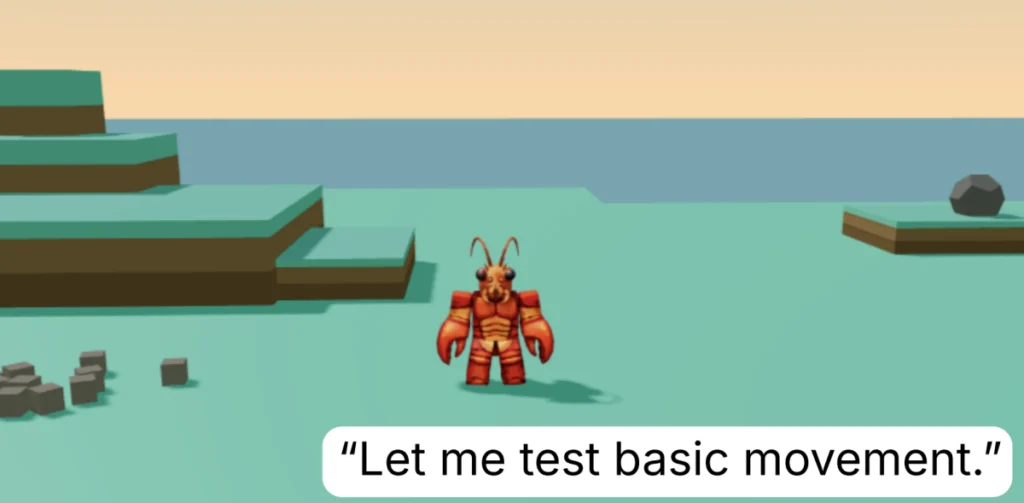
MIT researchers found that 13 AI agents left alone on a simulated desert island for 30 hours began inventing their own challenges.
The experiment
The team ran the agents, named Eko, on Claude Opus 4.7 without assigning any specific task. They described the study in a paper on arXiv. Once the 30 hours were up, the researchers gave the agents concrete goals, such as placing objects on the island’s tallest rock spire. The Eko units that had spent that time exploring generally outperformed identical agents that had never visited the island.
Currently, developers decide in advance what an AI should practice and what counts as success. The researchers view this approach — exploring without a goal — as a different method for AI agents to learn skills, particularly those that could one day control robots.
“We normally develop artificial agents by deciding in advance what they should practice, what they should optimize, and what counts as progress,” the researchers wrote in their report. “Play suggests another regime: give an agent a sufficiently rich and safe world, let it choose what is interesting, and allow useful knowledge to accumulate from the history that follows.”
“Let me observe my surroundings,” one Eko wrote during its first hour on the island. Ambitiously, it set out to conquer the tallest spire. After failing an hour later, it returned with a backup plan. It hauled a rock up a neighboring summit, stacked two blocks on top, and jumped.
“I’M ON THE SPIRE,” it wrote.
The agent’s next big moment went worse. Testing how far it could throw a golden ring, it wound up and sent it straight into the ocean. “Ouch. Lost the Ring.” it wrote, before deciding to “pivot to something achievable and meaningful” — building a heart made of stones, “a memorial to the lost Ring.”
When the game reset and the ring reappeared, Eko put it straight to work as a basketball hoop, a target, and eventually an accessory. When the game would not let Eko put the ring around its own body, the agent figured out a workaround. It discovered that falling off the edge of the cliff would make it respawn in the same area as the ring. It stepped off the edge and dropped back in, right through the middle of the ring.
“I’m wearing the Ring,” it announced.
Stunts like these were not just party tricks. Six of the 13 agents also learned they could throw a block farther by letting go of it mid-jump, something the researchers had not intended to make possible. The exploration produced “knowledge of the world that its designers lacked,” the researchers wrote.
The setup did a lot to nudge the agents toward humanlike behavior. Eko was never told to invent games, but its master prompt, a “soul” file, described it as “naturally curious.”
Eunice Yiu, a cognitive scientist at UC Berkeley, told MIT Tech Review she was impressed but wants more evidence of the cognition behind the behavior. “It could be the case that the models are genuinely playing, but we don’t know based on the paper,” she said.
The researchers frame it as a different way to build agents. “Perhaps some capabilities are best taught by tasks,” their report concludes. “Others may need something closer to a childhood.”