LandingAI has launched Agentic Document Extraction Gen2, a new document intelligence stack built on a model family called DPT-3. The previous version treated documents as a flat list of chunks. This update treats them as a tree structure, charges by output characters rather than page count, and links every answer to a specific line or word on the page.
Deployment options
The tool is generally available now. Developers can start for free in the ADE playground. Enterprises may run it in the US or EU cloud, within their own VPC on AWS, Azure or Google Cloud, inside Snowflake, or on premises including air gapped environments.
Two parsing models instead of one
Gen2 splits parsing into two models so the workload picks the price. DPT-3 Verity transcribes digitally created documents deterministically and returns a bounding box and a confidence score for every word. It targets high volume text, tables and simple form fields. DPT-3 Pro reads page layout before words, detects block types from tables and figures through marginalia and signatures, returns them in reading order, and handles scanned pages, handwriting, non Latin scripts and LaTeX math.
LandingAI states DPT-3 Verity charges roughly 40% of the credits DPT-3 Pro charges. Automated routing between the two is planned for fall 2026.
The pricing change is the real story
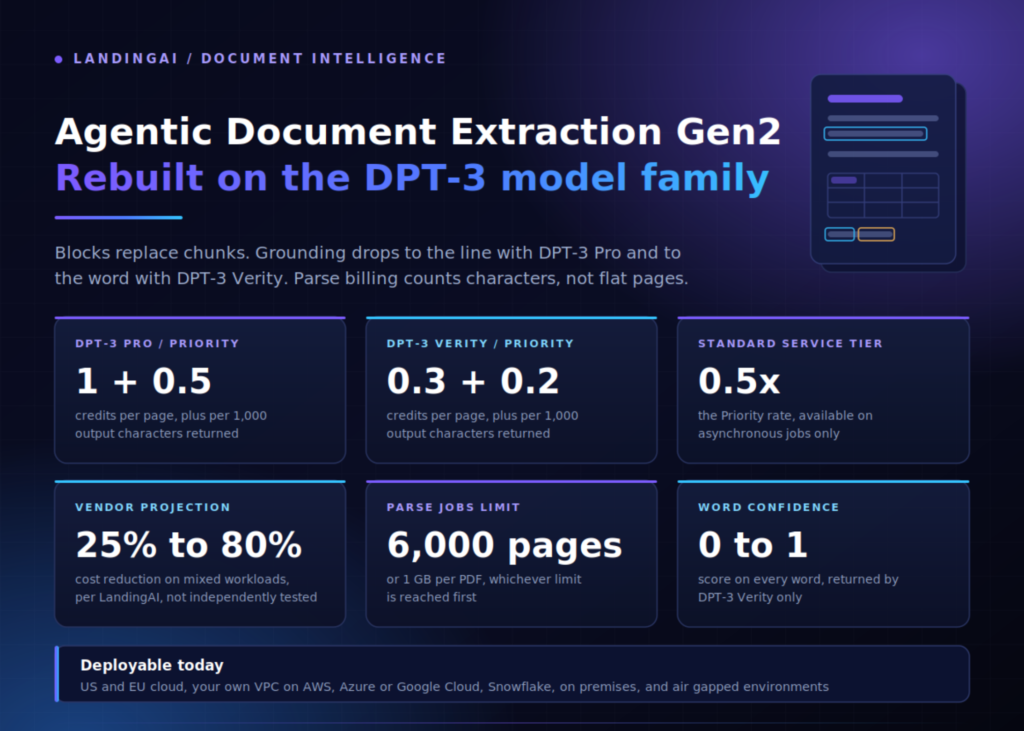
Under DPT-2, every page cost a flat 3 credits. Under DPT-3, credit consumption is the sum of a page component and an output character component. On the priority tier, DPT-3 Pro bills 1 credit per page plus 0.5 credits per 1,000 output characters. DPT-3 Verity bills 0.3 credits per page plus 0.2 credits per 1,000 output characters.
The standard tier halves both rates, so a 12 page Pro parse returning 48,120 characters comes to 36.1 credits on priority and roughly half that on standard. Totals round up to the nearest 0.1 credit, and the response metadata reports every input to the calculation.
Service tiers are the second lever. Priority is for when a person or an agent is waiting. Standard runs asynchronously at 0.5x price and suits pipelines that tolerate minutes to hours. Note that synchronous calls always bill at priority, and the playground itself runs on priority.
LandingAI projects 25% to 80% cost reductions on mixed workloads and claims parsing under one cent per page with Verity on standard. Treat those as vendor figures until you benchmark your own document mix, since the character component means a dense page can cost more than it did before.
Blocks, not chunks
The Parse v2 response has three top level fields: markdown in reading order, metadata, and structure. The structure is a document node whose children are pages, whose children are blocks. Block types include text, table, table_cell, figure, marginalia, attestation, logo, card and scan_code.
Every block carries a semantic ID in the form type-index, stable within a response but not across re parses, plus a grounding object with the page number, a range into the markdown string, and a normalized bounding box.
Markdown output is standardized too. Figures use <figure type=”CHART”> style elements with generated prose isolated inside <description> tags, so transcription is never mistaken for model commentary. Attestations emit stacked labels such as [STAMPED][SIGNED], with [ILLEGIBLE_SIGNATURE] and [ILLEGIBLE_TEXT] as fixed literals. Tables ship as HTML by default to preserve merged cells.
Atomic grounding and what it unlocks
Atomic grounding is the release’s most consequential capability. Every leaf block carries an atomic_grounding array: one entry per visual line with DPT-3 Pro, one entry per word with DPT-3 Verity.
Verity attaches a confidence value from 0 to 1 per word, computed as the lowest per character score in that word, giving teams a signal for routing uncertain transcriptions to review. Table cells now carry their own bounding boxes, though Pro leaves cell level atomic grounding empty.
Extract V2 draws citations from this grounding, so an extracted field traces to a specific word on a specific page. That makes PII redaction by coordinate, document diffing and reviewer UIs buildable rather than approximate.
What it means
For teams processing paperwork, the shift from flat chunks to a tree structure means code that previously extracted simple text will need to adapt to handle nested blocks. The new pricing model rewards concise output rather than page size, which helps if you are extracting only specific fields from large documents. However, dense pages with complex layouts may still incur higher costs. The ability to trace every extracted word back to its exact location on the page allows for more precise verification and easier integration into review workflows.