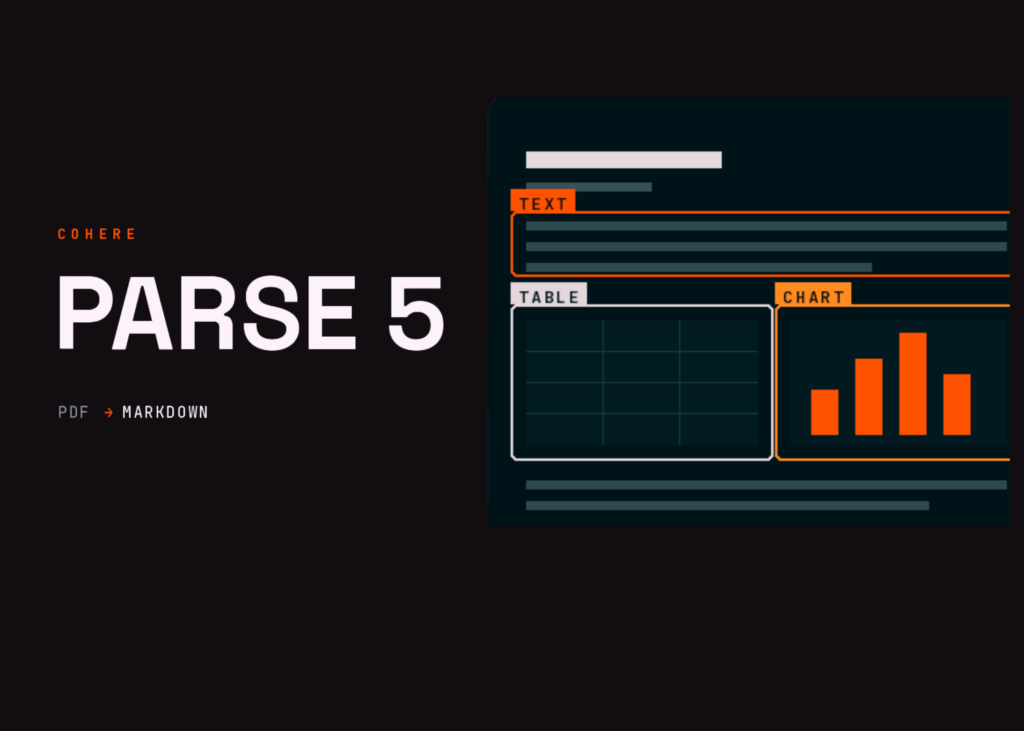
Cohere has launched Parse 5 (parse-v5.0), a 2.3B-parameter vision language model designed to ingest high volumes of enterprise documents. The model accepts PDFs, PowerPoint slides, or JPEG pages as base64-encoded data URIs and outputs Markdown containing text in reading order, HTML-rendered tables, lists, form key-value pairs, image descriptions, and bounding box coordinates. There is no separate OCR stage preceding the model. Cohere charges $1.50 per 1,000 pages for the API and places the product on price-performance metrics rather than peak accuracy. The company cites a self-reported ParseBench score of 79.2 to support this claim, though the metric covers only three of the benchmark’s five dimensions.
Deployment status
The tool is available for production use immediately. Access is provided via the Cohere Parse API, Microsoft Foundry, AWS SageMaker, and single-tenant Model Vault. There is no waitlist and no research license requirement.
- Target users: Mid-market teams with existing RAG stacks can start with metered API calls using a free trial key. Large enterprises requiring residency or air-gap compliance should use Model Vault or private deployment. Seed-stage startups may adopt the tool, but cost efficiency only becomes relevant above roughly 100,000 pages a month.
- Industries: Focus areas include financial services, insurance, healthcare, life sciences, the public sector, telecom, energy, and manufacturing. These are the document-heavy verticals where scanned forms and dense tables are standard.
- Use cases: RAG ingestion, intelligent document processing, claims and invoice pipelines, contract and filing search, and providing document context to agents.
How the model works
Parse operates as a 2.3B-parameter vision language model built on Cohere Labs’ North-Micro-Vision-Instruct architecture. It features an 8,192-token context window and a footprint of approximately 4.6GB. The system recovers text, reading order, tables, lists, forms, key-value pairs, images, captions, and the locations of page boundaries and visual elements in a single pass.
Nine languages are listed as stable: Arabic, English, French, German, Italian, Japanese, Korean, Portuguese, and Spanish. Zero-shot support exists for other languages, though accuracy is lower.
Two output modes matter in practice. The default returns a Markdown string per page. Setting output_format="blocks" returns typed blocks where a table block carries its HTML, bounding box, and description. This second mode enables citation-level traceability.
The benchmark score
Cohere reports a ParseBench score of 79.2 for Parse, averaged across tables, content faithfulness, and semantic formatting. This places it ahead of Mistral OCR 4 (74.5), Azure Document Intelligence (74.3), and Databricks AI Parse (72.4).
ParseBench is a LlamaIndex benchmark of approximately 2,078 human-verified enterprise pages scored on five dimensions: tables, charts, content faithfulness, semantic formatting, and visual grounding. Cohere’s figure averages three of these dimensions and excludes charts and visual grounding. These are the two dimensions where most parsers typically struggle.
Against the public leaderboard, the same vendors score far lower on the full five-dimension overall: Mistral OCR 4 at 60.68, Databricks AI Parse at 60.68, and Azure Document Intelligence (Layout) at 59.64. Azure’s three-dimension average calculates to 74.3, which matches Cohere’s figure exactly and confirms the methodology. Cohere Parse is not currently listed on that leaderboard, where LlamaParse Agentic leads at 84.88.
Therefore, 79.2 is a vendor-reported subset score and not a leaderboard position. It is a reasonable claim to test on your own documents.
Costs
Cohere prices the Parse API at $1.50 per 1,000 pages. On Model Vault, Parse 5 runs for $4.00 per hour or $2,500 per month on a Medium instance, and $7.00 per hour or $4,300 per month on an XL instance.
The crossover point where dedicated capacity becomes cheaper than metered calls is roughly 1.67 million pages per month for a Medium instance, and 2.87 million pages per month for an XL instance. Below this threshold, metered API calls are cheaper. Above it, dedicated capacity wins on price alone, before considering arguments about data residency, which is usually the real reason enterprises move to Vault.
What it means
For teams building document search or agent workflows, this model removes the need to stitch together a separate OCR tool and a layout parser. The single-pass output with bounding boxes allows developers to verify exactly which text came from which visual element, which is essential for compliance and debugging. However, organisations processing millions of pages will find the dedicated instance pricing competitive only at high volume; smaller teams will pay more per page than if they built a custom pipeline using open-source alternatives.