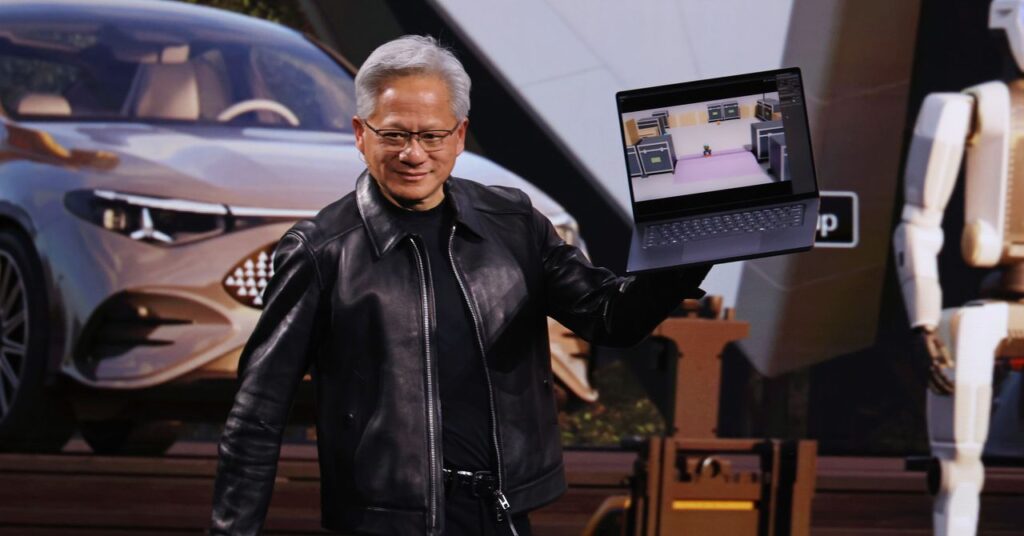
Jensen Huang told an audience of 4,000 at Nvidia’s GTC conference in Berlin on Wednesday that Europe must move from consuming artificial intelligence to producing it. He outlined a future built on robotics, AI agents, and modular data centres, with Nvidia providing the underlying hardware.
From inference to power
The previous GTC event in San Jose focused on making inference cheaper and compute more efficient. Seven months later, the discussion has shifted to power requirements, autonomous agents, and physical AI. The presentation concluded with Microduck robots, developed by Hugging Face after its acquisition by Nvidia, performing tasks on stage.
Modular data centres
The primary announcement was the DSX Pod, a modular “AI factory” designed for rapid deployment. The unit arrives fully assembled in a large metal container and is packed with Nvidia’s latest Vera Rubin compute racks. Deployment time is reduced to 14 days, a significant improvement over the months or years typically required for traditional construction.
This speed is particularly relevant in Europe, where infrastructure projects often face delays. Huang noted that the DSX Pod would also reduce the time compute hardware sits idle during setup. He described the approach as a complete transformation.
Industry partnerships and robotics
The address at Berlin’s Tempodrom, a venue resembling a circus tent with gamer-style lighting, mixed product sales with broad predictions. Nvidia positioned itself as the essential technology provider for every sector. During the speech, two Greenpeace protesters unfurled a banner reading “Clean up your dirty business.” Security escorted them out without incident.
Huang stated that humanoid robotics represents the next major industry. He argued that Europe is well positioned to lead in this area given its manufacturing heritage. However, he clarified that physical AI extends beyond robots. Telecom operators are already installing Nvidia GPUs in cell towers to handle increased loads. Nvidia also announced partnerships with Volkswagen and Mercedes-Benz for autonomous vehicles.
In the robotics sector, Nvidia is launching a full-stack platform to standardise configuration. A preconfigured reference robot called Agile One will become available in the first quarter of next year. This release aims to help developers begin building physical AI systems. Huang called the moment a great opportunity.
Model usage and agent demand
Regarding model usage, Huang predicted that every company will employ both closed and open models, customising the latter with proprietary data. He demonstrated that Nvidia’s own open-source models achieve frontier-level performance when tuned in this way.
He also forecast that AI agents will increase the number of users for software tools. The reasoning, iteration, and tool use capabilities of these agents are driving higher token consumption and greater demand for computing power, specifically Nvidia GPUs.
Conclusion
The 90-minute technical address concluded with an AI-generated Eurovision song summarising the announcements. The song made the event easier to follow than the speech itself.