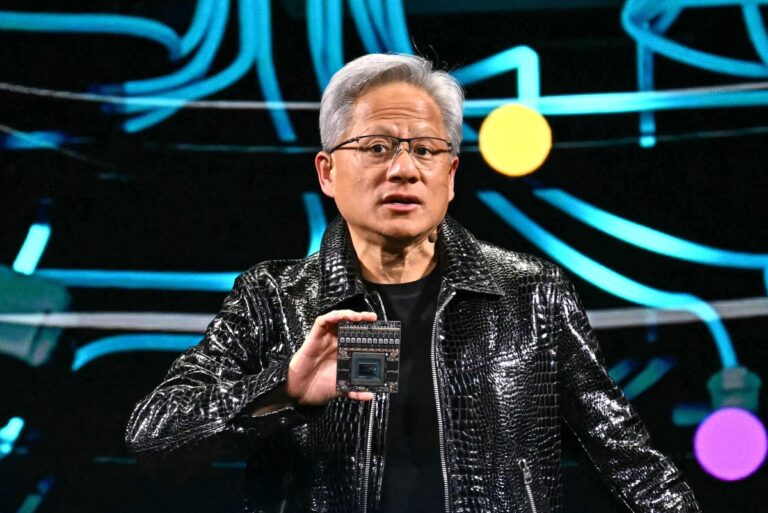
Jensen Huang resigned as Nvidia CEO after admitting to an affair with an alleged Chinese intelligence asset and facing reports of at least two other alleged affairs with Nvidia employees.
Hosts Brian Barrett, Zoë Schiffer, and Leah Feiger break down how the board turned on its founder, what interim CEO Colette Kress means for the company, and how this moment could be a golden opportunity for Nvidia’s competitors.
Articles mentioned in this episode:
- Jensen Huang Resigns as Nvidia CEO
- Meet Colette Kress, Nvidia’s New Interim CEO
- Jensen Huang Basically Lit More Than $1 Trillion on Fire in Less Than a Month
You can follow Brian Barrett on Bluesky at @brbarrett, Zoë Schiffer on Bluesky at @zoeschiffer, and Leah Feiger on Bluesky at @leahfeiger. Write to us at [email protected].
How to Listen
You can always listen to this week’s podcast through the audio player on this page, but if you want to subscribe for free to get every episode, here’s how:
If you’re on an iPhone or iPad, open the app called Podcasts, or just tap this link. You can also download an app like Overcast or Pocket Casts and search for “uncanny valley.” We’re on Spotify too.
Transcript
Note: This is an automated transcript, which may contain errors.
Brian Barrett: Welcome to WIRED’s Uncanny Valley. I’m Brian Barrett, executive editor.
Zoë Schiffer: I’m Zoë Schiffer, contributing editor.
Leah Feiger: And I’m Leah Feiger, director of politics and science.
Brian Barrett: We’re bringing you an extra episode this week because Nvidia’s CEO Jensen Huang has officially resigned. His resignation caps a swift, stunning fall for the man who spent more than three decades building a company into the engine of the AI boom. We’re going to talk about how a board known for deferring to its celebrity CEO finally changed its tune and who’s going to be running Nvidia at least for now. Let’s get started. Just for the room, we released a podcast this morning before this happened and then it happened. So now we’re talking again.
Leah Feiger: I mean, who doesn’t want multiple offerings from the Uncanny Valley crew, Brian?
Brian Barrett: It’s true. Constant updates. We’re going to do an hourly podcast from now on, just iterative, getting real in the weeds. No, how surprised is everybody that this happened? And I guess first, if you want some setup about what happened, you can listen to our previous episode, but I guess I’ll first say really quickly, Jensen Huang admitted to an affair with an alleged Chinese intelligence asset who was selling a lot of chips to, and then a report came out that he had another affair allegedly with someone who reported directly to him at Nvidia, and that feels like the final straw. So we’re caught up. Are we surprised still?
Zoë Schiffer: I mean, the first thing to say is the company does have rules on the books saying that you’re not supposed to have a relationship with a direct report. And so when we talked and it was the Chinese spy, although that is the obviously more scandalous thing that has happened, it also really felt to me like Jensen was going to weather that storm. But then when the second affair came out, that felt like it gave the board a really good excuse if they needed one to say, “OK, we have to stop.” And I think it’s fair to say here that while there is no current reporting on additional affairs, I think the concern is if two have already come out, what if more continued to become public and they need to stop the bleeding?
Leah Feiger: But he still fought pretty hard to retain his role, right?
Zoë Schiffer: I don’t think the board wanted him to resign. I don’t think Jensen wanted to resign. I think that their backs were completely against the wall on this one. The company has already been through an incredibly embarrassing scandal that will drag out for the next many months as Jensen is dragged before the Senate and has to answer to people who have serious concerns about his advocacy for China and where the Nvidia chips have been going and all of that. Now there’s a second affair again with a direct report and I think that the situation became very, very quickly untenable for everyone involved.
Leah Feiger: Absolutely. And now Nvidia has a new CEO in the name of CFO Colette Kress. Tell me about her.
Brian Barrett: Interim. So yeah, she’ll be there for the time being, but she’s been at Nvidia for a long time. She’s been there since 2013, which means that she’s worked closely with Jensen since before the company was the darling of the AI world back when it was a graphics processor for gaming laptops company. She was at Cisco and Microsoft before that. She’s a real industry veteran. I think my understanding is she’s really a classic CFO. I don’t know if she’s a long-term visionary leader of this company, but she knows Nvidia inside and out. And I think if you’re looking for stability and you’re looking for someone who’s not going to create new drama and who’s not going to have a scandal, that seems like she really fits that bill.
Zoë Schiffer: Yeah, I think what they need right now is stability, like you said. They need someone to take the reins. They don’t want anything else dramatic to happen to the company. And of course they’re going to immediately kick off a search for a new visionary leader, which as we said in the last episode, there’s not an obvious successor here. They’ve got to find someone who has incredible technical prowess, who has a real vision for where the AI industry is going and who will be able to learn Nvidia’s business. I think it’s doubtful that person … Well, actually, I really should have learned from this experience that I shouldn’t have hot takes. I was going to say, I don’t think the person’s going to come from—
Brian Barrett: No, keep doing it.
Zoë Schiffer: … Nvidia internally, but what do we know at this point? It could be anything. So yeah, Colette will take the reins for the moment and the company needs to weather this storm and come out the other side.
Brian Barrett: And I think she does, as you might have guessed, she’s going to be operating the business the way Jensen had, at least in terms of advocating for closer collaboration with China and the business lines that Nvidia has been going down, leaning more into CPUs recently, open source. I don’t think you’re going to expect anything other than business as usual. And when you have her in there, as we talked before, China is so important to Nvidia’s future. Jensen Huang had lost all credibility on that point. So having someone in there who can make the case that, hey, we should have a better relationship with China, we should be able to sell more to China, who is not compromised in the way that Jensen has been, that’s an upside. I mean, it’s a lot of downside for Nvidia that Jensen’s gone, but at least they can come into these conversations without that baggage. I think that’s the main point here.
Leah Feiger: And perhaps even right the ship even slightly. I mean, with news of Jensen’s departure, Nvidia’s stock plunged, absolutely plunged, but one of Kress’s big roles as CFO was communicating with Wall Street. So I’m assuming that there’s a world where this could be slightly reassuring to investors perhaps.
Brian Barrett: I think so. The thing about the market, I guess, is that everything’s always baked in. The market has already accounted for so much. So it did take a big plunge. I think as we’re recording this, it had been stabilizing a little bit. I shouldn’t say that because by the time this is out, it’s going to go wildly in one direction or another.
Leah Feiger: It means it’s a time for another emergency pod. We’re just going to keep this going all day.
Brian Barrett: We’re going to have to do another emergency pod. Exactly. All day. Get ready, folks.
Zoë Schiffer: We have been talking a lot though about how interconnected, not just the AI industry is, but the entire US economy, how tied up it is with just a few companies. And Nvidia really is, it’s kind of Nvidia and Anthropic that so much of this is riding on. And so I think we have yet to see what the ramifications of this will be if Nvidia is able, like we said, to weather the storm, continue growing and leading the AI boom. It has been, perhaps it won’t be dire, but so much of what has happened already has been completely unexpected for everyone involved so that I think there’s a lot of uncertainty and instability that we still have yet to account for.
Leah Feiger: So from the politics side, I can see this very much impacting the White House’s relationship with AI-related firms. I can just see this becoming a thing and we’re going to continue reporting this out, but WIRED is keeping a very close eye on what this means for these relationships. Talk to me from the Silicon Valley side, what is going to get impacted here? Is it crazy to say that Anthropic’s IPO could get tossed up in the storm? What are we really looking at?
Brian Barrett: No, so here’s my thing. I’m not sure about the Anthropic IPO. I think, again, everything’s priced in and I think they’re going to do just fine. It’ll still be worth whether it’s $1.2 trillion or $1.4 trillion, whatever. It’s going to be a huge IPO, one of the biggest history regardless of this. What I’m interested in is right now, people don’t have many alternatives. Even if you wanted to separate yourself from Nvidia because of this scandal for some reason, you’re not going to find something better out there for the most part. Some other companies have had some gains lately. So in the short term, I don’t know. I don’t think that this maybe changes that much. This will be one of the takes, much like Zoë writes her takes, I’m going to regret saying this. I think short term it doesn’t do that much. I think longer term though, we’ve already seen a lot of companies investing in making their own silicon and making their own chips and finding ways to optimize their own sort of hardware stack against their software. I think of it the way that after everyone saw Apple making its own processors and having huge efficiency gains on the iPhone, companies started doing that within smartphone world. Everyone has their own sort of processor in the smartphone world. I think that’s happening increasingly in the AI world, and I think that’s long-term a threat, not to the industry, but to Nvidia itself. It comes at a time when other companies are really trying to find a path to do this without relying so much on Nvidia, and this is only going to accelerate that process.
Zoë Schiffer: Yeah, I mean,