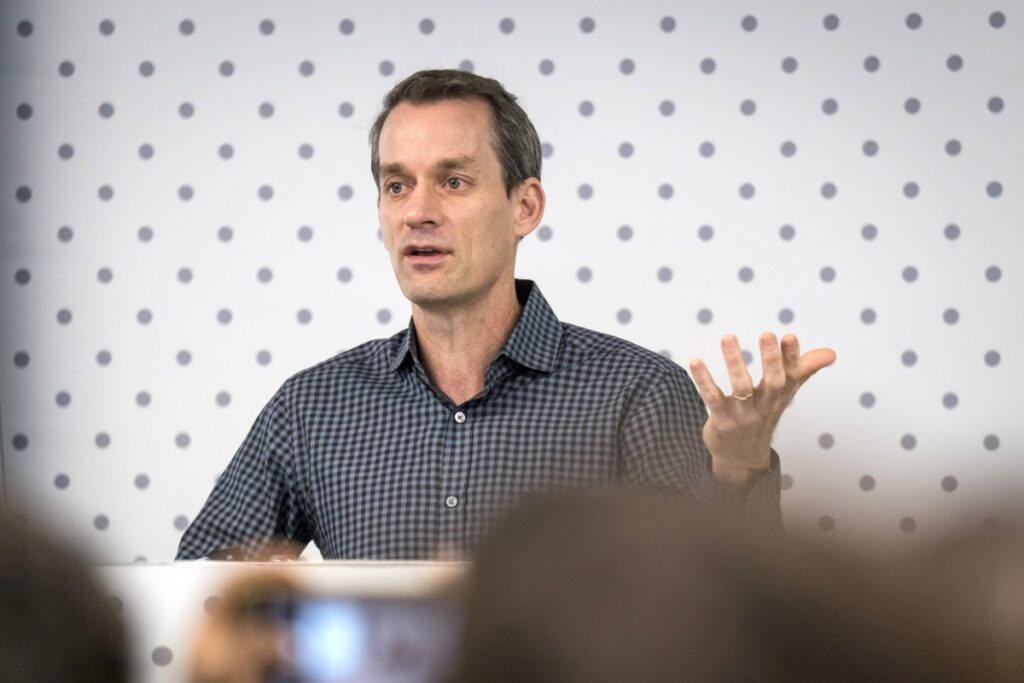
Jeff Dean, a senior executive at Google with tenure dating back to 1999, is leaving the company to start a new business.
Who is joining the team
He is taking co-founders Sanjay Ghemawat, Quoc Le, and Oriol Vinyals with him. Ghemawat is a senior fellow and engineer. Le helped found Google Brain. Vinyals works at Google DeepMind. Dean will act as CEO.
The new group is calling the project Discovery Loop. It is a public benefit corporation. Their aim is to use AI to speed up scientific research.
How they plan to work
Discovery Loop intends to run thousands of experiments at once using high-performance algorithms. The goal is to automate parts of the research process and increase the scale of testing.
They are also looking at recursive self-improvement. This means using AI to build more powerful AI models without human intervention.
“While science and engineering have tremendously advanced society over past centuries, progress has traditionally relied on slow, sequential human iterations, creating a significant bottleneck,” the company said in a press release. “Discovery Loop is developing advanced AI systems that leverage massive computational scale to fundamentally transform the speed and efficiency of innovation by automating complete experimental loops.”
Using AI to speed up discovery has been a topic of interest for years. Until recently, it stayed mostly as an experiment with little commercial use.
Funding and backing
Google’s parent company, Alphabet, has provided financial support. Radical Ventures and Khosla Ventures led the initial funding round. Kleiner Perkins, Lightspeed, and Doerr Capital also took part in the deal announced on Wednesday.
“The next great frontier for AI is to go beyond answering questions and to begin making discoveries,” the founding team said in a joint statement. “By fundamentally accelerating how engineering and scientific discovery are conducted, we can deliver the benefits of transformative technologies to the world far sooner.”
Dean’s history
Dean joined Google in 1999 as the 30th employee. He helped build the core infrastructure for Google search, including the crawling and indexing systems. He also worked on the query-serving system. His work influenced Google Gemini multimodal models and early AI research at the firm.
He told the New York Times that AI can now automate what used to be a very human-intensive process.
“We think there is opportunity for AI to more fully automate what has traditionally been a very human-intensive experimental loop,” Dean told the New York Times. “You will get both a higher quantity and a higher quality of experiments, and that will lead to scientific breakthroughs and advances.”
What it means
Scientists and engineers will face a shift from manual trial and error to automated, high-volume testing. This change removes the bottleneck of human speed. Researchers can now run far more tests in less time. The focus moves from asking questions to finding answers automatically.