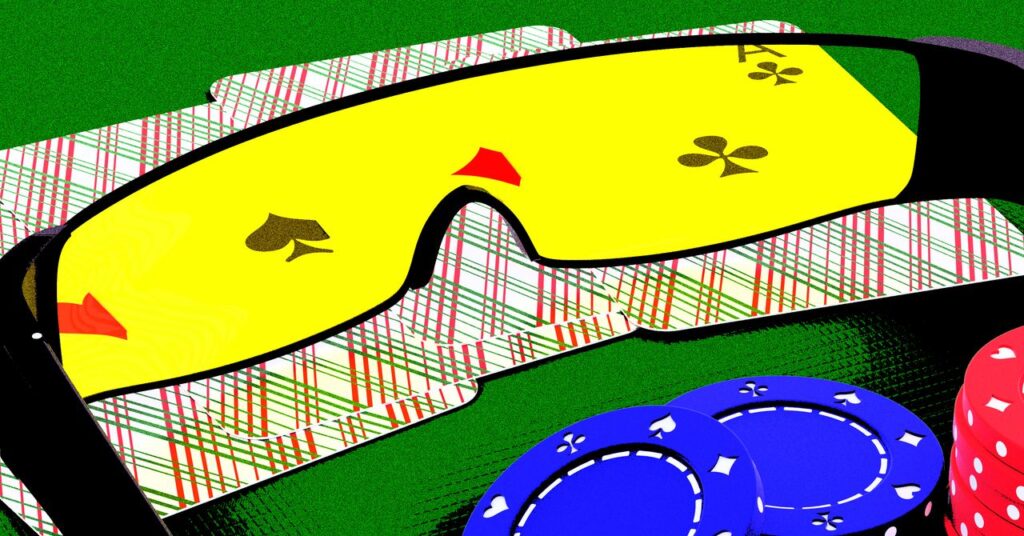
At the 2026 World Series of Poker Main Event, a text overlay appeared on screen during the live broadcast. It displayed live metrics on player movements and a chart showing the likelihood of different hand types. The tool, developed by Luke Geel, an engineer for the US Air Force, was designed to automate the detection of tells. Its introduction sparked significant debate within the poker community regarding the integrity of the game.
Do Tell
Geel’s system processed footage from the tournament’s first few days in early July. It tracked eye movements, blink rates, posture, chip handling, and hand fidgets. The software cross-referenced these inputs with hand outcomes to predict whether a player held a strong made hand, a drawing hand, or was bluffing.
Experts remain doubtful about the tool’s accuracy. The 2026 Main Event attracted over 9,000 entries, yet most players never sat at the three tables equipped with cameras. The AI was trained using the same broadcast feeds that captured the action. Even for the few players who spent time at those specific tables, the footage was insufficient to cover the vast range of situations possible in a poker tournament.
Michael Gagliano, a 17-year professional who reached the final table and is playing for the $10 million prize, confirmed the limitations. He reviewed every second of ESPN’s live streams during the two-and-a-half-week break after the final table was reached in mid-July. He searched for tells on his remaining opponents but found the lack of screen time for any single player hindered his ability to spot them.
“The streams are varied enough that you don’t get the same players too frequently,” Gagliano said.
“I don’t know how much actual information I’m going to be able to act on from what I saw,” he added.
Any AI analysing the footage would face the same constraints, even in a long tournament.
More Than Just Cookies
Professionals argue that camera-based AI cannot match human nuance. Most non-players understand the importance of tells through the 1998 film Rounders. In the movie, Matt Damon’s character folds a monster hand after noticing John Malkovich’s character eating Oreos, a habit that signals weakness. While that scene is memorable, it is a simplification of the reality.
“To reference the Rounders Oreo cookie tell, it’s a little more abstract than that,” said Shaun Deeb, a two-time WSOP Player of the Year who finished 15th in the 2026 Main Event.
“Physical tells are so much more expansive than I think the public realizes,” Deeb said. “There are leg tells, checking tells, verbal tells, breathing tells, pulse tells. There’s an insane amount of tells available, and most of those can’t be picked up by a camera.”
An AI can track visual and audio patterns but cannot deduce intention. Determining when a player projects confidence is only useful if it links to their actual hand. Confidence does not always equal strength. A player might feel extra confident with a hand that is weak for the situation because they believe they have the best cards.
“How strong is two pair to one player versus another player?” Gagliano asked. “Maybe someone is extra confident with a hand that’s actually weak for the situation, but for some reason they think they have the best hand, so they’re really confident.”
“Maybe if I was playing a casual tournament, I would think my two pair is extremely strong. But in the Main Event I’m still a little nervous, because it’s a high-stakes situation. So maybe my body language is referencing the situation rather than the hand strength.”
Geel acknowledged that a larger sample of hands would improve the tool. He told WIRED via email that he has run blind tests on other poker competitions with mixed results. He remains transparent about the limitations of the current data.
Deeb suggested the feature was an attempt to mimic other sports. “I think they randomly found something to try to make it like another sport, and I just think it was swing-and-a-miss,” he said.
While the tool appeared during portions of the July broadcast, a representative from Omaha Productions, the company licensed by ESPN for WSOP coverage, confirmed it would not be used for the final table. The representative declined to provide a reason for the decision.
Watching the Detectives
Skeptics concede that such tools will likely evolve and be used for financial gain. In the high-roller tournament scene, where buy-ins reach six figures, a small pool of professionals play events that are often broadcast. Hundreds or thousands of hours of footage exist of these top players, many of whom play dozens of events every year. It is common for players to study streamed footage to gather information on regular opponents. Improved AI could optimise this process.
Deeb is not worried. As a top pro, he frequently coaches players making deep runs in the Main Event. This process often involves bringing in a live tells specialist to observe both opponents and the client. A close friend of Deeb’s watched the streams during his run this year to perform the same task.
While he will use recorded footage if it is the only option, Deeb says the filmed route is not optimal.
“The teams I hired, we always had a spot for the person spotting the tells to be watching the player in person,” he said. “We thought it was much better than what you get on TV.”
Tools like the one used by ESPN are not allowed at any live poker table. Some tournaments or high-stakes cash games limit or ban electronic devices on the table surface to prevent cheating. Deeb predicts Meta smart glasses and similar devices will be outlawed soon for similar reasons. Even if a player has an AI providing a perfect list of tells, they must spot the tells themselves at the table while avoiding giving away their own information.
As long as that remains the case, Deeb is not losing sleep over an AI outperforming him or other top pros, no matter how advanced it gets.
“I would take my team versus the AI,” he said. “And make a bet on it.”