For makers and artists in the creative space, the arrival of home robots signals a shift away from speculative hype toward tangible utility. While the tech giants in Silicon Valley chase the dream of fully autonomous humanoids, a different philosophy is taking root in Martinez, California, about as far from the Bay Area’s epicentre as possible. Here, Hello Robot is proving that practical assistance is more valuable than maximalist design.
A pragmatic approach to assistance
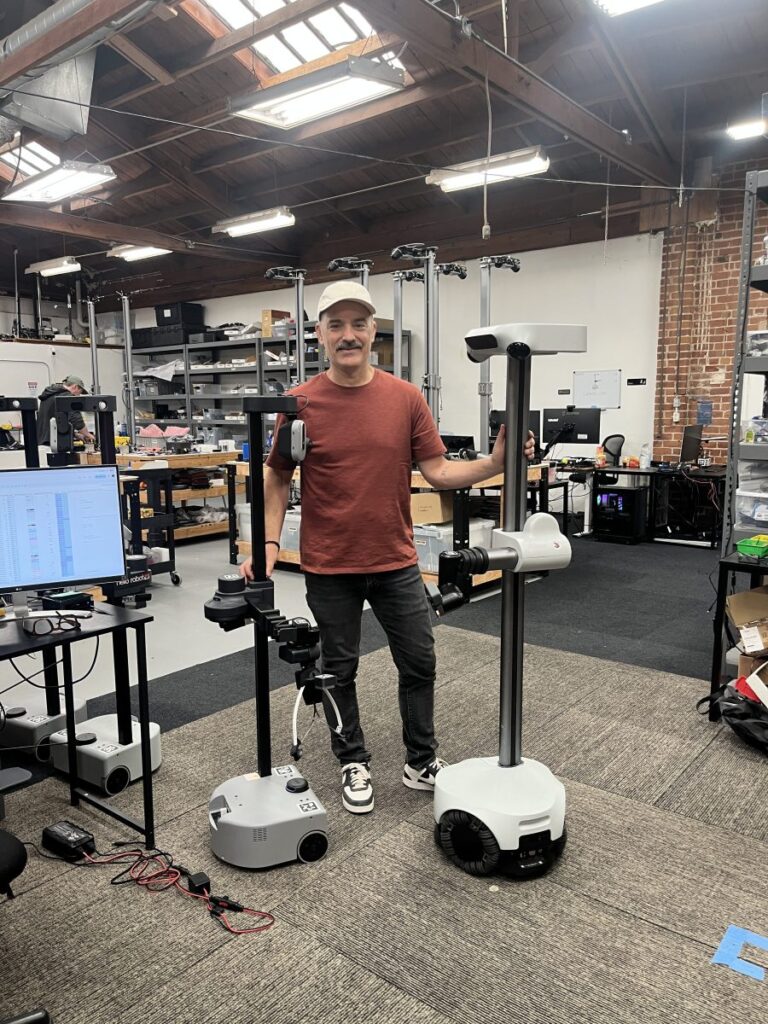
Released last month, the fourth iteration of the Stretch robot defies the typical humanoid aesthetic. It features a telescoping arm with pinchers and moves on a heavy, omnidirectional wheeled base, topped with a sensor-studded head and a vaguely human torso. When its power runs low, lights around its “eyes” glow red, a signal the company’s engineer, Blaine Matulevich, jokes looks “angry.”
Founded in 2017 by CEO Aaron Edsinger, a former robotics director at Google, and CTO Charlie Kemp, a professor at the Georgia Institute of Technology, Hello Robot has avoided the trap of building foundation models or promising to replace every human task. Instead, they are tackling a critical gap: working inside real homes with real people, rather than keeping machines behind glass in sterile laboratories.
This focus is vital. As artificial intelligence advances, the industry faces a severe shortage of useful training data. While simulation techniques improve, investors are increasingly prioritising actual deployment. Bullhound Capital recently noted in a sector report that companies deploying first accumulate site-specific recovery loops and workflow tolerances that competitors cannot buy or synthesise. “In robotics, the moat isn’t just IP, but accumulated operating hours under real-world liability,” the report stated.
Real-world impact
Keith Platt, an investor now serving on Hello Robot’s board, joined the company after living with a Stretch unit as a housemate. Diagnosed with quadriplegia in 2021, Platt retains control only over parts of his shoulders, neck, and head. He began collaborating with Hello Robot in 2024, supported by the company’s occupational therapist to assist him and others with similar conditions.
Platt operates his Stretch via a voice-controlled iPhone app, commanding it to move autonomously before taking direct control to manipulate objects. A deceptively simple project involved teaching the robot to serve him a protein shake for breakfast, a task he previously required human help for.
“When we first started out with that activity, it took me independently, no one there, took almost two hours,” Platt told TechCrunch. “But I was gonna stick with it. It got down to where, within a few minutes, I could drink the whole shake and put it back on the counter.”
For Platt, regaining independence for even small tasks, such as handling reading glasses or brushing his teeth, is immense. He believes that if robotic assistants could allow people with mobility challenges to spend a full day at home safely, it would be “life-changing” for families, enabling them to work or leave without hiring professional caregivers.
Stretch ships with limited autonomy, a deliberate choice to keep humans in the loop. Matulevich explained that being in control is a feature, not a bug, ensuring the robot remains embodied and responsive to human intent. Consequently, Platt does not worry about the machine falling over if it encounters an error.
Hardware realities
Despite heavy investment in robotic “brains,” the physical bodies remain problematic. Components are becoming cheaper, but current technology still produces heavy limbs requiring high-energy, active balancing. A robotic arm weighs significantly more than a human’s, and physics remains unforgiving.
When robots err, they cause damage. One startup, the Bot Company, is currently facing legal action from a San Francisco Airbnb owner who claimed the company’s robot scratched furniture, broke appliances, and chipped bathroom tiles while working in the apartment.
“The state of hardware today is actually abysmal from the perspective of, ‘I want to have robots in my parents’ place,'” Mahi Shafiullah, a postdoc at the University of California, Berkeley, told TechCrunch. He recalled industrial robots in his lab accidentally punching through a plastic kitchen play set they were meant to manipulate carefully.
Shafiullah later adopted the third generation of Hello Robot’s Stretch for his PhD research at New York University. Models he developed using Stretch went on to win the best demonstration prize at this year’s Computer Vision And Pattern Recognition (CVPR) conference.
Edsinger compares his strategy to Waymo, which became the leader in self-driving cars by prioritising safety first. This contrasts with 1X, which garnered significant attention last year for unveiling Neo, a humanoid robot intended for home chores. Although 1X claimed to sell out its planned 10,000 units for the year, none have actually been delivered.
“Hello Robot has been really cautious and really caring about this problem, because I think they’re designing it to be around people first,” Shafiullah said. “And then they’re thinking about, where are the capabilities that they can fit in within those limitations?”
Homeward bound
Stretch 4 is priced at $30,000, which is slightly higher than units from Chinese manufacturers. However, Edsinger points out that those often lack integrated sensors and software, add-ons that ultimately drive up costs. The company expects to manufacture between 200 and 300 units at its Martinez headquarters, with the initial run already sold out.
Edsinger aims to keep the robot accessible to researchers and developers on low budgets. A key design criterion is that Stretch must be shippable in a cardboard box via standard carriers like UPS or DHL. Once wooden crates and installation teams become necessary, costs rise and accessibility drops.
Current customers include researchers testing sophisticated AI models, enterprise clients evaluating the robot in data centres, and developers creating in-home aides for people with disabilities. The combination of its comprehensive sensor suite, physical capabilities, and safe operations positions it as a strong candidate for realising the hopes of physical AI advocates.
“The algorithms may be there, but the data is not, and data is actually like 80% of the ingredient that matters,” Shafiullah said. Having a robot capable of safely collecting that data represents a significant step forward. Hello Robot intends to iterate, using lessons from Stretch 4 to inform the next generation of bots, potentially lowering prices and increasing capabilities to achieve true robot-human collaboration at home.
Key takeaways
“In robotics, the moat isn’t just IP, but accumulated operating hours under real-world liability.”
“The state of hardware today is actually abysmal from the perspective of, ‘I want to have robots in my parents’ place’.”
“The algorithms may be there, but the data is not, and data is actually like 80% of the ingredient that matters.”