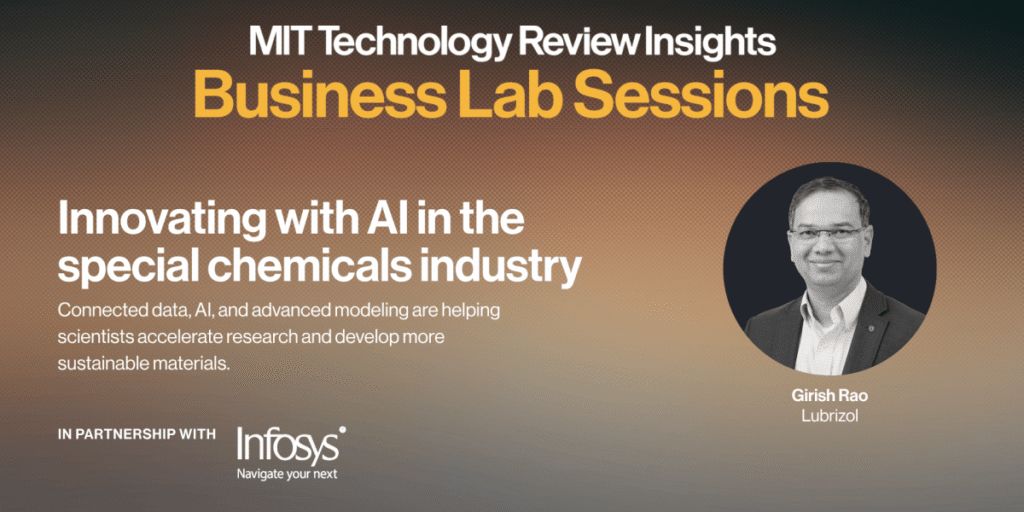
Lubrizol is connecting its business processes, modern data platforms, and cloud infrastructure to support research and development teams.
Girish Rao, vice president of information technology at the specialty chemicals manufacturer, explains the company is building a digital foundation. The goal combines decades of accumulated technical data with the deep expertise of chemists and engineers who understand customer needs and the physical constraints of their work.
Data scientists can help identify patterns, test new hypotheses, and model possibilities before researchers conduct physical experiments. Rao emphasises, “it’s not about replacing scientific judgment; it is about giving our scientists better tools.”
Scientists, data scientists, and IT teams approach problems from different perspectives. They prioritise experimental validity, model performance, and platform security and scalability, respectively. By bringing these groups together in “fusion teams,” Lubrizol aligns them around shared objectives, starting with small pilots to build trust.
“Once the trust is built between the team members and they know what value they’re about to create,” Rao says, “things go a lot better.”
Cloud infrastructure gives the company flexibility to access computing resources and modern tools without making the substantial investments required to build and maintain its own data centers.
These capabilities could prove especially valuable in advancing sustainability. Digital modeling can help researchers evaluate more formulations, explore materials such as starch and corn-based alternatives, and assess trade-offs across a product’s life cycle. Promising a material in a laboratory is only the first step.
Scaling production while meeting performance expectations, regulatory requirements, and financial constraints is still a tightrope walk. AI’s ability to model multiple variables could help teams navigate those competing demands.
Looking to the future, Rao expects AI, automation, advanced modeling, digital twins, and connected data to converge as laboratories become more intelligent and manufacturing plants more efficient. The opportunity lies in bringing these capabilities together responsibly and at scale.
“It’s not just a single technology. I think it’s the combination of all of these, and it’ll be the ability to connect all these processes that are going to generate tremendous amounts of data.”
This webcast is produced in partnership with Infosys.
This content was produced by Insights, MIT Technology Review’s custom content arm, not its editorial staff. It was researched and written by humans, with any AI tools that may have been used limited to production processes under human oversight.