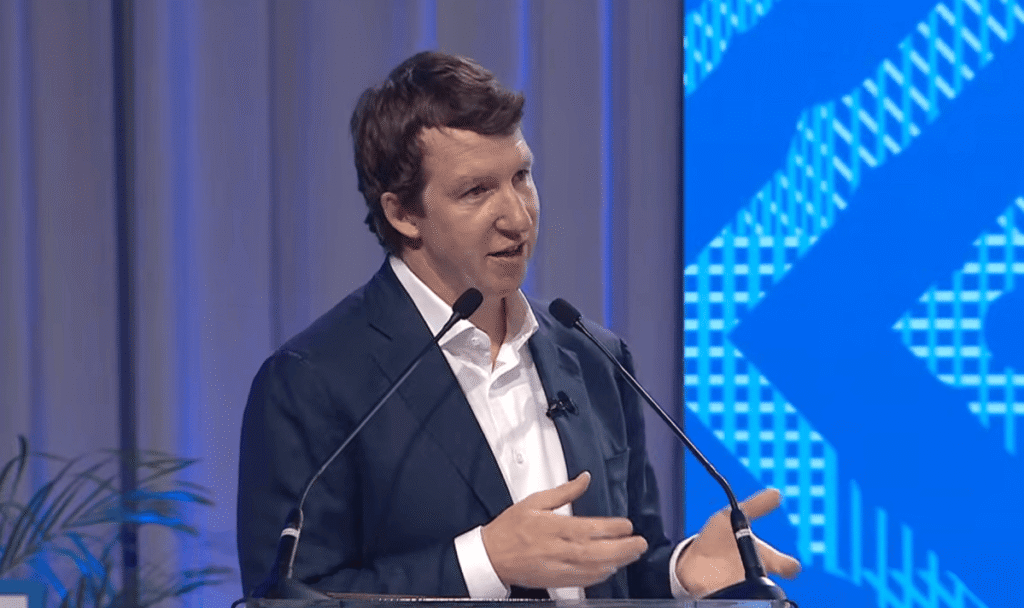
Jack Clark delivered a speech at the IMF Annual Meeting in Bangkok on Saturday 17 October declaring that the technological singularity has begun.
The address, given during the Per Jacobsson lecture, was aimed at economists, bankers and policymakers. Clark argues that humanity is now entering a phase of rapid, autonomous AI development that will fundamentally alter national security, economic trajectories and the pace of scientific discovery.
He stated that while he is a narrator of these events, a principal agent behind them and a translator between communities, he accepts full responsibility for his role. He views his work as a permanent effort to remain truthful and clear about his own culpability.
Why AI progress matters now
Clark began by establishing his credentials as a human being with nearly 40 years of experience. He spent two decades as a journalist focusing on data centres before leaving the profession in 2016 to work at OpenAI. He later co-founded Anthropic. Throughout this time, he has argued that AI systems could eventually become powerful enough to alter global security and the planet’s economic path.
According to Clark, that moment has arrived. AI is already changing national security, shifting economic outcomes and contributing to its own development. He warns that the coming changes will exceed current expectations and that preparation is essential.
Researchers and science fiction writers have long predicted a future where AI drives scientific and technical progress so quickly that humans cannot keep pace. This concept is known as the singularity. Vernor Vinge described it in 1993 as a point where current models must be discarded because a new reality takes over.
Clark believes convincing evidence now exists that this year has marked the start of that process. The implications affect every part of life, but the most critical is the acceleration of progress across all of science, not just AI.
This acceleration brings both wealth and peril. The benefits will largely come from science. AI-driven invention will reshape the global economy, change how nations build infrastructure and improve public health. It will also force societies to confront deep philosophical questions about how to manage this technology.
For the last 50 years, many countries have seen falling research productivity even as the number of researchers has grown rapidly. Ideas and inventions have appeared harder to find. That dynamic has shifted because AI systems can now augment, extend and automate parts of human labour.
This shift is most visible in software development. AI systems are now more capable and efficient than the vast majority of software engineers globally. A single person can now write software for anything they can imagine, creating products that previously required entire teams.
Inside Anthropic, researchers are now producing almost 10 times the amount of code they generated during the first four years of the company.
New capabilities bring new challenges. Coding improvements have made AI systems much better at cybersecurity and cyberattacks. This has sparked a global race to deploy these tools for better cyberdefenses while bad actors use them to carry out hacks. These outcomes are inseparably bound together.
These effects will extend beyond coding to science and robotics. Some properties of the global economy, such as the rate of innovation, may change. We could see a higher frequency of entirely new general purpose technologies creating new industries, similar to the internet, mobile phones and AI itself.
Proof from the frontier
Clark cites 2026 as the year we first saw signs that AI systems can work at the frontier of science. He points to several examples:
In mathematics, AI systems have proposed solutions to longstanding problems including the Navier Stokes Millennium Prize, the Jacobian Conjecture and several open Erdos problems. In many cases, AI provided the core insights needed for solutions.
In biology, researchers have used AI to design viruses from scratch, identify new drug candidates and create drugs currently in trials. Much of this work was designed by AI.
In robotics, AI systems can now operate laboratory equipment remotely. This allows for automated experimentation in biology and materials science, accelerating progress in areas like batteries and fuel-cell development.
These examples rely on the same underlying technology. Singular entities like Claude, ChatGPT and Gemini can now carry out work at the frontier of multiple scientific disciplines.
Quantitative metrics support this view. The Humanity’s Last Exam test, developed to assess AI performance on difficult scientific challenges, saw top scoring systems jump from 8% in January 2025 to 67.7% for Claude Opus 5.5 this week.
FrontierMath, released in November 2024 to assess how well AI could solve hundreds of challenging math problems curated by professional mathematicians, saw the best systems rise from 2% to 94%.
Similar patterns appear across other scientific fields. Sudden and steep increases in capability are visible everywhere.
Clark closes with TheoPhysEval, a paper published last week that tests AI on unpublished problems in theoretical physics. The 50 questions were compiled by physicists worldwide.
AI systems scored highly. Indian physicist Suvrat Raju noted that he does not know of any individual who could solve a significant fraction of the problems without AI assistance.
When the team investigated mistakes, models like GPT-6-Astra and Opus 5.5 insisted they were correct and that the expert-supplied answers were erroneous. Experts then found subtle errors buried deep inside their calculations. As they revised their answers, Astra’s score rose to 98% (49 out of 50).
This means some of the world’s scientific experts built a test of problems an AI could not have read the answers to. The AI not only scored high but improved its score by finding errors in the human experts’ work.