
How much would you pay to have your own signature plugin? One that you’ve built yourself, loads flawlessly in a DAW, and has the look and quality of any other plugin in your library. Traditional plugin development would price that in the ballpark of tens of thousands of dollars – but what if you could pay just $1,000 instead?
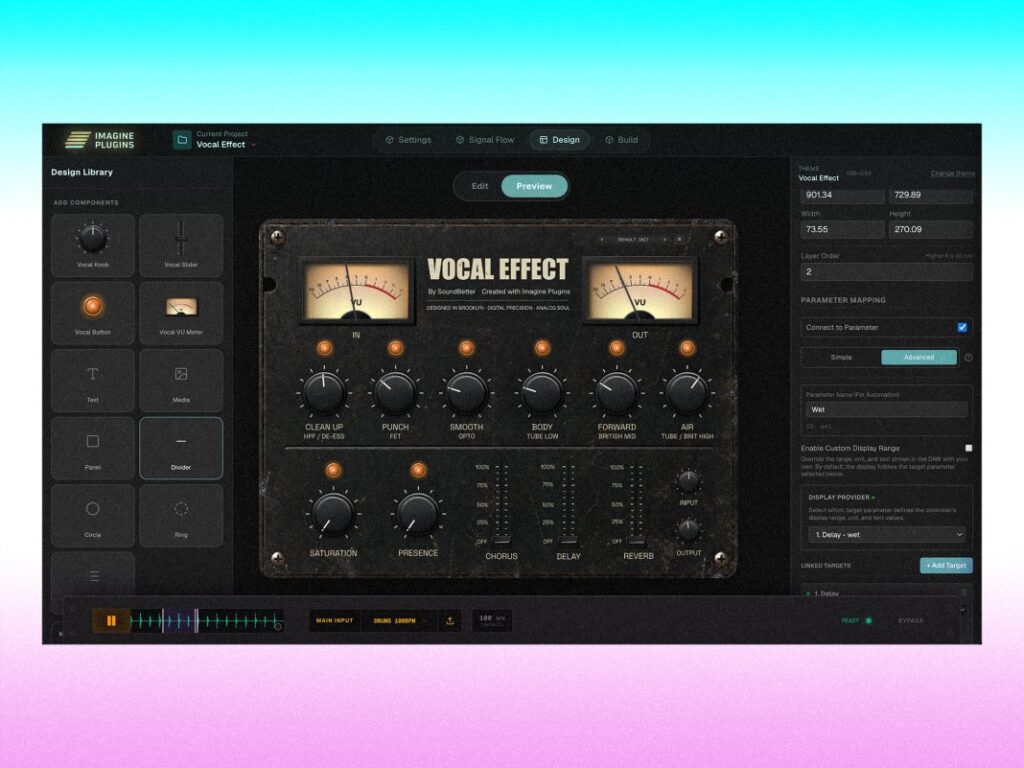
That’s the pitch from Imagine Plugins. With drag-and-drop DSP modules and a suite of designs for every dial and fader, this new offshoot of the online music service marketplace, Sound Better, has created a browser-based platform for building plugins without the need to hire a developer, and without asking an AI to build something for you.
It’s a model that follows the revolution of website builders, where complex code is neatly wrapped up in a smooth GUI and hidden behind the scenes. In fact, users don’t need to know a single thing about digital signal processing to create a functioning plugin.
“We realised we could do for plugins what Squarespace did for web development”, explains Shachar Gilad, one of the founders behind Imagine Plugins. “Creating plugins is quite an involved process. It’s a huge rabbit hole and ends up taking a couple years before you can make anything good. For those who are interested in that, I think it’s fascinating – but many people aren’t, they just want to have a plugin.”
Outside of learning to code C++, or making plugins using the development platform, Juce, building a plugin typically requires specialist knowledge. Unlike building a website, audio software involves far greater complexities, for a start you’re working with real-time audio processing, routing pathways that can reach byzantine status, all with the added need to optimise CPU.
Leap-frogging over these obstacles might appeal to many people, especially now as visual-coding languages have become incredibly popular in game development, film and visual effects software; ushering in a whole new group of artists who find the simplified environment far more approachable. The question is whether it is possible to abstract away the complexity of plugin development without sacrificing quality. Drawing upon his background at big audio companies including the likes of Apple and Waves Audio, Gilad believes he might be able to find the answer.

“If you’re an individual or small company wanting to start making plugins, you really have two options”, explains Gilad, “one is to learn digital signal processing, which is the secret sauce of sound manipulation with code; the other path is hiring someone who has that expertise to translate your vision.”
Having had a front row seat during the process of making his own plugins at SoundBetter, such as Butterfly Effect and Halo Effect, Gilad knows just how difficult it can be to bring an idea to the plugin market. “It’s expensive, it’s time consuming, and the process is not that pleasant, especially for a lot of creators in our industry that are very hands on, DIY, and relatively technical. For them to relinquish control and let someone else translate their vision is not a great experience.”
Expensive is of course a relative term given that the starting price is $1,000 per plugin for creators earning under $150k a year, and $5,000 per plugin for professionals earning between $150k-$300k a year. It’s not cheap. But compared to the alternatives, it arguably strikes a fair balance between paying huge costs to hire a developer, and the potential that a user could sell their plugin in perpetuity – theoretically making the endeavour pay for itself.
However, this price point is still a big ask for bedroom producers or even most touring artists. So, who is Imagine Plugins really aimed at?
“There are a couple different use cases here, but one is folks with a platform”, says Gilad, “they have a large following, they’re educators on music production, they have a large YouTube following, and they want to be able to give something to their users – whether it’s a giveaway, whether to share their knowledge, or to commercialise their audience. For them to try to create a plugin is a natural thing for them to do, either to sell, or give to their audience.”
What would have taken weeks and months before hearing the first instance of a plugin now takes less than 60 seconds to compile and run inside Imagine Plugins. It’s honestly impressive considering that it all runs in a web browser too. Given how much time and money you are saving, the price might be worth it for people seriously considering selling plugins.

As with most creative endeavours, the build process starts with a blank canvas where users can select different DSP components from a list and place them on the page. Reverb, delay, EQ, distortion, and more, are the building blocks that will get you started on an effects chain, with room to add deeper interest with effects such as a reverse and granulator.
The trick to creating something unique lies in the routing methods. To that end, the utility components offer Band Split, Mid/Side Split, Mix, Merge, and Polarity Flip, to name a handful. You can also throw in LFO’s to further mod the signal. With each component containing even more parameters that can be tinkered with – mixing, matching, and routing these blocks together can produce huge variation in designs.
“Between several dozen blocks with multiple parameters for each block, you can essentially create infinite combinations,” says Gilad. “We don’t want people to just throw their effects in and then put their name on it, we want people to route them and chain them in creative and interesting ways.”
Of course, a plugin is only as good as the quality of its DSP modules. Leaving nothing to guesswork, users can listen to the quality for themselves; as you build the plugin, the results can be auditioned nearly immediately, with a short wait to compile the plugin. Crucially, the plugin can also be downloaded and loaded in a real DAW for testing before buying.
Additionally, most DSP components have been made in-house at Imagine Plugins, or else licensed. “We don’t want to give the exact names of the things that we’re modelling, but I think most engineers can gather what these are”, says Gilad. “Some of them we licensed from who I believe are some of the best DSP engineers in our industry, including analogue models of classic compressors and EQs that you know mixing engineers often reach for”.
Adding to the quality assurance, Imagine Plugins code-signs each plugin, which means that a DAW will recognise that it comes from a trusted developer. Following a short review by the team, the plugin is delivered to the user in the standard VST, AAX, and AU formats, complete with an installer, and with support for Mac and Windows.
With lower financial overheads and no need for specialist knowledge, Gilad believes what remains are the creative parts of plugin manufacturing. “I think that the world in general is going to a place where your imagination is the limit.” If no-code platforms such as this do take off, we could see a future where releasing a plugin is just as viable as releasing a sample pack. On the other hand, amongst an already saturated plugin market, do users want to spend $1,000 to throw their hat in the ring? Only time will tell.
The post Imagine Plugins is changing who gets to make plugins appeared first on MusicTech.