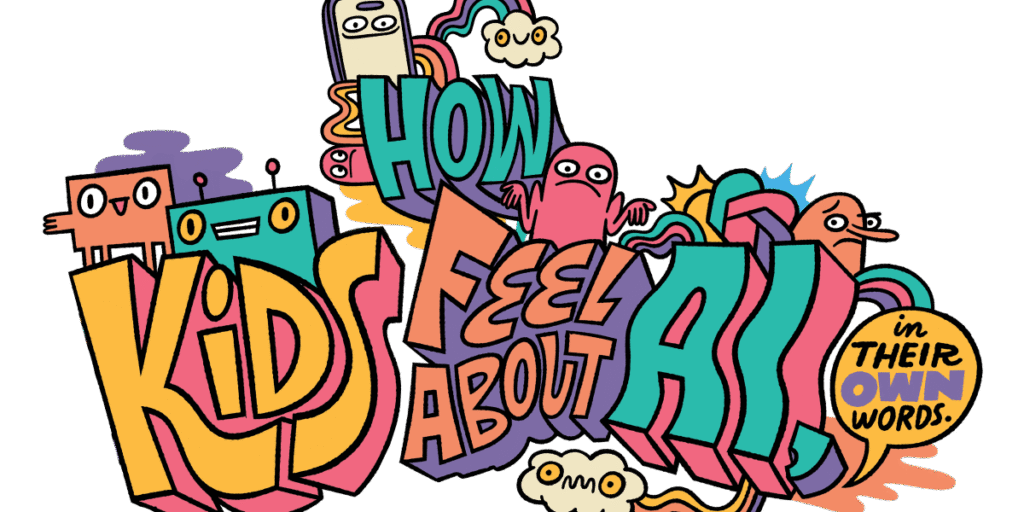
We asked 10 to 18-year-olds about artificial intelligence and heard a mix of apathy, practical use, and genuine worry. We expected stories of cheating or inspiration, plus standard fears about deepfakes. Instead, the responses were far more specific. Many kids used words like “bruh” or “meh” when asked. Some were deeply opposed to the technology and refused to discuss it. One teen admitted peers use it to write essays they know they shouldn’t. Another said she would not touch it because of the environmental cost. A 17-year-old named Winter told us: “AI isn’t the solution to our problems. I’m afraid it’s going to be the end of creativity and critical thinking.” Yet most admitted to using it at least a little.
Elementary and middle schoolers did not seem focused on AI. They were not begging for it like they do for iPhones or Snapchat. Many of their first encounters came from parents or schools. It was often just embedded in the devices and apps they already relied on, such as a Google search.
The findings match the data. A survey published in February 2026 by the Pew Research Center found that 57% of US teens had used chatbots to search for information. Fifty-four percent tapped them to help with schoolwork. Forty-seven percent had used them for fun or entertainment. Only 12% had used them for emotional support or advice. Teens are over four times more likely to use AI in innocuous ways than in potentially harmful ones. Some are using it to build things, whether a character, a tech platform, or a tutor to help other kids study.
None of that means the worries are misplaced. Kids can stumble into unfiltered content, lean on a chatbot instead of their own judgment, or trust an answer that is wrong. They should be protected from those dangers. But the danger is the reason to teach the thing, not to avoid it. We do not teach teens to never drive. We teach them to check their blind spots.
What surprised us most was how much young people might be able to teach adults about AI, and how clearly the kids who use it could name what they will and won’t hand over. They are not as worried that it will take their jobs as they are that it might impact society. With increasing access to tools that could in theory do their thinking, talking, or even friend-making for them, it sounds as if most want to keep their hands on the wheel.
Interviews have been edited for length and clarity.
The Coder
Remy, 16, New York
The word that comes to mind when I think about AI is “indifferent.” I just do not find the current applications that exciting for my own use. I go to school. I teach tae kwon do. I read. I play games with friends. None of that needs AI. I mean, I use it. I mostly use Claude, the free version, for programming outside of school. I had it help me write a program to see if I could tweak my computer’s overclock. So I see the appeal.
But at school, I actually think AI mostly makes my assignments worse, not better. In English, everything is now in-class writing, because teachers do not want kids cheating. So we have only 70 minutes to write a whole essay, and I think that hinders my writing. (Did you know Princeton voted to let faculty proctor exams for the first time in over a century? Their honor code goes back to 1893, and now it is over because of AI.)
As far as code goes, I’d also rather build things myself. I’ve been making a reinforcement-learning model in a game engine with a friend; it moves randomly at first, gets rewarded for walking toward a coin, and after enough iterations it teaches itself the most efficient path. I’ve also tested AI for game development, and it is not there. It makes sloppy code, and it is bad at blending mechanics into something cohesive. I’d spend more time correcting it than writing it myself.
I think AI right now is sort of like the first car or the first airplane. It’s interesting but crude. It’s obviously an amazing invention but not actually good yet.
Overall, I think AI right now is sort of like the first car or the first airplane. It’s interesting but crude. It’s obviously an amazing invention but not actually good yet. It’ll get somewhere. One thing I read about was AI flagging breast cancer more accurately, trained to catch its own false positives so a human still verifies. That’s the version I care about.
The Organizer
Danielle, 18, California
I’m studying engineering, and my life goal is to innovate technology that will help as many people as I can. The way I see it, AI is not inherently good or bad; that is decided by the people using it. It is already being used for lots of good. Just think about how it helps people with personalized education and more accessible medical diagnoses.
So far, the biggest project I’ve worked on with AI is called Next Voters. My teammates are more on the technical side, and I’m working on scaling. Right now, we’re focusing mostly on city councils as well as states. Our system turns dense, hundred-page documents into a headline and a few plain-language bullet points in your inbox. And everything is cited, so you can click straight to the actual policy to learn more. The information comes to you, instead of you having to remember to go search or prompt for it.
One AI agent finds official government sources for a given city or state—the council website, the proposed bills, the meeting transcripts. Another verifies they’re real and credible; another scrapes them every week for the latest updates; another sorts them into categories like civil rights, immigration, and economics; and the last one writes our weekly newsletter.
The project’s goal is to reduce the barriers to democratic participation—to make sure anyone, regardless of race, gender, income, or education level, has an easy way to get the information they need and then think critically about how they want to use it. We made it because right now, it feels as if most teens are not very engaged. I was in English class when the war in Ukraine came up and someone said, “There’s a war going on?” That gap, plus all the emotionally charged social media misinformation that gets promoted because it earns the most clicks, makes me nervous for the next generation of voters.
We do not want AI to think for people; we want to use it to disperse knowledge. In other words, we want to deal people the cards and let them play them however they want, but we have to make sure they have the cards in the first place.
The Cringe-o-meter
We asked kids to rate a range of AI uses from totally fine to not okay.
The Naturalist
Hazel, 17, New York
When ChatGPT first came out, my dad showed it to me and it seemed fun. But as it got more prominent and seemed to be everywhere, I started to feel uneasy. Then I learned about the environmental impact.
I’m a rock climber and I hike a lot. It’s good because when I’m on a wall, I’m just focused on staying on that wall. I’m not thinking about my phone or anything else. That’s why I love it. I also love the views and being around animals—even insects. I want to be an ecologist, and the more time I spend in nature, the more I want to protect those wild spaces.
The part that bothers me most about AI is the data centers that companies are building to enable it. They house these huge