Inkling 2 Mini has arrived as the new leader for local AI, claiming top spots on the Artificial Analysis Intelligence Index v5 across 32 of 48 benchmarks. The model handles multimodal inputs with a 1M-token context window while running on modest hardware.
Its performance relies on an unusual architecture: a looped Mixture-of-Experts design with 24 physical layers, where the middle 12 layers execute three times per token. This means every token passes through 48 layers. The checkpoint uses mixed NVFP4 and MXFP8 precision and includes a DSpark drafter for speculative decoding.
While frameworks like vLLM and SGLang support the model, their official recipes target NVIDIA B200 and GB300 GPUs. This left out NVIDIA RTX PRO 6000 cards, where kernel compatibility can differ. We tested the model on a single NVIDIA RTX PRO 6000 96 GB GPU to see how fast it could run.
Instead of manual tuning, we gave a coding agent the inference-optimisation skill, the hf CLI, and access to Hugging Face Jobs. The agent ran experiments for an afternoon.
The setup
The inference-optimisation skill follows a fixed protocol using a small, engine-agnostic benchmark script:
- Measure hardware and estimate theoretical ceilings before tuning.
- Change one variable at a time, bracketing every candidate between two control runs.
- Keep a change only if it beats both controls without regressing other metrics.
- Log every run, including regressions and dead ends.
The script measures single-user decode, aggregate decode at concurrency N, cold prefill at several lengths, and time to first token. It uses token counts directly from the server’s usage response. All runs used a fixed panel of six prompts: code, an explanation, a story, a comparison table, a bash script, and a history summary. Temperature was set to 1.0, thinking on was 512 output tokens, and 12 repetitions were used whenever speculative decoding was enabled.
We adapted the skill for Hugging Face infrastructure using three components:
- HF Jobs for compute. The nvidia-rtx-pro-6000 Job flavor uses the same GPU as the Inference Endpoint, costing $2.75/h for both. A ~150-line driver takes a list of server configs, starts each one, runs an unmeasured warmup, calls the benchmark script, shuts the server down, and prints one ledger line per run.
- CPU Jobs for reading engine source. When a flag was undocumented, the agent ran a cheap cpu-upgrade Job to grep the installed Python package inside the container. This revealed SGLang’s environment variables and vLLM’s speculative-config fields.
- Inference Endpoints for deployment, created via hf endpoints deploy using the exact image digest and flags that passed verification.
The baseline was our existing org endpoint config: SGLang with –attention-backend fa4 and no speculative decoding.
Results
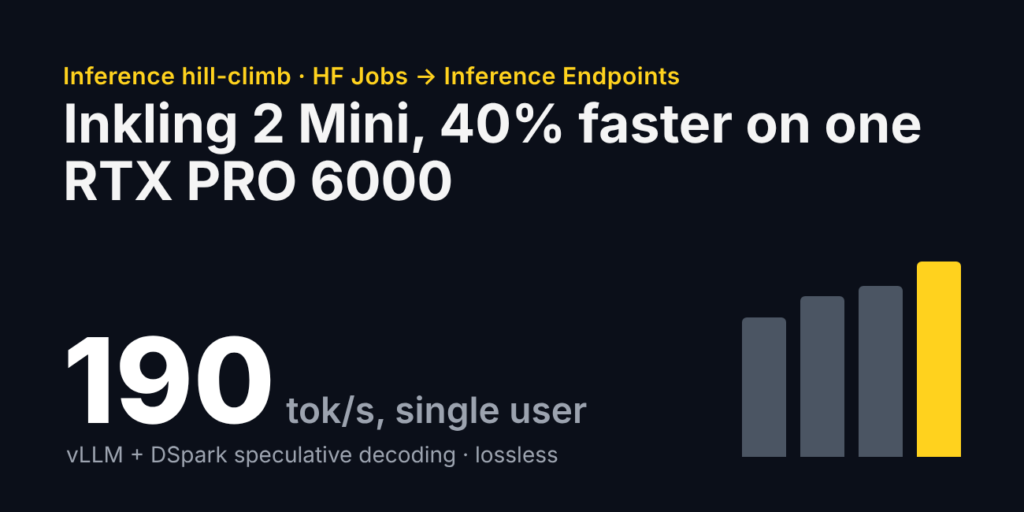
Single-user decode speed (median of 12 requests). vLLM + DSpark reaches ~95% of the memory-bandwidth ceiling at its measured acceptance rate.
| Config (1× RTX PRO 6000) | 1-user decode (tok/s) | 8-user aggregate (tok/s) | Prefill 4K / 32K (tok/s) | TTFT |
|---|---|---|---|---|
| SGLang, no speculation (baseline) | 134–139 | 543–598 | 18.7–19.1K / 16.9–19.1K | 41–114 ms |
| vLLM, no speculation | 157.0 | 638 | 20.7K / 20.7K | 33 ms |
| SGLang + DSpark (8 drafts) | 166.6 | — ¹ | 18.0–19.5K / 18.9–19.1K | 38–51 ms |
| vLLM + DSpark (7 drafts) | 190.6 | 716 | 20.7K / 20.6K | 40 ms |
| Deployed endpoint (over the internet) | 194.9 | 673 | 11.7K / 19.2K ² | 198 ms ² |
¹ SGLang’s RTX PRO 6000 DSpark recipe caps –max-running-requests at 4. Raising it to 8 reached 660 tok/s, still behind vLLM.
² Includes ~160 ms of client-to-endpoint network round trip.
All of the speedup comes from switching to vLLM nightly, enabling DSpark with 7 drafts and probabilistic draft sampling, and adding two memory flags so vLLM’s DSpark setup actually starts on 96 GB:
vllm serve thinkingmachines/Inkling-2-Mini \
  --tool-call-parser inkling \
  --enable-auto-tool-choice \
  --reasoning-parser inkling \
  --max-model-len 262144 \
  --gpu-memory-utilization 0.85 \
  --speculative-config '{"method":"dspark","num_speculative_tokens":7,"draft_sample_method":"probabilistic"}'
Both num_speculative_tokens: 7 and draft_sample_method: “probabilistic” were validated directly. Shorter draft counts (such as 5) are rejected at startup because both engines enforce the checkpoint’s fixed block size. Switching to greedy draft sampling dropped vLLM decode speed by 11% at temperature 1.0.
Why it stops around 190 tok/s
Before tuning, the agent probed the RTX PRO 6000 inside a Job. The card offers 1,469 GB/s copy bandwidth, 416 TFLOPS BF16, and 792 TFLOPS FP8. Because every token makes 48 layer visits, plain decode re-reads ~2.7 GB of attention and dense weights, ~2 GB of routed experts, and ~0.9 GB for the LM head. At 1,469 GB/s, that gives a single-user bandwidth ceiling of ~256 tok/s.
Without speculation, vLLM at 157 tok/s hits 61% of that ceiling, mostly limited by kernel launch latency across 48 visits. Speculative decoding changes the memory math on an MoE. Verifying 8 positions together activates the union of their routed experts, reading roughly 40% of each layer’s experts instead of 6%. At our measured acceptance of ~2.3 tokens per step at temperature 1.0, the bandwidth ceiling falls to ~201 tok/s. At 190.6 tok/s, vLLM + DSpark is already at ~95% of hardware bandwidth, so further flag tuning has almost nowhere left to go.
What didn’t work
Most candidate flags were unsupported, noisy, or slower.
vLLM
| Flag | Result |
|---|---|
| Shorter draft length (3–6) | Rejected at startup; requires num_speculative_tokens = 7 (checkpoint block size − 1). |
| draft_sample_method: “greedy” | −11% at temperature 1.0 (168.6 vs ~190.4 tok/s). |
| rejection_sample_method: “block” | 190.1 vs 190.3–190.5 for controls; no effect. |
| enable_adaptive_verification | Assertion error at startup for the Inkling 2 drafter. |
| draft_lm_head_quantization: “fp8” | Only supported for DeepSeek DSpark drafters. |
We also skipped rejection_sample_method: “fly” and “synthetic” on purpose because they alter the output distribution, and we wanted a strictly lossless speedup.
SGLang
| Flag | Result |
|---|---|
| Shorter draft length (3–6) | Rejected at startup; requires –speculative-num-draft-tokens 8 (gamma + 1 for the bundled drafter). |
| SGLANG_ENABLE_NV_MEGA_RUNTIME_OPTIMIZATION=1 | +4% once, failed to reproduce against fresh controls. |
| SGLANG_OPT_USE_FUSED_DRAFT_SAMPLE=1 | +2%, within run-to-run noise. |
| SGLANG_OPT_MOE_QUANT_ONCE=1 | +1%, within run-to-run noise. |
| SGLANG_DSPARK_USE_GREEDY_DRAFT=1 | −9% at temperature 1.0 (156.8 vs ~172 tok/s). |
Benchmarking gotchas
A few measurement issues caught us along the way:
- Triton JIT during timed prefill. vLLM’s first 4K prefill came back at 202 tok/s instead of 20K because Triton was compiling kernels during the timed request. Running an unmeasured warmup across prompt lengths and concurrency fixed 4K prefill, though the first run in each Job still under-reported 32K prefill due to last-chunk shape differences.
- Orphaned servers holding GPU memory. The initial driver stopped servers via a PID saved from setsid … &, which is not guaranteed to match the process group ID. The previous server stayed alive on port 8000, broke the next launch, and turned into a zombie that still passed kill -0. Managing the process with subprocess.Popen(start_new_session=True) and waiting until both GPU memory and port 8000 areSource Read original →