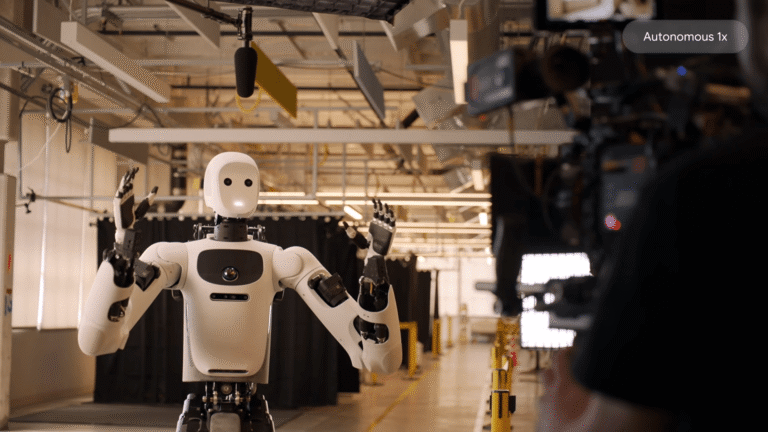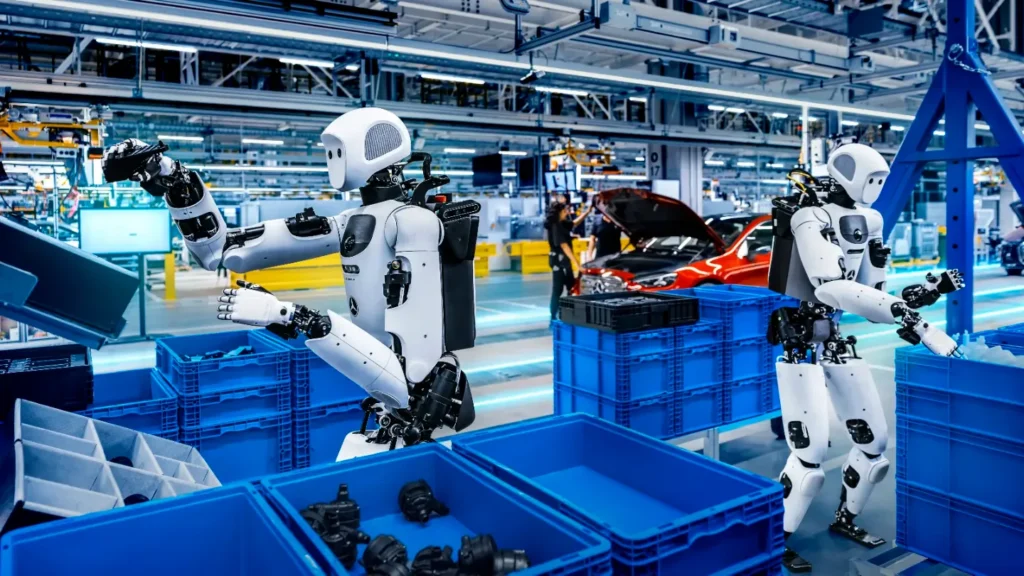
Mercedes-Benz assembly lines in Hungary and Germany have seen a humanoid robot sort metal parts with a 96 percent success rate during a recent pilot.
Google DeepMind attributes this performance to Gemini Robotics 2.5, a new vision-language-action model. The system takes visual input, processes language instructions, and outputs specific movements for the robot.
The company tested the model across more than 200 tasks, ranging from serving food with tongs to pipetting liquids. Google DeepMind claims the new model beats its own previous baselines by 30 to 100 percent, depending on the task. It also completes work 20 to 30 percent faster.
The tool is compatible with various hardware. It works with Apptronik’s Apollo 2, a humanoid robot featuring a five-fingered hand with 22 degrees of freedom. It also runs on the Franka Duo platform, which uses two-finger parallel grippers.
Testing on live production lines
Google DeepMind, Apptronik, and Mercedes-Benz ran the pilot on active lines in Kecskemét, Hungary, and Sindelfingen, Germany. The Apollo 2 robot performed kitting duties. It sorted metal parts from bulk bins and placed them into trays in the sequence required for each vehicle.
Two models operated together during the test. Gemini Robotics ER monitored the workflow, while Gemini Robotics 2.5 controlled the hands and arms. Google DeepMind reports the 96 percent success rate for this specific pilot.
Apptronik CEO Jeff Cardenas stated the models improved significantly within a few weeks of post-training. He noted the system transitioned to Mercedes production with minimal performance loss.
Safety benchmarks and jailbreak testing
Google DeepMind says Gemini Robotics 2.5 uses real-time control to avoid physical hazards. In internal evaluations, safe task completion improved by 33 percent near obstacles and by 43 percent near people.
The company has also released the ASIMOV-Jailbreak benchmark on Hugging Face. This open-source tool contains hundreds of prompts designed to disguise unsafe requests in various scenes. It tests whether robotics models can be tricked into performing dangerous actions.
According to Google DeepMind, its own model, Gemini 4 Argon, achieves a jailbreak resistance of 99.5 percent. This is an increase from the 82 percent resistance recorded for its predecessor, Gemini Robotics ER 2.
Simulation training using Argon
Development of Gemini Robotics 2.5 relied on Gemini 4 Argon as a simulation engine. Argon can generate thousands of simulated training runs from a real camera scene to create a digital twin.
Combined with real-world training demonstrations, this approach aims to help the robot generalise more quickly to new scenes and objects. Argon can also derive hypotheses about error causes from video recordings. It tests improvements in simulation before applying them to the actual robot.
Google DeepMind is rolling out Gemini Robotics 2.5 to partners Agile, Apptronik, and Mercedes-Benz.
What it means
For manufacturers, the update suggests robots can handle specific assembly tasks like sorting parts with higher reliability and speed. The integration of a language model for simulation means training data generation becomes more efficient. The release of the jailbreak benchmark provides a standard for testing safety against adversarial prompts, which is critical for deploying autonomous systems in shared environments.