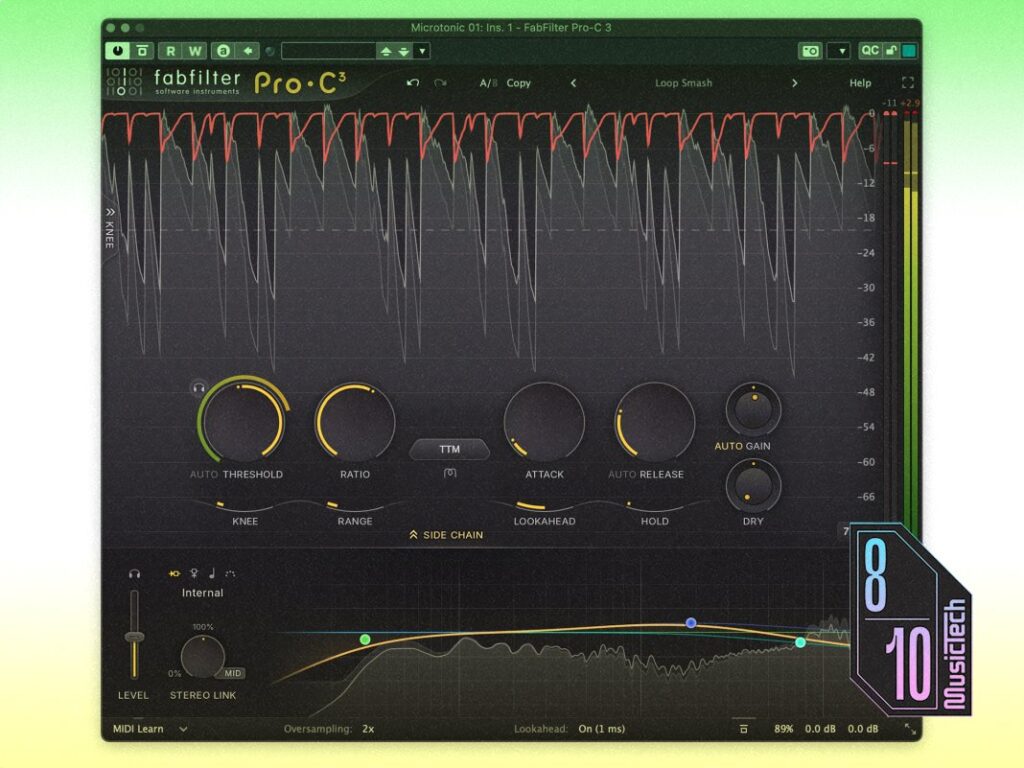
For producers and sound designers, the latest iteration of the FabFilter Pro-C compressor offers a toolkit that rivals the most complex hardware emulations without sacrificing usability. Priced at £149, or $199 for new purchases, this update introduces enough depth to justify its place in a high-end signal chain, provided you can navigate its expanded feature set. The real value lies in how it bridges the gap between creative saturation and surgical dynamics control, all while maintaining the intuitive workflow that made the original version a staple in studios worldwide.
Core functionality and workflow integration
While the software accommodates a vast array of signal paths, its true strength emerges when integrated into a broader ecosystem. The plugin is designed to coexist seamlessly with the Pro-Q 4 equaliser, allowing users to manage an entire channel strip-from EQ through compression to gating and de-essing-within a single visual interface. This unified view streamlines the mixing process significantly, particularly for those who already own the suite.
Technically, Pro-C 3 now offers fourteen distinct compression styles and three character modes to shape the sonic texture. Enthusiasts can select a Vintage Vari-Mu for classic warmth or a Vintage Op-El to mimic the smooth curve of a LA-2A. Beyond these emulations, the library includes modern presets and a unique TTM (To The Max) mode. This algorithm applies upward compression to quiet sections and downward compression to peaks, effectively normalising the overall level while preserving dynamic contrast.
To add grit, the unit features a dedicated saturation circuit with Tube, Diode, and Bright modes. These options introduce analogue drift and harmonic distortion, which can be placed before or after the compressor stage depending on the desired effect. The interface itself is highly scalable, offering four different size configurations to fit various screen real estate, alongside a new auto-threshold function that is particularly useful for dialogue and podcast production.
Sidechain capabilities and signal routing
The most significant technical leap in Pro-C 3 is the sidechain section, which now includes a six-band equaliser. This allows for precise frequency shaping before the compressor engages, effectively acting as a miniature Pro-Q instance. Users can place up to six nodes across the spectrum, choosing from ten filter shapes and six slope options. Furthermore, the stereo imaging can be manipulated via mid-side or surround linking, ensuring the compressor reacts to specific frequency bands or spatial positions within the mix.
Triggering the compressor is equally sophisticated. The Host sync function enables the unit to respond to musical subdivisions, including dotted and triplet timings, without the need for external aux tracks. Alternatively, MIDI notes can be used to trigger the compressor, allowing for creative gating techniques directly from a keyboard or DAW controller. With up to 32x oversampling, the plugin ensures that these complex calculations do not introduce audible digital artefacts.
Comparison and pricing
Competitors such as u-he Presswerk or DMG Audio Compassion offer comparable sonic quality, yet they often demand a steeper learning curve to unlock their full potential. FabFilter has prioritised accessibility, ensuring that the advanced feature set remains approachable for beginners and veterans alike. While the upfront cost of £149 is substantial, the company offers loyalty discounts of up to 60% for existing customers, making the total investment significantly lower for those building a library of tools.
Key takeaways
- Pro-C 3 expands the original plugin with 14 compression styles and 3 character modes, including a unique TTM algorithm for dynamic normalisation.
- The new six-band sidechain EQ and Host sync features allow for precise frequency-triggered compression without external routing.
- Seamless integration with the Pro-Q 4 ecosystem enables full channel strip management from a single interface view.
- High-fidelity performance is maintained through 32x oversampling, ensuring clean processing even with complex sidechain modulation.