Apoorv Shankar believes humans will soon interact with technology through a series of approvals and rejections. AI agents will proactively come to us to complete tasks, and humans will say, “Yes, order that Uber,” or “No, don’t get lunch from that spot.”
But if you get multiple pings from an AI agent throughout the day, taking out your phone to say yes or no every single time will be a “bottleneck,” he says. That’s why he made the Aina Ring. It has a small display and a joystick-like button that lets you quickly accept or reject an AI agent’s actions with your hands. Your phone can stay in your pocket.
History and pricing
Aina has been in stealth for the last 15 months, though the company debuted a few experimental products at CES 2026 under a different name: Project Mirage. One was called Dune—think of it as the precursor to the Aina Ring. Connect it to your Mac and the three buttons become context-aware controls based on what you’re doing. In a meeting? The buttons can turn into shortcuts for mute, camera off, or record.
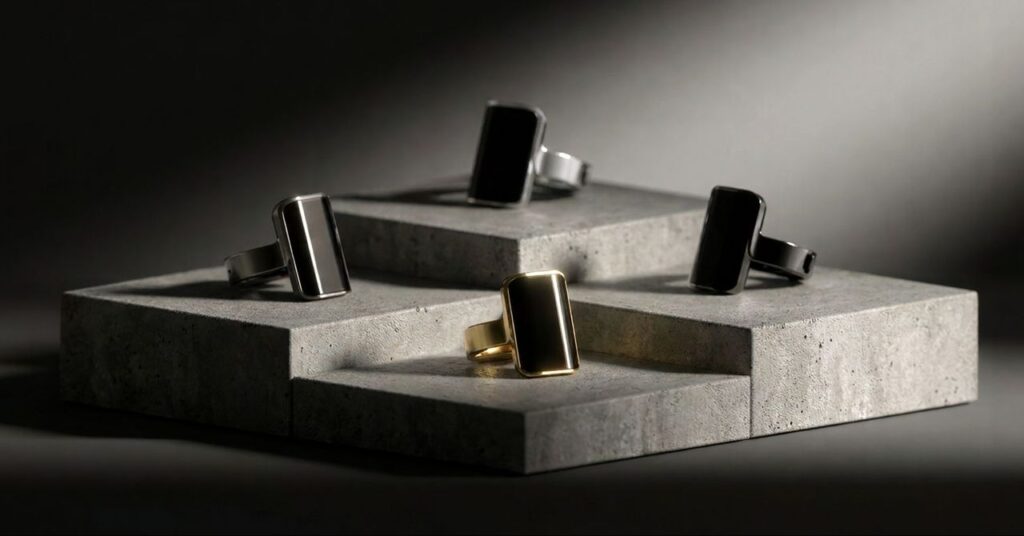
Aina studied how people used Dune and developed the Aina Ring, which it’s announcing today. Preorders are live now, and the ring costs $399 for a limited time before the retail price rises to $499 when it starts shipping in January 2027.
“Approvals are going to be the future of interfaces and interaction, and we wanted to build a device that just made it easy to approve stuff,” Shankar says.
This isn’t Shankar’s first time with a smart ring—he previously was the vice president of hardware at Ultrahuman, a fitness- and health-tracking ring that competed with Oura. (Ultrahuman was briefly banned in the US after a patent dispute with Oura.)
The team explored other gadgets like smart glasses and pendants, but ultimately decided the ring was the most convenient way to interact with agents. The titanium Aina Ring connects to Macs or iPhones, and at any moment, the onboard assistant is looking for the three things you need next. It learns your routines from your personal data, like location, calendar, and email, and after you connect various third-party services in the Aina app, like Uber or Spotify.
If you usually go for a run at 6 am, as soon as you put on your running shoes, it will suggest continuing the podcast you started last night, or play music—the ring’s joystick doubles as a music-playback controller. If it’s 8:30 am and you usually take an Uber to work, it’ll suggest the ride—flick yes on the ring, and it’ll handle the task right away. If you’re running late for a Zoom meeting, Aina will ask if you want the assistant to send an email saying you’ll be late. Shankar calls these “Aina Cues,” powered by the ring’s Context Aware Operating System.
Many of these actions will likely be limited based on what apps and features are supported, though Shankar says users can create their own Cues using natural language. So if you want the ring to prompt you about turning on the coffee machine every morning at 8 am, you can configure that. If your favorite app or service doesn’t work through Aina, you can connect your preferred AI agent—like Muse or Instinct—to Aina, and they will handle the task through virtual browsers.
Display and voice
The display is crucial to make sure the user knows whether an action went through. “Agents today don’t respond immediately,” Shankar says. “For us to trust these devices—that what I said actually just happened—you need display confirmation.”
These Cues aren’t the only capability on the Aina Ring. Aina Voice lets you quickly talk to your AI agents by pressing the center button, or ask Aina to take notes, similar to smart rings like the Sandbar Stream or Pebble Index 01. The ring also has a tiny speaker, so you can take phone calls—initiate the call with a voice command, then bring your hand to your ear, like you’re James Bond talking through an earpiece. (Bond would strongly advise against the gesture.)
Like the experimental Dune gadget, the ring also turns into a context-aware remote based on what you’re doing. If it knows you’re in a Zoom call on your Mac, it will offer up Zoom controls on the ring. If you’re watching TV and can connect your TV system to Aina, it can act as a TV remote.
Competition and limitations
Many companies have tried and failed to be the next gadget for the AI revolution. Humane and Rabbit are two notable examples, but nothing has stuck so far. OpenAI is developing such a product with ex-Apple designer Jony Ive. But many of these devices claimed to replace your phone, and some, like the Rabbit, just felt awkward to carry around alongside the smartphone.
The Aina Ring isn’t trying to replace anything—Shankar says phones are “too perfect.” Instead, it’s just a means to stop you from being a bottleneck, so your AI agents can keep working on your behalf.
“We are seeing a major shift in how we operate with things—agents are able to do so much, and everything is waiting on us,” he says. “I don’t have an easy way to approve—we’re going to see that a lot more once we see what the potential of proactive AI is.”