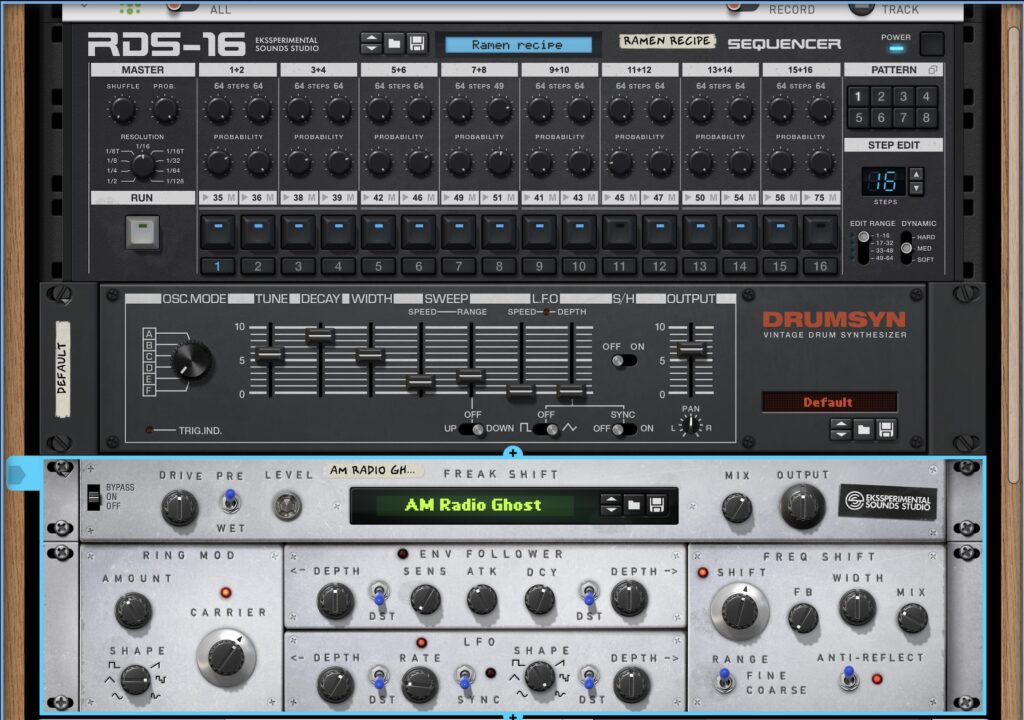
EKSS has launched FreakShift and the RDS-16 sequencer for Reason. Erik Karl Stephan Söderberg built these Rack Extensions to mimic boutique hardware in a digital environment. They are available for purchase until the end of June.
Söderberg created EKSS as a producer name alongside his gear. He has been developing virtual instruments for Reason since version 1.0, expanding into a deep catalog of virtual gear in 2017. The tools replicate the specific character of hardware builders rather than generic software presets.
The FreakShift effect
This unit combines a ring modulator, a Bode-style frequency shifter, and an envelope follower with an LFO. Users can place drive before or after the effect. Additional depth comes from an optional external carrier, an insert effect between the two engines, and a routable LFO for modulation.
The rear panel shows the extensive connectivity. A simple test setup includes the RDS-16 sequencer and the DRUMSYN drum synthesizer. The DRUMSYN draws inspiration from the vintage Pearl Syncussion SY-1. Further routing and CV control are possible within the device.
RDS-16 sequencer
The RDS-16 Rack Drum Sequencer offers 16 channels, 8 patterns, and up to 64 steps per pattern. Channels support independent length settings for polyrhythms and probability controls. Dynamics range from soft to hard. Resolution options include 1/2 to 1/128 with triplets. Global shuffle and master probability settings are also included.
Placing the device above another instrument triggers it. Users can combine it with other Players to access separate trigger and CV outputs. Steps function as either triggers or gates. Preset patches exist for General MIDI, Rack Extension drum machines, native Reason devices, and melodic scales.
The tool is already a primary choice for production. Future updates will utilise the SDK improvements in Reason 14. Planned features include greater control, fills, and step conditions.
Other essential tools
The full CV Tool Kit is expensive and offers more comprehensive voltage control than most alternatives. Individual modules, such as the CV LFO Tool, outperform many native or third-party options. The CV LFO Tool alone provides significant utility.
Every module features extensive input and output connections on the rear panel.
The DRUMSYN synthesizer allows trimmable tweaking and syncable CV and LFO. The ES10 is a compact synth similar to the SH-101, delivering a Roland-style sound.
Amalgam combines FM, subtractive, granular, and ring modulation in a single unit. The ES400 FM synth offers a DX-inspired interface. The sound design approach remains accessible throughout the collection.
Ouroboros is a multi-effect unit containing delay, distortion, filter, reverb, LFO, and noise generation. Flexible routing and patching allow for dark, dubby textures. Anoma is another effect unit worth considering.
Additional modules include the Filter Chain X8187 and the TransFluxer LoFi Soundscaping Multi FX. The latter functions as a complete album of effects within a single Rack Extension. The TURN2ON FLANGERDBL from a different developer also provides an MXR-style sound.
There are too many options to list them all. The strategy is to trial a selection and choose the modules that feel like a personal secret weapon. The variations ensure a suitable match for any workflow.
Context for Reason users
Reason is now part of LANDR, with the company changing ownership and introducing subscriptions. The Rack Extensions scene is quieter as developers compete with native VST support and official add-ons. However, unique tools remain available that are not found elsewhere.
These devices integrate better than standard plug-ins. They include copious CV I/O on the back. They feel more like full-featured hardware than Eurorack modules from VCV, Softube, or Reaktor. The interface offers instant-on inspiration typical of the Reason environment.
Reason 14 shows new GUI features in the RV-9 Reverb Station. An upcoming SDK5 update may bring further improvements. Developers will need to see how well the new tools perform.
Users should enjoy the current collection while waiting for future updates. The author has stopped writing to finish the techno tracks started during the review.