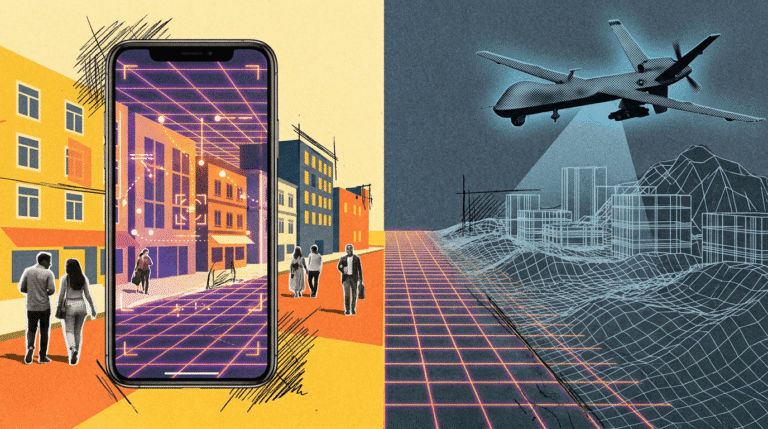
Ukraine has opened a data room containing millions of points gathered from tens of thousands of drone flights, making them available to military contractors and commercial firms. More than 100 companies and the UK government have since gained access to this material. The Ministry of Defense announced this move in January. The goal is to attract funding and partnerships while turning the front line into an active site for model training. War creates conditions that AI companies struggle to reproduce in their own laboratories.
Explosive growth
Records from American drones over Syria and Yemen informed the first generation of semiautonomous military hardware in the late 2010s. The difference now is that access to that data is being used to develop a wider ecosystem. The financial value to defense firms is immense because battlefield data offers large volumes of machine experience gathered under conditions that no laboratory can produce.
That is because the data most valuable for training AI models comes from exceptions. A signal jams, visibility disappears, or a human operator improvises. AI companies spend years and enormous sums trying to capture enough of these moments to make their models more robust. War produces them at a frequency that controlled testing cannot match.
Processed and matched against records of what its operator was doing, that data turns operational records into training sets. Combat becomes a commercial asset. Many conflicts have already seen this training loop happen as drone footage feeds subsequent generations of military technology, and the market is set to grow.
Enabled Intelligence, an American company that specializes in processing data to become usable in AI training, says it has already made more than half a million hours of Ukrainian drone footage available to feed into the next round of models. The company advertises possible uses in both military and commercial systems.
Closing the data loop
Many of the drones that now define our modern age of warfare began as civilian technology. They have recently been turbocharged by new, commercially available AI systems, which allow cheap machines to operate autonomously—either individually or as a flock—as the environment changes around them. Each flight then creates a record of what the system encountered.
The resulting data is critical. The controlled lab environments usually developed to train these autonomous systems can approximate failure but are no match for the live conditions of a battlefield with very real risks. Military intelligence programs have held data generated by sensor-heavy systems like Predator and Reaper drones for nearly a decade through programs like Project Maven. Access remained entirely within the defense world. The data generated was available only through restricted, classified channels for the sole purpose of developing new weapons systems that would feed back into the same military that produced the data in the first place. That experience is now being shared to a much broader development network.
The loop now closes. Commercial technologies adapted for the battlefield are generating data that can flow back into the industries from which they came, becoming part of the data infrastructure relied on by governments and the private sector alike. Drones that were trained in the signal-jammed airspace over Ukraine are now being deployed in the agricultural sector to help farmers map and survey their fields in places lacking the cell signal necessary for previous generations of technology.
Other countries are likely to follow Ukraine in selling their battlefield data, and we are not ready for the new marketplace this will create. Bad actors could acquire the data, but purchase controls already mitigate that risk. Intelligence operatives scrutinize potential customers’ infrastructure for ways that data could reach enemies or nefarious actors.
Training data creates a new tracing problem, though. Whereas the movement of commercial datasets can be followed when planted contact details appear two steps from the original buyer, the provenance of AI training data vanishes in a manner embedded in the technology itself. Another risk is that this use of the data creates an extractive economy in which wealthier countries far from danger benefit from the mortal threat borne by frontline states, potentially creating a market incentive for war to continue as an unending mine for digital gold.
A fraught new frontier
Existing laws regulate how militaries may conduct war. But they say almost nothing about what happens when records created in combat are stripped of their operational context, packaged as data, and licensed to companies whose products circulate far beyond where they were made. The responsibilities of the companies that design these systems remain unsettled. Ukraine is building access controls, which are mentioned in the newly signed UK-Ukraine AI agreement, but no governments are actively working on regulating what happens when data has been absorbed into a model and crosses back into civilian markets.
Those records contain human lives. The soldiers and civilians visible in them did not agree to become training material for products that might be sold years later. But sensor data, camera footage, and coordinates from civilians fleeing a drone strike now constitute the sorts of data that inform how future machines will make decisions. That is a problem of consent. Individuals featured in the data—be they targets, controllers, or civilians standing by—become part of the training material. The autonomous capabilities based on that data do not stop at the edge of the battlefield. Such capabilities move into other military or commercial systems like delivery vehicles or agricultural machinery. Errors and assumptions embedded in the data travel with the model even once it enters civilian life.
Battlefield data should not be treated as ordinary commercial material. But there is currently no agency or regulator that has jurisdiction over this issue. In the meantime, governments that provide access to defense data should treat it as they would a controlled weapons transfer, recording its origin, licensing its users, and restricting onward sharing. Ukraine has begun to grapple with this. Its Avengers Labs program allows companies to train models on battlefield data without giving them direct access to sensitive databases. Yet that mitigates only one part of the problem.
Governments should require disclosure when models trained on wartime material are later incorporated into civilian products. The goal of such regulation should be to make the path from combat to commerce visible. What these companies are really mining is experience. And soldiers cannot consent to having their experience used in this way—as training data that produces model advantage and ultimately supports a product used far from where the war was fought.
The question is no longer only what the technology companies can sell for use in war. It is what they can extract from it. To protect ourselves from the excesses of this new industry, we need a regulatory system that follows battlefield data wherever it goes, from combat to model to commercial product.
Cory Alpert is a researcher at the University of Melbourne, looking at the impact of AI on democracy. He previously served in the Biden White House.