Cloudflare has released a preview of Clairic, a new extraction model running on Workers AI that returns typed values rather than generated text. The system targets a task developers usually assign to large language models: pulling totals, dates and IDs into JSON. Clairic answers every requested field in a single forward pass, without reasoning steps or output tokens.
TL;DR
- Size: Parameter count undisclosed. 65,536-token context window. Up to 4 images per request.
- Runs on: Cloudflare-hosted GPUs via Workers AI (
@cf/cloudflare/clairic). No local version until weights are released. - Performance: Sub-second extraction in Cloudflare tests. No standard accuracy benchmark published yet.
- Best: Extraction step took 0.46 s versus 16.1 s for GLM-5.3 in Cloudflare claims pipeline tests.
- Worst: 4 of 21 TSA next-day forecasts fell outside its 80% interval. Multi-step arithmetic is unreliable.
What is Clairic?
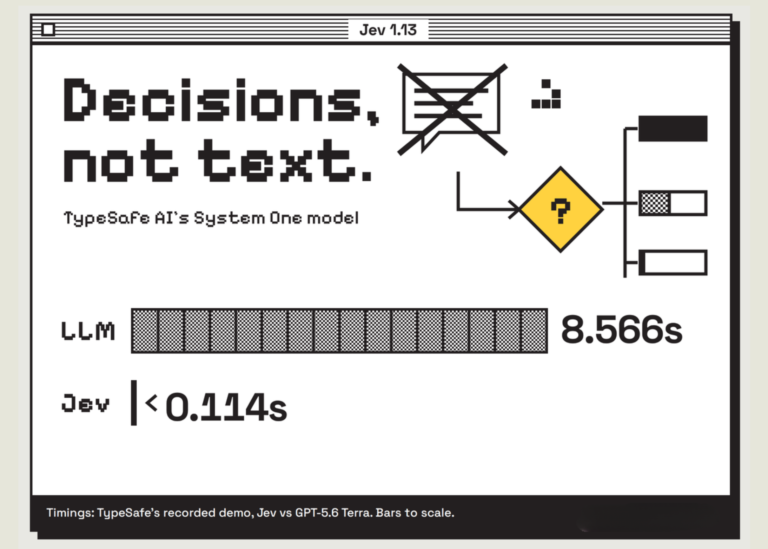
Clairic is a Cloudflare model that extracts, computes, estimates and forecasts typed values from unstructured inputs. It builds on the System One idea from TypeSafe’s Jev, named for Kahneman’s fast, intuitive thinking.
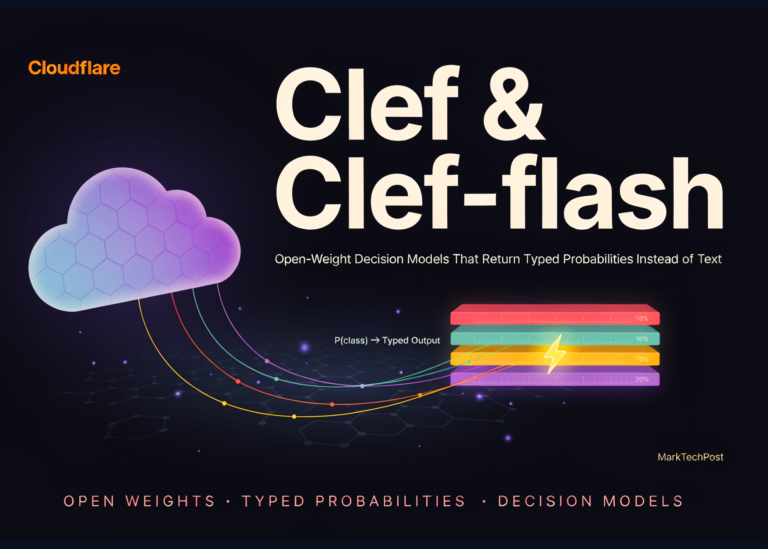
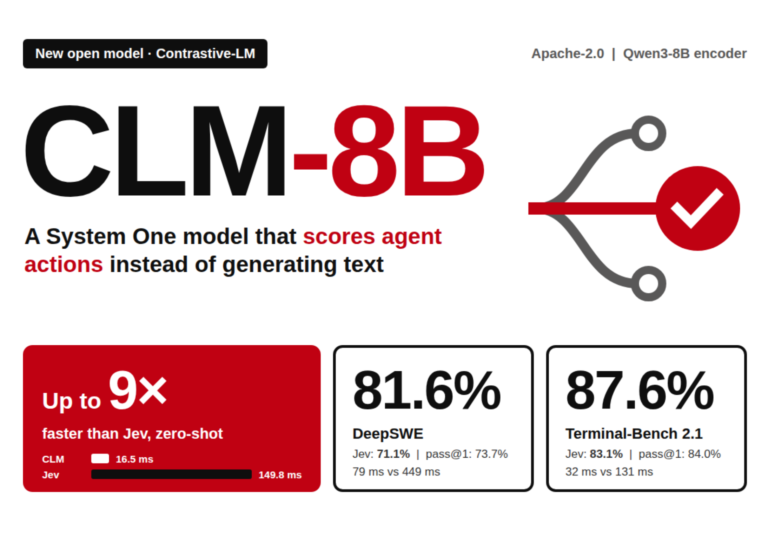
Jev and Cloudflare’s own Clef are decision models. They score options you list in advance. Clairic covers answers you cannot list, such as an invoice total, a date or a repair cost.
Cloudflare frames a 3-part stack. Extraction models turn raw input into typed values. Decision models turn values into decisions. LLMs turn decisions into words.
How does a Clairic request work?
A request has a state (text plus up to 4 images) and a map of named, typed fields. Each field can carry plain-language instructions. Supported types are text, number, date, time, datetime, duration, list, estimate and forecast, per the Workers AI changelog.
Every scalar answer includes p_null, the probability that the value is absent, plus a confidence score. Text answers return exact spans with character offsets. Estimates and forecasts return a median and an 80% interval, from p10 to p90. Forecasts cover up to 64 steps.
There is no field limit. Fields that do not fit beside the input in one 8,192-token pass split into parallel passes. Each pass sees the whole input. In the docs example, a 61-token invoice ran in 3 passes. It billed 655 input tokens, including 472 schema tokens. Wide schemas can cost more than the document itself.
What did Cloudflare’s tests show?
In a support-email example, Clairic added price and tax into $701.10. It also computed 11 days since delivery. Neither number appears in the email. A missing tracking number returned null instead of a plausible guess.
On a skewed receipt photo, it read all 7 present values and returned null for the absent discount. Its lowest confidence was 0.776, on the order number.
For forecasting, Cloudflare predicted daily TSA checkpoint counts for 21 days. Average error was 3.3%. 17 of 21 actual counts fell inside the 80% interval. 3 of the 4 misses fell on Columbus Day weekend.
The main test is a damaged-product claims pipeline. Clairic extracted facts, Clef chose refund or repair, and GLM-5.3 wrote the reply. Cloudflare compared this against GLM-5.3 handling all 3 steps.
The cascade finished in 19.3 s versus 61.7 s, about 3.2x faster. Extraction took 0.46 s against 16.1 s. The decision step took 0.22 s against 21.9 s. Cost per million claims fell 49%, from $11,740 to $6,032. The reply step still dominated, at 18.6 of the 19.3 s.
Both pipelines got the facts and decision right. Clairic’s repair estimate was identical across runs. GLM-5.3 returned $250, $250 and $220. Cloudflare says Gemma 4 and Qwen failed the all-LLM version.
How does Clairic compare with Clef, Jev and GLM-5.3?
| Metrics | Clairic | Clef | Jev | GLM-5.3 |
|---|---|---|---|---|
| Developer | Cloudflare | Cloudflare | TypeSafe AI | Z.ai |
| Class | System One extraction | System One decision | System One decision | System Two LLM (reasoning) |
| Output | Typed values: spans, numbers, dates, durations, lists, estimates, forecasts | Probabilities over options you list | Typed decisions with calibrated probabilities | Free-form text |
| Parameters | Not disclosed | 27B | Not disclosed | Not disclosed |
| Context window | 65,536 tokens | 65,536 tokens | Not disclosed | 1,048,576 tokens |
| Image input | Yes, up to 4 | Yes (text, JSON, images, video) | Not disclosed | Not disclosed |
| Input price | $0.10 / M tokens | $0.24 / M tokens | $0.042 / M tokens | $1.40 / M tokens |
| Output price | None | None | Free | $4.40 / M tokens |
| Speed | 0.46 s extraction step (Cloudflare test) | 209.3 ms median (Cloudflare evals) | 70 to 500 ms end to end (TypeSafe) | 16.1 s extraction step (Cloudflare test) |
| Availability | Workers AI preview; open weights planned | Workers AI; Apache 2.0 weights | TypeSafe API, early access | Workers AI, Paid plan |
Where can developers use it, and what does it cost?
Clairic is live as a preview at @cf/cloudflare/clairic. Call it through the Workers AI binding with env.AI.run() or the REST API. AI Gateway works with the same endpoints.
Pricing is $0.10 per million input tokens with no output charge. That undercuts Clef’s $0.24 but sits above Jev’s $0.042. Weights are promised but not yet released.
What it means
For developers building apps that process documents or images, this removes the need to chain multiple models. You no longer send a request to one model to extract data, then to another to decide, then to a third to write a reply. The extraction step is now a dedicated, fast pass that returns numbers and dates directly. This reduces latency and cost for the data gathering part of the workflow, though the final text generation remains the most expensive step.