Mayor Zohran Mamdani told New Yorkers on Monday night that the federal government has given up on regulating artificial intelligence, leaving the task to local officials.
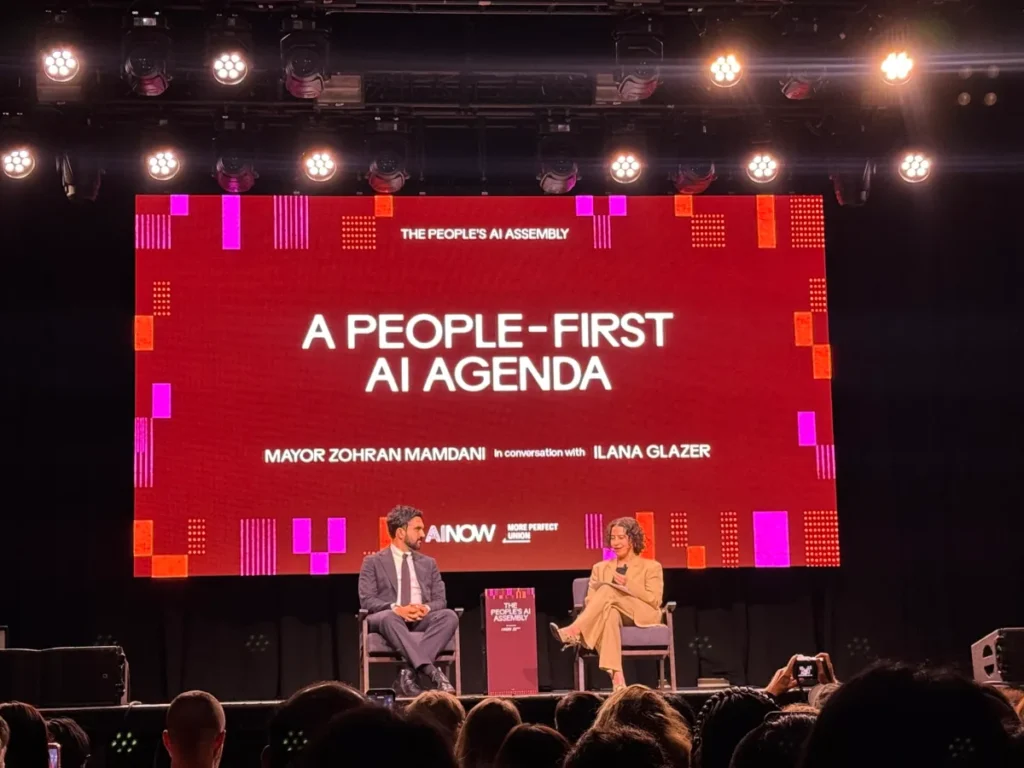
The mayor and activist Ilana Glazer, known for the sitcom “Broad City”, spoke at Webster Hall in Manhattan. Glazer questioned Mamdani about how society should handle the future of AI. He urged the city to reject the idea that the technology is taking over jobs, children’s minds, and personal dignity by force.
This stance comes as the national government does little to control the technology. At The People’s AI Assembly, hosted by the AI Now Institute, Mamdani argued that the rapid spread of AI is not inevitable. He called on public officials to hold companies accountable.
Last month, Mamdani ordered a ban on AI use in elementary and middle schools. Glazer, who is a parent, said the arrival of the technology in classrooms makes her nervous.
“It just makes me nervous. It feels so non-consensual, as though…this has to be in schools. It wasn’t two years ago. Why does it have to be in schools?” she said.
Over the summer, the mayor introduced a policy requiring landlords, brokers, and real estate platforms to clearly disclose when listing photos or videos were made with AI. The rule aims to protect New Yorkers from “house-phishing”, where people are tricked by misleading property images.
Both moves challenge the assumption that schools and the public must accept AI as it arrives.
“Nothing has to be,” Mamdani said at the event. “There’s a creep that comes with this, and there’s an intent to overwhelm that leaves people feeling as if there is simply no option.”
He noted a “reckless adoption of technology without any kind of a reckoning with the limitations of that technology”. He cited the U.S. military’s February strike on a school in Iran that killed more than 150 people, including at least 123 children. Officials involved in the Pentagon’s internal investigation told Bloomberg that overreliance on AI in targeting was one factor in the attack.
“There is this desire to speak about [AI] as if it is infallible, as if it cannot be questioned, as if the only people who can regulate it are the ones who are currently developing it,” Mamdani said. He noted that Facebook made similar arguments back in 2008. “What it really is,’ he continued, “is an attempt to escape any kind of accountability at any level, without also jeopardizing the potential valuation from an IPO.”
Anthropic is expected to debut on the public markets this year, and OpenAI has said it will go public in 2027.
Mamdani criticized the “complete abdication of federal law” regarding AI.
“At a national level, when the conversation is about artificial intelligence, it’s so often framed in this language of an arms race with China, and any of the humanistic concern, we just push to the side in a language of national competition,” the mayor said.
President Donald Trump’s Superintelligence Task Force, announced earlier this month, largely focuses on allowing powerful AI companies to self-regulate, rather than creating new federal restrictions. This comes despite growing fears about AI’s effect on every facet of human life, including warnings from whistleblowers at Anthropic, Google DeepMind, and OpenAI that AI could lead to human extinction.
“As we are looking at what comes after this federal administration, there has to be a very different kind of framework in how we think about AI, talk about AI, the accountability we’re willing to bring forward when it comes to that,” Mamdani said.
What it means
For people making things, the shift means New York is moving away from passive acceptance. Schools are barred from using the tools in younger grades, and real estate listings must label AI-generated images. The mayor’s argument suggests that without federal rules, cities must act as the primary line of defence against unchecked corporate expansion.