Anthropic says its new Slack integration, Claude Tag, is already writing 65 per cent of the code on its own product team.
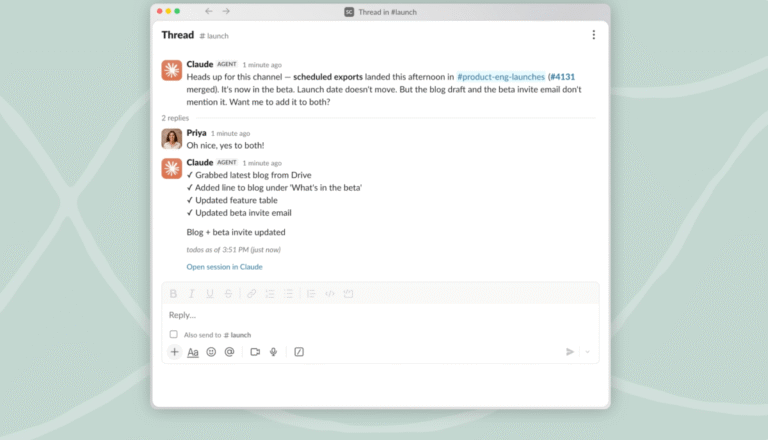
The tool allows administrators to grant the model access to specific channels, tools, and codebases. Once connected, any team member can tag @Claude and assign a task in plain English. The AI breaks the request into steps, executes them using available resources, and posts the results back in a thread.
How it works inside the company
Anthropic describes this as an evolution of the earlier Claude Code feature. The tagging workflow is already standard for the product team, where the internal version handles the majority of coding tasks. Engineering staff use it for development, while other departments apply it to track product metrics, manage support tickets, and diagnose bugs.
One shared brain per channel
Unlike a private one-on-one chat, each Slack channel hosts a single Claude instance that interacts with all members. Everyone sees what the model is working on and can continue a conversation started by another person. Over time, the model builds context by observing activity within the channel. It can also access data from other sources if permissions allow, but it will not share information from private channels.
When ambient mode is active, @Claude proactively surfaces relevant information and follows up on stalled threads or tasks. The system works asynchronously, allowing the model to schedule tasks for itself and track projects over hours or days. Direct messages enable private responses using each user’s personal tools and connectors.
Admin controls and data isolation
For enterprise customers, administrators define exactly which tools and data the model can access in each channel. This creates separate Claude identities for different purposes, ensuring memories remain isolated between teams. A model configured for sales will not share its context with the engineering team. Admins can also set token limits and review a full log of every action, including who triggered it.
Claude Tag is currently in beta for Enterprise and Team customers. It replaces the older “Claude in Slack” application, giving administrators 30 days to migrate. The tool runs on Opus 4.8.
What it means
For teams building software, the shift from individual chats to a shared channel agent changes how work gets done. Instead of asking the same model repeatedly for the same context, the AI retains the team’s collective memory. This reduces repetition and allows the model to act as a persistent resource that monitors progress and handles follow-ups without constant human prompting.