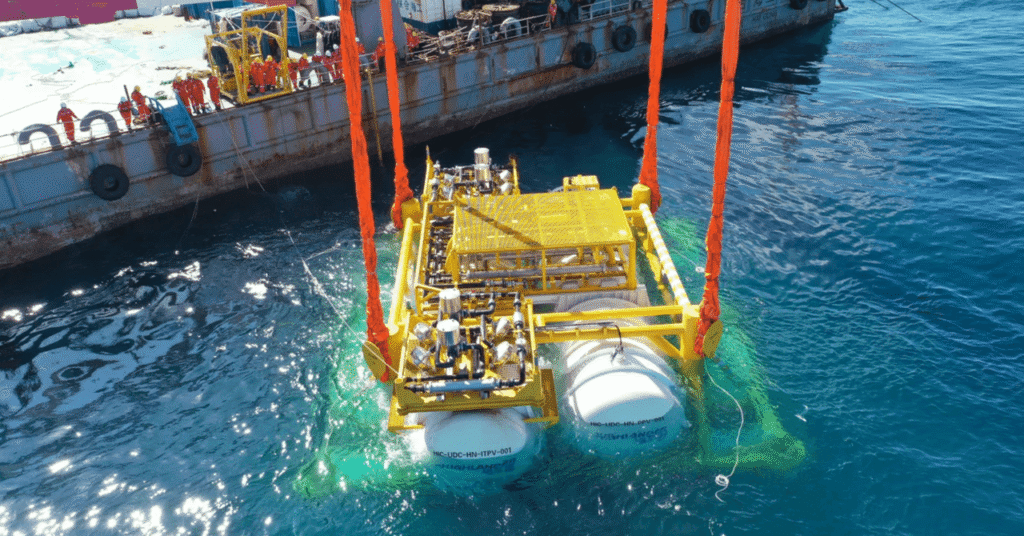
For makers and artists relying on generative models, the infrastructure powering these tools is shifting beneath our feet. China has launched the world’s first wind-powered underwater data centre (UDC), a move that prioritises energy resilience over the fossil-fuel dependency often associated with high-performance computing. Located off the coast of Shanghai, this submerged facility signals a strategic pivot: as artificial intelligence demands more compute, the race is no longer just for speed, but for a secure, green power grid that can sustain the next generation of creative tools without relying on volatile external suppliers.
The engineering behind the dive
This project is a joint venture between private firm HiCloud Technology and state-owned China Communications Construction, backed by an investment of 1.6 billion yuan (roughly $236 million). The complex sits 10 metres deep in the Lin-gang Special Zone, a designated free trade area in Shanghai. Here, seawater acts as a natural coolant, slashing the energy required for thermal management to under 10 per cent of total consumption.
In traditional data centres, air conditioning systems typically devour 40 to 50 per cent of the electricity bill. By contrast, this underwater design achieves a Power Usage Effectiveness (PUE) of no more than 1.15. In industry terms, where 1.0 is the theoretical maximum efficiency, this figure is considered state-of-the-art.
It is worth noting that HiCloud previously opened the world’s first commercial underwater data centre in Hainan in 2023. However, the Shanghai site marks the true milestone as the first to run entirely on offshore wind.
A strategic shift in energy security
Construction finished in mid-October last year. According to government reports, the facility uses more than 95 per cent green electricity. This approach reduces overall energy consumption by 22.8 per cent while eliminating land and water usage entirely.
The initiative underscores a broader geopolitical reality: only 32 countries currently host data centres specialising in artificial intelligence, yet 90 per cent of that global infrastructure is concentrated in just two nations-China and the United States. While the US has scaled back some energy transition investments, Beijing is aggressively reducing fossil fuel dependence to meet climate goals and insulate itself from external supply shocks.
This aligns with a new energy law enacted last year, which mandates minimum consumption targets for clean sources and prioritises renewable energy and hydrogen. Furthermore, as of June 2025, all solar and wind power must be traded via market mechanisms or auctions, phasing out legacy feed-in tariffs to boost investment in clean tech.
Ultimately, this is not merely an environmental project; it is a long-term economic and geopolitical strategy. By securing its own energy supply, China aims to strengthen its technological autonomy and maintain its lead in the global race for the infrastructure required to support future AI advancements.
Key takeaways
- China’s new Shanghai underwater data centre is the first in the world to operate using offshore wind power, marking a significant shift in how AI infrastructure is powered.
- Submerging the facility allows seawater to cool the servers, reducing energy use for air conditioning to under 10 per cent and achieving a PUE of 1.15.
- The project is part of a broader Chinese strategy to secure energy self-sufficiency and reduce reliance on fossil fuels amidst the accelerating demand for AI compute.
- With 90 per cent of global AI data centres concentrated in China and the US, these infrastructure battles are central to global technological competition.