Cantina Security, working with Yeta Labs, has released apex-flash-1. This is an open-weights model trained specifically for vulnerability research. It is a reinforcement learning fine-tune of Z.ai’s GLM-5.3-Flash, released on Hugging Face under the MIT license.
The weights are deployable on vLLM, SGLang, or Transformers, but BF16 requires roughly 640 GB of GPU memory.
What Cantina Built
apex-flash-1 has 321.3B total parameters, per its Hugging Face safetensors metadata. The GLM-5.3-Flash base is a Mixture-of-Experts model with 18B active parameters.
Cantina trained it with GRPO using a rank-256 LoRA plus selective full-parameter training. The data covers 150 tasks built from 50 real vulnerability cases.
Each case appears in 3 variants: guided whitebox, focused whitebox and focused blackbox.
Authorization, identity and scope flaws make up 72% of cases. Accounting and numerical precision bugs add 18%. Time validation, business rules and SSRF cover the rest.
As per the model card on HF, RL rollouts ran inside the Codex agent harness on production-like software and protocol environments.
Benchmark Results
Cantina evaluated 60 tasks from 20 held-out vulnerability cases. Each model ran the set once, with costs estimated from provider pricing.
- apex-flash-1: 40/60 solved (66.7% pass@1), about $2.38
- GLM-5.3-Flash (base): 36/60 solved (60.0%), about $4.56
- Claude Opus 5 High: 43/60 solved (71.7%), about $74.68
Opus solved 3 more tasks but cost about 31x more per run. That is roughly $0.06 per solved task for apex-flash-1 versus $1.74 for Opus. These are company-reported numbers on an internal benchmark.
A Worker Model, Not an Orchestrator
Cantina positions apex-flash-1 as a worker orchestrated by a larger model. The card lists code reading, tool use, exploit development and verification as target skills.
An experimental apex-flash-1-abliterated variant ships with modified refusal behavior. It was not separately evaluated.
Cantina’s rationale is that defenders need capable models they can run and control locally.
How It Compares
| Feature | apex-flash-1 | Aikido Altar-1 | Cisco Foundation-Sec-8B-Reasoning | GLM-5.3-Flash |
|---|---|---|---|---|
| Developer | Cantina Security + Yeta Labs | Aikido Security | Cisco Foundation AI | Z.ai |
| Base model | GLM-5.3-Flash | GLM-5.3 (pruned) | Llama 3.1 8B | Own pretraining |
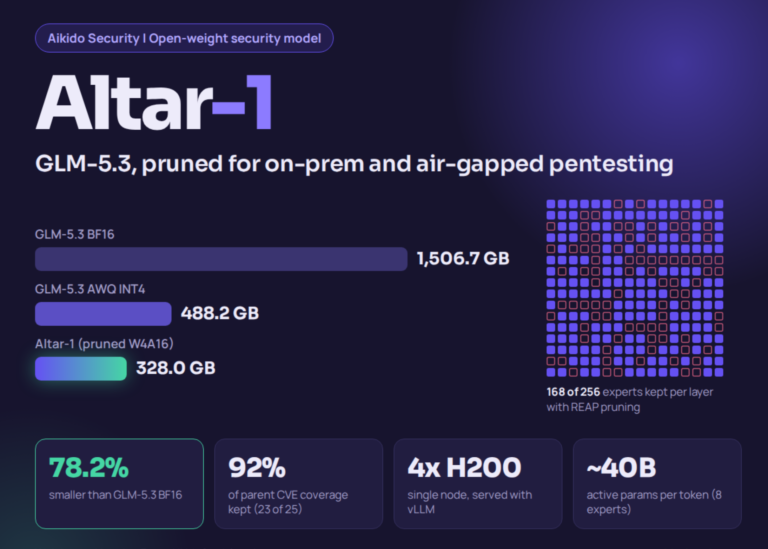
| Size | 321.3B total, BF16 | 328 GB, INT4 (W4A16) | 8B | 320B total, 18B active |
| License | MIT | Inherits GLM-5.3 license | Custom (see NOTICE.md) | MIT |
| Security method | GRPO RL on 50 real vulnerability cases | Expert pruning (REAP) + quantization | Instruction tuning + RLHF on security QA | General-purpose base |
| Primary use | Agentic vuln research worker | Air-gapped autonomous pentesting | SOC triage and threat defense | General coding and agents |
| Hardware | Multi-GPU node (~642 GB BF16 weights) | 4x H200 with vLLM | Single GPU | Multi-GPU node |
| Published security result | 66.7% pass@1, 60 tasks | 60.4% recall, 32-CVE internal set | Cisco-reported security benchmarks | 60.0% on Cantina’s set |
Sources: Cantina, Aikido, Cisco, Hugging Face model cards. © Marktechpost
What it means
For security teams, the immediate value is cost reduction. Running a full benchmark suite with apex-flash-1 costs about $2.38 compared to roughly $74.68 for a comparable high-end API model. The model allows organisations to run vulnerability research in-house on local hardware rather than relying on external cloud services.