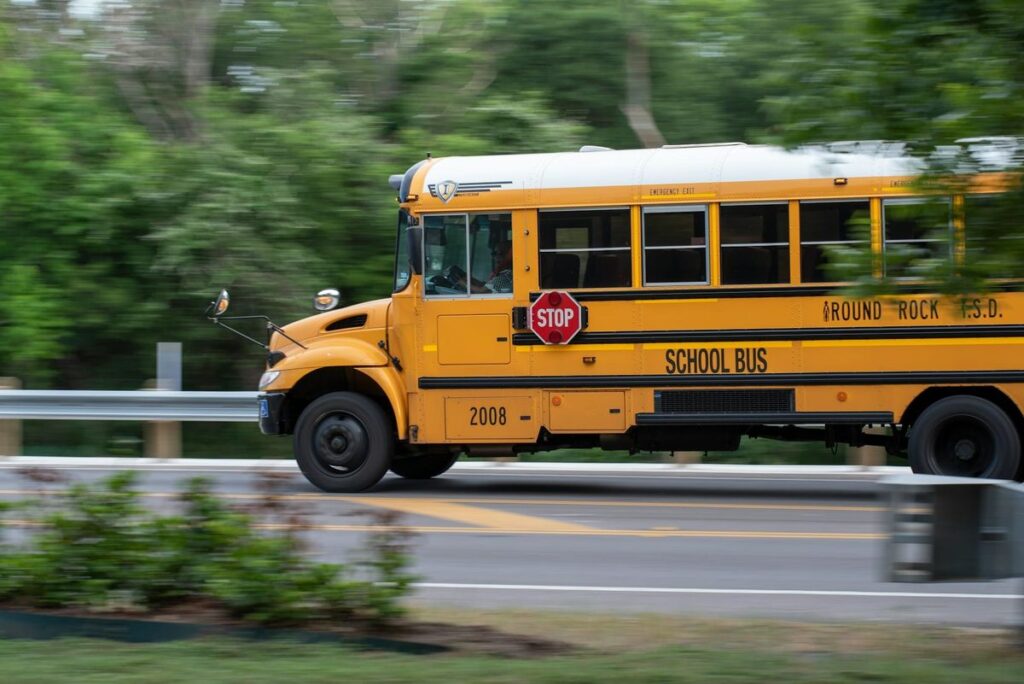

BusPatrol, a company that has installed AI-powered cameras in tens of thousands of school buses around the U.S., now plans to turn those cameras into automatic license plate readers (ALPRs), capturing the location of every vehicle the buses drive past, and give that data to law enforcement, 404 Media has learned. The plan will essentially transform school buses into roaming surveillance vehicles, taking a technology that was originally designed to issue tickets to people illegally passing stopped buses and using it for much wider and general law enforcement, likely without a warrant.
BusPatrol has already taken steps to share the collected data with law enforcement contracting giant Axon, according to leaked BusPatrol documents and a source with knowledge of the plans. Internally, BusPatrol has acknowledged how controversial its plan to collect and share this data is, pointing specifically to concerns about ICE using license plate data, but emphasizes the likely success of selling the angle of protecting children.
“Who would have thought that school buses would be turned into the mass surveillance state?,” Michael Soyfer, an attorney from the Institute for Justice, which has various ongoing ALPR-related lawsuits, told 404 Media in a phone call.
BusPatrol says it has cameras in more than 40,000 buses across 24 states. Ordinarily, those cameras track whether a vehicle illegally passes the school bus while it has its stop signs, or stop arms, extended. BusPatrol then reviews the footage and passes it to the police, who decide if the driver violated the law. BusPatrol then sends the ticket to the driver. For cities and counties, the attraction of BusPatrol is as a revenue generator while also theoretically making cars drive more safely near children. (In April, Bloomberg Businessweek published an investigation showing in one case there was no evidence of a decline in collisions near stopped school buses, and the respective county paid BusPatrol tens of millions of dollars.)
The planned changes would dramatically expand that system to scan the license plates of all vehicles the buses pass, regardless of whether they violated a law, and then give that data to law enforcement, either directly or through contractors the agencies already use. The system would work much like other ALPR systems: BusPatrol’s cameras would take a photo of each car a bus drives past, record the car’s license plate and GPS location, and then law enforcement can query that data, according to one of the documents describing the plans.
Typically, law enforcement agencies query ALPR tools without a warrant. Officials can enter a license plate of a vehicle and see all of the locations that vehicle was spotted at and when, meaning they can map a car-and by extension a person’s-movements, depending on how many cameras are active in the particular area. The Institute for Justice has argued that warrantless use of ALPR systems is unconstitutional, describing similar systems as a “dragnet.”
Often ALPR cameras are in a fixed position. Cameras from Flock, a widespread ALPR system, are typically attached to poles. A roaming ALPR camera inside a school bus, though, will likely cover a larger area, and capture more data, than a stationary camera as the school bus drives around.

There are also concerns about who can access collected ALPR data and for what purpose. Often, ALPRs are pitched as a way for cities to find stolen cars or missing people. But last year, 404 Media revealed that local cops were performing lookups in the national system of Flock on behalf of ICE. That coverage and others, such as police using Flock cameras to track a woman who self-administered an abortion, have triggered a nationwide debate around ALPR cameras, with many communities deciding to rip out the cameras altogether.
BusPatrol is aware of the controversy around ALPR cameras, and particularly of the concern that ICE may gain access to the data, according to the BusPatrol documents viewed by 404 Media. The company anticipates the plans will receive resistance from communities that already have school buses with BusPatrol cameras installed, they say. 404 Media contacted multiple school districts listed as BusPatrol users on the company’s website but did not receive a response. The company also sees potential legal issues if it provides incorrect data.
“Protecting children is one of the highest priorities of any community. In theory, a technology could be narrowly tailored here and not engage in surveillance or collect information except when there appears to be a violation of stop arm laws. But by trying to plug a child-safety technology in to the unethical license plate mass-surveillance ecosystem that lacks societal acceptance and legitimacy, you guarantee that your technology will have problems with acceptance,” Jay Stanley, senior policy analyst at the American Civil Liberties Union’s (ACLU) Speech, Privacy, and Technology Project, told 404 Media in an email. “Leveraging something everybody supports-in this case protecting children-in order to expand mass surveillance is a typical way of trying to get people to accept surveillance, one we’ve seen since 9/11 and before.”
Stanley said that BusPatrol is part of a larger trend: “using AI to scale surveillance for compliance purposes.” He said this will start with laws that he suspects everyone supports, like the stop arm statutes banning people from overtaking stopped school buses. But when AI monitoring tools are extended to other laws, rules, and norms “there’s a real risk that AI will be used to create a hellscape of over-enforcement. We’re already seeing AI used to ticket drivers who are holding cellphones and to monitor workers such as delivery drivers in oppressive minute ways.”
The reason for turning buses into surveillance vehicles is to generate more revenue, according to the source with knowledge of the plans. After GI Partners, an investment firm, invested $300 million in BusPatrol, it has “been pushing the company to find alternate revenue streams,” the source said. 404 Media granted the person anonymity as they weren’t permitted to speak to the press.
404 Media sent BusPatrol a detailed set of questions, including whether BusPatrol is exploring the possibility of sharing ALPR data with Axon or other companies. At first, Kate Spree, senior manager of brand communications at BusPatrol, said in an email “This inquiry is based on a false premise and inaccurate information. BusPatrol does not pool or sell data across communities; student safety program data is used only to support the BusPatrol program in the community where that data was created.”
When 404 Media asked clarifying questions and said that the reporting is based on leaked BusPatrol material, Spree stopped replying to text messages and emails.
GI Partners did not respond to a request for comment.
BusPatrol is already figuring out how to integrate with Axon, the source explained. Axon sells its own ALPR cameras and in 2024 acquired Fusus. Fusus lets law enforcement bring in camera feeds and data from disparate sources into a single interface, and add AI features such as scanning for people wearing certain clothes to live footage.
Axon’s website has a page that says “BusPatrol Works with Axon [Coming in 2025],” and Axon mentioned a partnership with BusPatrol in an April press release, but publicly neither company has said what that partnership means in practice. The source with knowledge of the plan said that originally the Axon partnership was for “full fleetwide realtime camera access,” but the cost was too high. Instead, BusPatrol plans to add an AI accelerator to its school bus devices to facilitate the ALPR feature.
The rollout won’t be immediate, according to the source, with a trial run on one bus currently underway, before increasing to 100 by the end of next month.
The company has also discussed the possibility of providing the collected license plate data to Flock, according to the BusPatrol documents. Flock told 404 Media in an email it does not work with BusPatrol.
ALPR companies often explore ways to expand their fleet of cameras or obtain images from unlikely sources. In August 404 Media reported Flock was looking to integrate with Nexar, a company that makes AI-powered dashcams placed inside peoples’ personal cars. That move would increase the amount of data available to Flock, and by extension, law enforcement agencies that tap into it. Vigilant Solutions and Digital Recognition Network, two ALPR sister companies now owned by Motorola Solutions, have gathered ALPR data through cameras installed in police and repo men’s vehicles.
This month 404 Media reported the FBI wants to buy nationwide access to license plate readers.