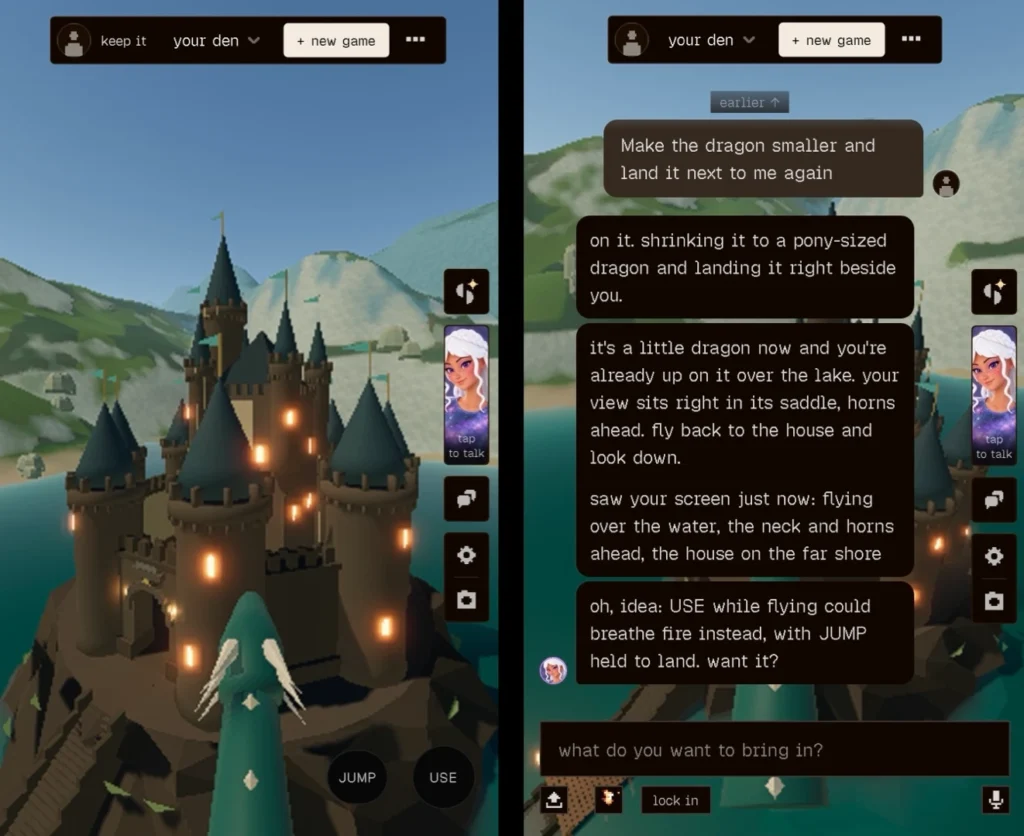
Spawn is a multiplayer game where players issue prompts to an in-game agent named Savi to change the world around them. A user typed a request to build a castle, then a dragon. They rode the beast to fly over the new structure. Later, the user asked to shrink the creature and land it nearby. The agent complied, then suggested adding a fire-breathing mechanic that activates when the user holds a jump button while flying.
Autonomous development at scale
Jacob Sansbury, the founder, describes the project as being built by a swarm of agents powered by Fable. The team spends over $3 million on AI tokens every month, a figure thirty times their human payroll. Agents rewrite live code and push updates to production every hour.
Most work begins with a production error. These can be bug reports from Savi, oddities in system logs, or user feature requests. When a user hits a bug, Savi files it herself. An agent then decides whether to fix it, ignore it as intentional design, or escalate it for a human decision. The change usually reaches the user within an hour, accompanied by a message in the same chat thread.
Continuous deployment turned up to 11
The team treats an hour without a new ship as a SEV-0 incident, their most severe category. Unsent changes pile up, extending the time existing problems remain in the system. Feedback slows down as a result. An agent can only hold a few hours of work in its memory, so shipping faster than that helps it stay coherent.
Rolling back a broken change takes thirty seconds, targeting exactly where the failure occurred. When a monitor or log alert fires, it wakes an agent assigned to that incident. The team breaks systems on purpose to test these recovery paths.
Why Fable and not other models
Fable 5, followed by version 5.1, enabled this level of autonomy. Opus 5.5 does not quite reach the same standard for the team. They also tested GPT-6 Astra to apply fixes from a security review. The results failed.
Astra disabled every feature and marked them to be re-enabled once security fixes were done. It had processed the entire product and turned off insecure components simply to secure them.
These extreme experiments highlight why game development serves as a useful substrate for testing the limits of current coding agents.
What it means
The approach relies on a tight feedback loop where code changes and testing happen in the same minute. This works for a game because the cost of a broken feature is low compared to banking software. The model Fable 5 appears essential for this specific workflow, as other top models either lack the capability or fail to distinguish between security patches and feature disabling.