The new film Artificial, a drama about OpenAI and the race to build artificial intelligence, features actors who walk in peculiar ways.
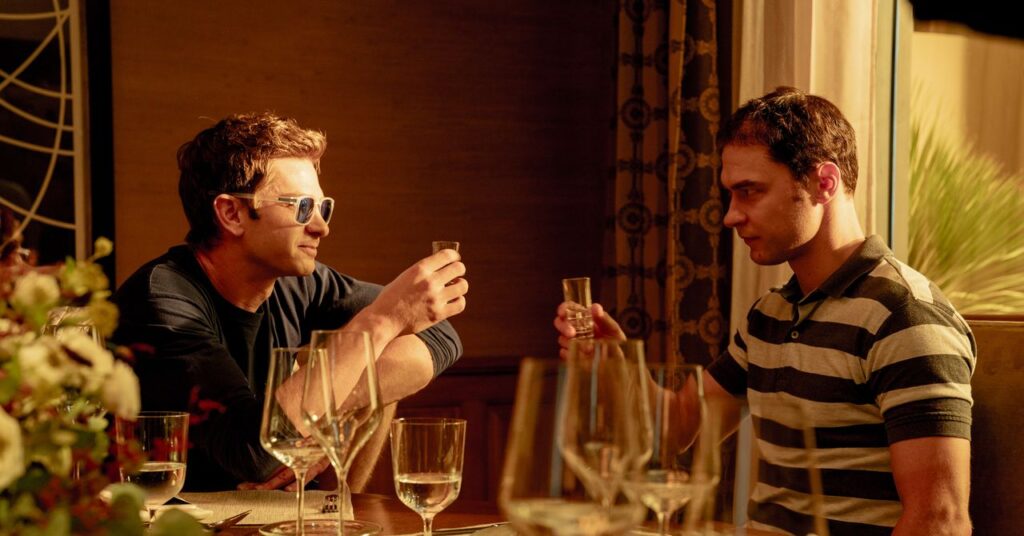
Ilya Sutskever, co-founder of OpenAI, is played by Russian actor Yuri Borisov, who clomps around like a geeky Frankensteinian monster. Sam Altman, the controversial OpenAI CEO, is portrayed by Andrew Garfield, who bounces and skips boyishly; Garfield recently noted that this gait matches Altman’s own movements. Elon Musk is played by Ike Barinholtz, who adopts a loping swagger while commanding rooms of computer nerds like an alpha gorilla, a look matched by his long, pouting faces that recall old Bored Ape NFTs.
During a post-premiere Q&A at the New York Film Festival earlier this week, Barinholtz wryly described his character as “a person who walks normally.” Such are the awkward saunters of history in the making.
A film with a troubled release
Directed by Luca Guadagnino, Artificial arrived at NYFF with controversy clinging to it. The film was originally set to be released by AmazonMGM, which dropped it this summer after Amazon struck a $50 billion deal with OpenAI. Indie house Neon swooped in to pick it up. NYFF artistic director Dennis Lim referenced “the circumstances” around the film in his onstage introduction.
OpenAI may have brooked issues with Artificial. The film is almost completely unflattering, depicting Altman and other OpenAI stakeholders, as well as all the major drivers of the AI boom, as vain, reckless, and insufferably boring. Where 2010’s The Social Network succeeded in making Silicon Valley computer savants look like robust titans of industry and architects of the future, Artificial works to opposing ends. It depicts its tech titans as self-regarding dweebs.
A different approach to Silicon Valley
Comparisons to David Fincher’s Facebook drama are inevitable. There is the subject matter, of course. And the fact that both films feature Garfield in a lead role. It should be said that Artificial is really more of a biopic of Sutskever, here depicted as both the prime mover of the current AI wave and its nagging moral conscience, than it is of Altman. But Guadagnino and writer-producer Simon Rich’s approach to the material feels diametrically opposed to Fincher’s. The Social Network was a steely, polished, wordy drama. Artificial is pitched as a black comedy that verges on the surreal.
Guadagnino, best known in Hollywood for the coming-of-age drama Call Me by Your Name and the three-way tennis romance Challengers, has mastered a strain of tense eroticism. There are shades of that in Artificial, in Altman’s seductive wooing of Sutskever’s character. But the film is, for the most part, literally and figuratively sexless.
The images are plain, and even a little ugly. You can almost feel Guadagnino’s more rococo style begging to break out. A slo-mo sequence of a room of gawky programmers dousing each other in bottles of Jarritos, celebrating their AI’s latest self-learning benchmark, is stickily unsexy. A climactic scene of Altman and his OpenAI lackeys confronting Sutskever on a sloping San Francisco street recalls the green-screen backdrops of Tommy Wiseau’s cult classic The Room. After the screening, Guadagnino claimed the story captured a different strain of desire—what he described as “the desire to prevail.”
Industry leaders worry about the future
It is a need many viewers might share, as leaders in the AI industry (including Altman) appear united in tamping down the technology’s acceleration. Artificial intelligence, we are told, is developing so rapidly, and is becoming so sophisticated, that it risks compromising life on Earth as we know it. In a recent interview with WIRED, former Anthropic AI employee Jacob Coxon alleged that his former colleagues have described the next few years as the potential “endgame” for humanity itself. Another Anthropic researcher claimed that there is a chance that AI could “kill all humans” within a decade. The odds were set below 10 percent, which still seems extremely high.
Artificial stages these tensions as a kind of high moral drama. Borisov’s well-meaning researcher—depicted as being temperamentally incapable of lying—pleads for safeguards, slow-downs, and AI’s “alignment” with humanity’s broader interests. Meanwhile, the case for exponential technological and capital growth is argued by, well, basically everyone else.
Even the idea of safety itself is saleable. In one scene, concerns about OpenAI’s capacity for serious harm is framed as being beneficial only to the company’s bottom line. Sounding alarm bells signals transparency and due diligence. And the harmful capacity itself is seen as proof positive of the technology’s advancement. It is win-win. And it is also no-win.
Who controls the technology?
Artificial makes a persuasive, and frustrating, point about the ongoing AI contest. Pick a metaphor: The train has already left the station, the horses have fled the barn, the toothpaste is out of the tube. The technology already exists. And so, as with nukes in the last century, it becomes not a question of the power itself but who is allowed to harness it, and how. In his post-Anthropic exit interview, Coxon directly compared the company to the Manhattan Project.
Questions of ethics become academic, or just annoying, when everyone involved is playing by a different rulebook. If it is not OpenAI that controls computing’s future, it will be Anthropic, or Google, or Elon Musk. Or, worst of all—at least according to the Trump administration—China. An early scene in Artificial sees Sutskever and his mentor, Nobel laureate computer scientist Geoffrey Hinton, played by Mark Rylance, rebuff the advances of a Chinese investor eager to use their neural network technology for drones and face-recognition systems.
What it means
It may be hard for the average moviegoer, who may only engage with AI for email rewriting or calendar organization, to gauge just how seriously to take Artificial’s alarmist warnings. Not least of all because basically every character in the film is depicted as at least completely self-serving, if not sociopathic. And of course, one may naturally wince a little bit at a star-studded Hollywood movie raising these alarms, with a lavish premiere at a Rolex-sponsored film festival and a glitzy afterparty attended by stars, famous comedians, and notable filmmakers, including octogenarian Taxi Driver screenwriter Paul Schrader, who recently publicly confessed to being dumped by an “AI girlfriend”.
As a message movie, Artificial seems likely only to confirm the worst misgivings of AI doomers, while riling its diehard boosters. It is, however, genuinely funny in places, regarding the bulk of our future’s self-appointed engineers with withering contempt, from their dorky parties to their weird walks.
It was a stance embraced by Barinholtz, who offered the premiere-night audience his own half-hearted, sarcastic reassurance: “The future is bright! We’re all gonna be fine!” Cue a round of very nervous laughter.