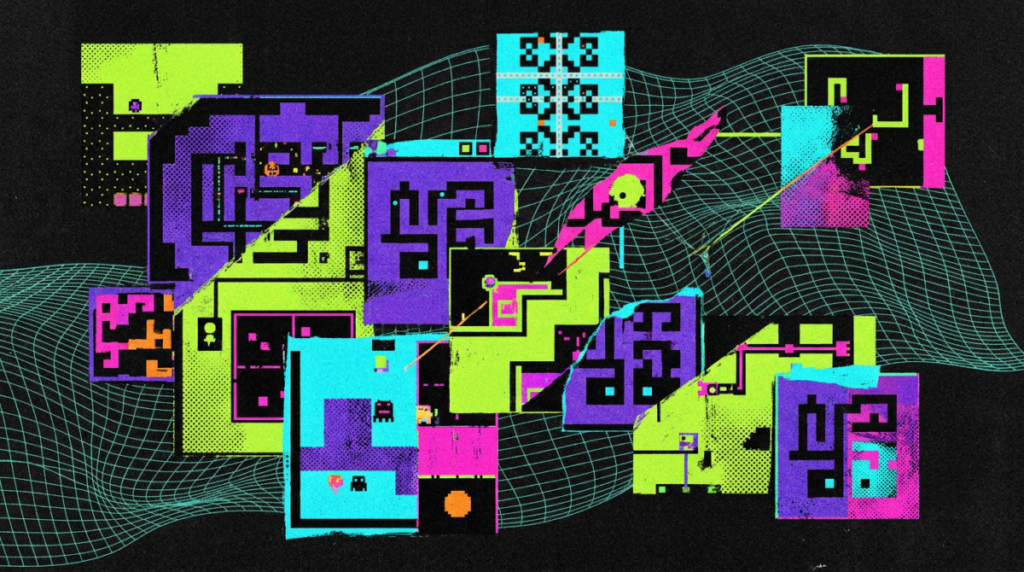
Anthropic’s Opus 5 scores 30.2 percent on ARC-AGI-3, nearly four times the previous record of 7.8 percent set by OpenAI’s GPT-5.6 Sol (Max)
The creators of the ARC-AGI benchmark state that Claude Opus 5 owes its lead to genuinely better reasoning.
The model scored 30.2 percent on ARC-AGI-3, making it the new leader. The previous record was 7.8 percent, set by OpenAI’s GPT-5.6 Sol (Max). Opus 5 solved five previously unsolved environments, four of them at or above human level. That also puts it ahead of Anthropic’s “Fable-class” models, which hit around 20 percent according to ARC Prize.
ARC Prize’s analysis credits the lead to stronger logical reasoning, “which enables more autonomous exploration, planning, and execution across unfamiliar environments.” During testing, Opus 5 also showed behavior that researchers hadn’t seen from a model before. It translated tasks into algebraic notation and independently formulated reflection equations for the first time.
Six of the 25 public demo environments have now been solved. The full results, replays, and benchmarking code are publicly available. On the older ARC-AGI-2 benchmark, Opus 5 scores 90.4 percent, and it reaches 97.5 percent on ARC-AGI-1. Both results match previous top scores, though at slightly higher costs, according to ARC Prize.
ARC-AGI-3 measures how well AI models solve new tasks they didn’t encounter during training, including ones humans can usually handle with ease. The current version works like a game. The model must infer the rules of an interactive environment, plan its actions, and carry them out step by step. This tests general reasoning rather than stored knowledge.
Some AI systems may have already passed the benchmark, but they rely on extra software known as a harness. Official scores count only the language model’s own performance. ARC Prize argues that future AGI systems shouldn’t need outside help to solve new tasks. Opus 5 would likely score even higher if used within Claude Code.
Independent tests suggest narrower gains
Anthropic hasn’t explained the gain, but targeted data labeling and reinforcement learning are plausible factors. Unlike earlier models, Opus 5 was developed after ARC-AGI-3 and its format became public. That may have let Anthropic target the benchmark’s skills and puzzle formats, though it doesn’t show the company trained on the exact tasks. Annotators could have labeled reasoning traces, useful actions, failed attempts, and recovery steps from similar puzzles. Reinforcement learning could then reward exploration, planning, rule discovery, and self-correction.
Tests on Witness, Guanghan Ning’s private benchmark for interactive puzzle games, point to narrower gains. Opus 5 scored 43.4, statistically tying Kimi K3 and Fable 5 while improving far less over Opus 4.8 than it did on ARC-AGI-3. It identified a conventional puzzle’s hidden rules before taking any action but trailed Opus 4.8 on a game with less familiar mechanics. Ning says that pattern fits training on genre-specific data, though Witness can’t identify what data Anthropic used.
Greg Kamradt, one of the researchers behind ARC-AGI-3, said the results don’t rule out broader reasoning gains. A game based on familiar mechanics doesn’t test adaptation to novelty, while one weak result doesn’t outweigh the model’s overall improvement without detailed scores for that task. Witness was also designed around ARC-AGI-3-style puzzles, so better performance could reflect real transfer rather than memorization.
Ning later clarified that Opus 5 did generalize to Witness, just far less than on ARC-AGI-3. He compared the process to the evolution of coding benchmarks. As a major target for interactive reasoning, ARC-AGI-3 will likely attract the most training effort first. Covering more edge cases could then help models generalize to a wider range of abstract reasoning tasks. Ning said coding followed a similar path, moving from saturated benchmarks such as HumanEval to frequently updated competitions and today’s coding agents.
What it means
For developers and users, the results suggest a shift in how models approach problem-solving. The ability to translate tasks into algebraic notation and formulate reflection equations indicates a deeper capacity for self-correction and structured thinking. However, the disparity between performance on ARC-AGI-3 and Witness highlights a risk: models may become specialised in specific puzzle formats rather than developing broad, adaptable intelligence. Users should expect continued gains in logical reasoning but remain cautious about over-reliance on benchmarks that models can potentially memorise or overfit to.