Amazon Web Services released an open-source decision model inspired by TypeSafe’s Jev. AI developers are increasingly looking for intelligence suited to computer automation rather than frontier large language models.
Strands Decider 2B
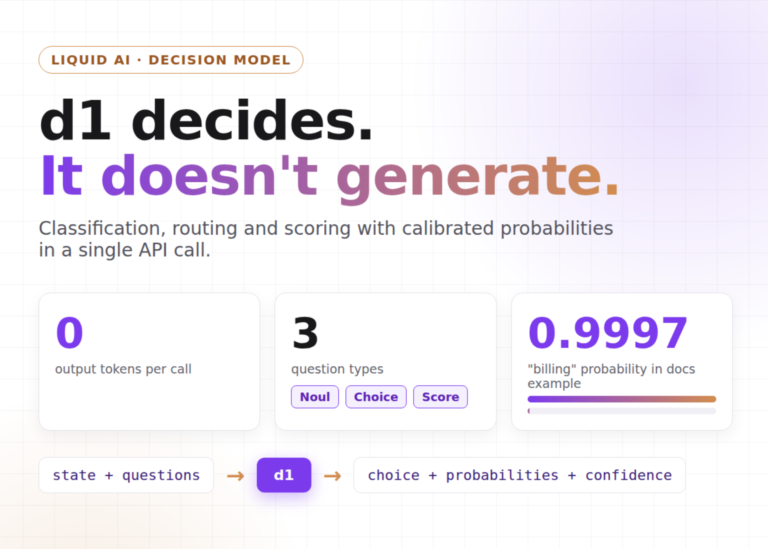
Amazon’s Strands Decider 2B arrived the same week OpenAI announced a similar product. This high-speed, low-cost tool sorts between pre-decided options and delivers a measure of confidence in the choice. The model is fully open-sourced, available now, and small enough to run locally.
Amazon distinguished engineer Marc Brooker developed the project after seeing Jev and attempting to build his own version. The homebrew project was successful enough to briefly reach the top spot on the Jevbench ranking for models of its size. Amazon engineers then cleaned it up and released it as an offering from Strands Labs. This organisation develops new tools and protocols for deploying AI agents.
Brooker says the need for a tool like this emerged in conversations with AWS customers. Their agentic workflows did not always require the capability or cost of a fully-featured large language model at every moment.
“What originally piqued my interest in this class of models was that they make a perfect decider for a workflow step,” Brooker told TechCrunch. “What is the next thing for me to do here, based on where I am?” He said it offers customers “a workflow step that can be structured in a way that is more reliable, thanks to the confidence scores, thanks to the closed domain of answers, [and is] lower latency, potentially lower cost.”
Like other decision models, Strands Decider is built on the “torso” of a large language model. In this case, that is Qen3.5-2B. Instead of generating text, it delivers calibrated choices. TypeSafe named their model Jev after the economist William Stanley Jevons. They hoped to invoke his theory that the falling cost of something, like computer intelligence, can actually increase its demand.
The fact that dozens of similar models have been produced by researchers since TypeSafe debuted its idea shows the wide interest. It also raises the question of how valuable they can be. Brooker suggests that the challenge will be in optimising the model’s speedy decision-making without compromising its intelligence.
“There is a very careful balance to be found where you want to push its performance on accuracy and calibration on these kinds of tasks, without degrading its performance on understanding different languages, on having the kind of knowledge it has, which is what makes it general purpose and interesting and useful,” he told TechCrunch.
Still, he does not necessarily expect the frontier labs to dominate the space. With smaller markets, the cost to build something interesting is in the hundreds or thousands of dollars.
For their part, TypeSafe executives say they are keeping their heads down and improving future models.
“I get that people think it’s a gold rush, but they might be underestimating the difficulty of making the models actually smart,” CEO and founder Diogo Almeida told TechCrunch. He said that for now, he did not see real competition for his company emerging yet.
“The current batch seems more like ML people wanting to implement a cool architecture than a team deeply dedicated to making intelligence useful.”
What it means
Developers building automated workflows now have a smaller, cheaper option for making choices. They do not need to call a massive, expensive model to decide the next step in a process. This allows for faster responses and lower bills, provided the specific decision logic is already defined within the system.