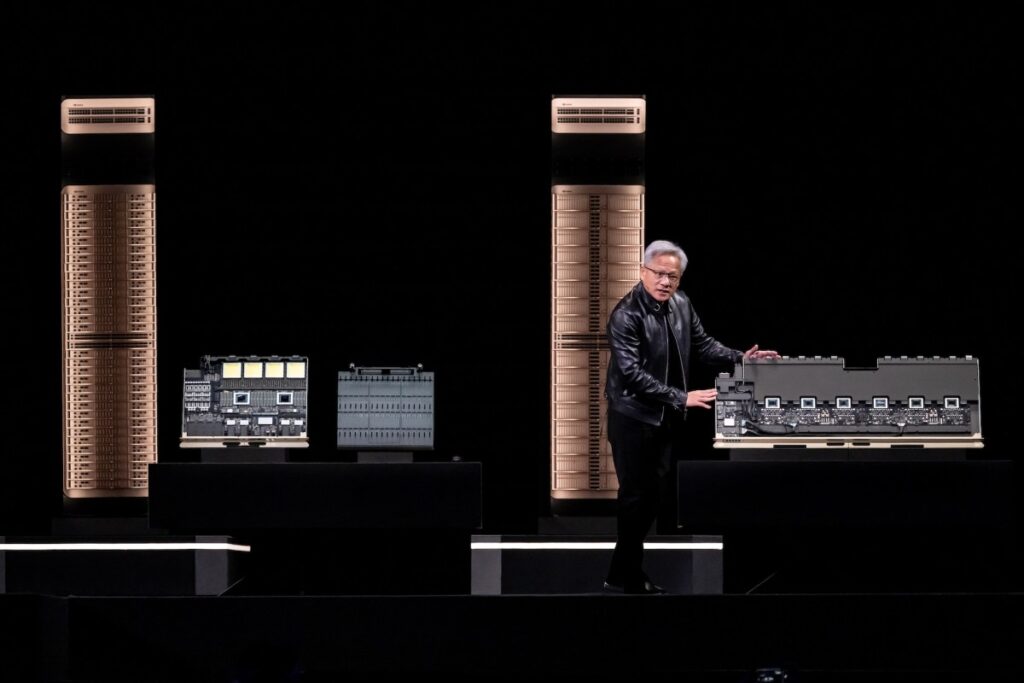
Amazon and Nvidia have signed a deal to supply another 2 million GPU chips to Amazon’s data centers.
The hardware includes Nvidia Blackwell Ultra, Rubin, and Rubin Ultra units. Delivery to Amazon Web Services infrastructure is scheduled for 2027 and 2028.
The agreement was announced during Nvidia’s quarterly earnings call. It follows a pact from just five months ago where Amazon committed to deploying more than 1 million Nvidia GPUs starting this year. Nvidia stated that current demand has exceeded those initial expectations.
Neither party disclosed financial terms. However, based on unit costs, the transaction is worth tens of billions of dollars.
This move is significant because it expands beyond a simple purchase. It occurs while Amazon simultaneously invests in its own AI chips. Nvidia confirmed that its networking hardware, open models, CPUs, data processing software, and robotics platform will also be integrated across AWS.
Both companies cited “surging demand” from startups, enterprises, AI labs, and governments as the driver for closer cooperation.
Amazon is ramping up its own silicon efforts, particularly with CPUs. Peter DeSantis, Amazon’s AI chief, noted that AWS is in talks to sell its Trainium chips to other companies. These chips serve as a direct alternative to Nvidia’s H100 or Blackwell units for deep learning tasks. Amazon’s Arm-built Graviton CPU is also positioned as a challenger to traditional server chips from Intel and AMD.
Amazon reported that its custom chip business crossed a $25 billion annualized revenue run rate. This growth was driven by $225 billion in total commitments from AI labs including Anthropic and OpenAI.
Despite Amazon’s progress, Nvidia remains the dominant force in AI chips.
The 2 million GPU chips arrive in AWS starting the third quarter. Nvidia CFO Colette Kress added that the company plans to ship an unspecified number of Vera CPUs. Some will be integrated with Rubin, others standalone.
Nvidia CEO Jensen Huang previously identified a “brand new $200 billion TAM” for the company regarding these CPUs.
Kress stated that Nvidia expects Vera to be deployed by every major hyperscaler, neocloud, AI lab, and system OEM. Shipments are already underway to lead partners including Oracle and SpaceXAI.
The partnership extends to Amazon’s warehouse robots and enterprise offerings.
Amazon plans to adopt Nvidia’s full physical AI stack to power its robot fleet. This includes Omniverse, Cosmos, Isaac, and Jetson. Nvidia recently introduced a new version of Jetson designed as a more accessible robotics computer for entry-level edge AI.
On the enterprise side, AWS will serve Nvidia’s Nemotron family of open models on Amazon Bedrock and SageMaker.
Nvidia reported sales of $96.2 billion for the second quarter, beating analyst estimates. Data center revenue accounted for the majority of sales at $89 billion, an increase of 117% from a year ago.
The company expects revenue to reach $108 billion in the third quarter. This figure will include sales from the next-gen Rubin GPUs, which began production shipments this quarter. Investors are watching these initial sales for signs that demand will continue into Nvidia’s next generation of hardware.
Nvidia has committed $279 billion to secure supply and manufacturing capacity for current and future data-center projects. This is a substantial increase from $119 billion last quarter. The commitment includes $92 billion in projected spending for the rest of the fiscal year and another $87 billion in fiscal year 2028.
“The thing that matters for the industry is that AI is now doing productive and useful work,” Huang said during the call. “AI is generating profitable tokens… If we had more compute, we could generate more profitable tokens, which results in more profit for all of the services. This is the exact phase where we’re at, which is the reason why everybody’s leaning in.”
Investors will watch to see if additional compute translates into additional profits as AI companies pour hundreds of billions of dollars into infrastructure.
What it means
For people building AI applications, the immediate effect is access to more powerful hardware. The shift from 1 million to 3 million GPUs per cycle means larger models can be trained and run more efficiently. Startups and labs can scale operations without waiting for hardware availability. However, the competition from Amazon’s own chips means buyers will have options, though Nvidia currently holds the lead in performance.