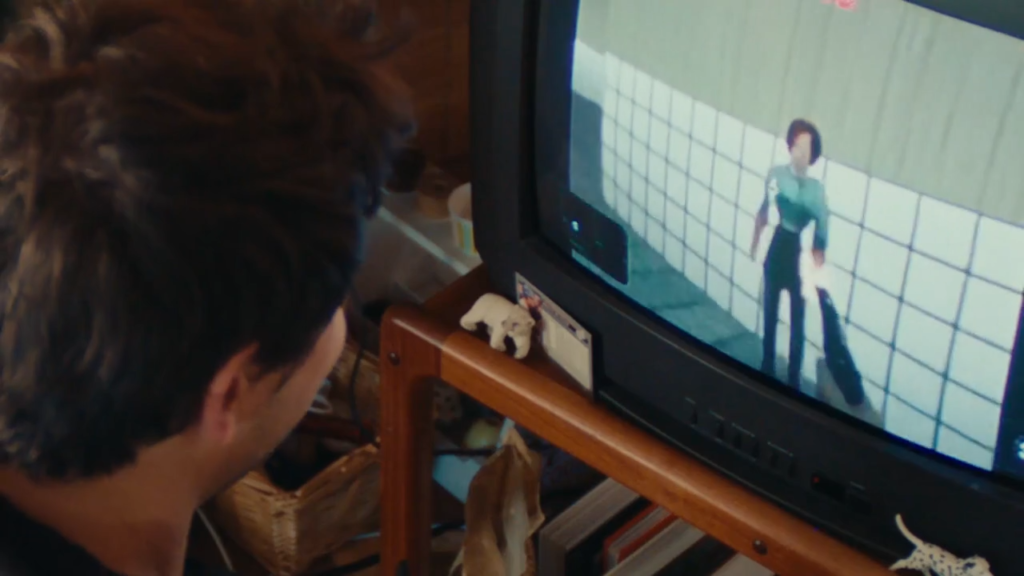
Agora-1 turns the N64 classic GoldenEye into a playable AI simulation for four players
Key Takeaways
- AI lab Odyssey has released Agora-1, enabling up to four players to interact simultaneously in an AI-generated GoldenEye environment.
- Agora-1 separates simulation and rendering: one model continuously calculates the shared game state, while a second renders individual perspectives for each player in real time.
- Odyssey also introduced Starchild-1, an interactive audio-video world model that generates synchronized visuals and sound while responding to ongoing text input. The company sees future uses for both technologies in AI agent training and collaborative robotics.
Agora-1 is one of the first multi-agent world simulations. Until now, world models were mostly limited to a single active player. Agora matches up to four players into a shared deathmatch simulation where everyone interacts with the same generated world. Everything they see is created in real time by Agora-1. The model acts as a learned game engine.
Unlike video generators such as OpenAI‘s Sora or Google’s Veo 3, Agora-1 doesn’t spit out a fixed clip. Instead, it continuously simulates a game state and renders a separate perspective for each player. Odyssey splits this into two parts: simulation and rendering. One model learns from the game’s internal state how the world changes based on player actions.
A second, diffusion-based model learns to turn that shared state into visuals. Because the state is managed explicitly, Agora-1 can also generate new levels without losing the source game’s mechanics.
Earlier multi-agent approaches like Multiverse or Solaris struggled mainly when players lost sight of each other, according to Odyssey. Agora-1 aims to deliver consistent views of the same world from multiple angles.
Starchild-1 adds audio and text interaction
Odyssey also introduced a sister model called Starchild-1. The startup describes it as an interactive audio-video world model that generates synchronized visuals and sound while responding to ongoing text input. It runs on modern hardware at up to 24 frames per second. Unlike Agora-1, Starchild-1 focuses on a single user – but adds speech and ambient audio. There’s no public demo yet, just video samples and a technical paper.
Google’s Genie 3 is currently the best-known competitor among world models. It produces more visually impressive environments but only supports a single user. Veo 3 and Sora 2, meanwhile, generate short, self-contained videos with no control during playback.
Agora-1 is playable as an early research preview on the Odyssey website. The team, led by CEO Oliver Cameron and CTO Jeff Hawke, also sees uses in collaborative robotics where multiple robots need to reason together about actions and space, and in training AI agents inside fully simulated environments.