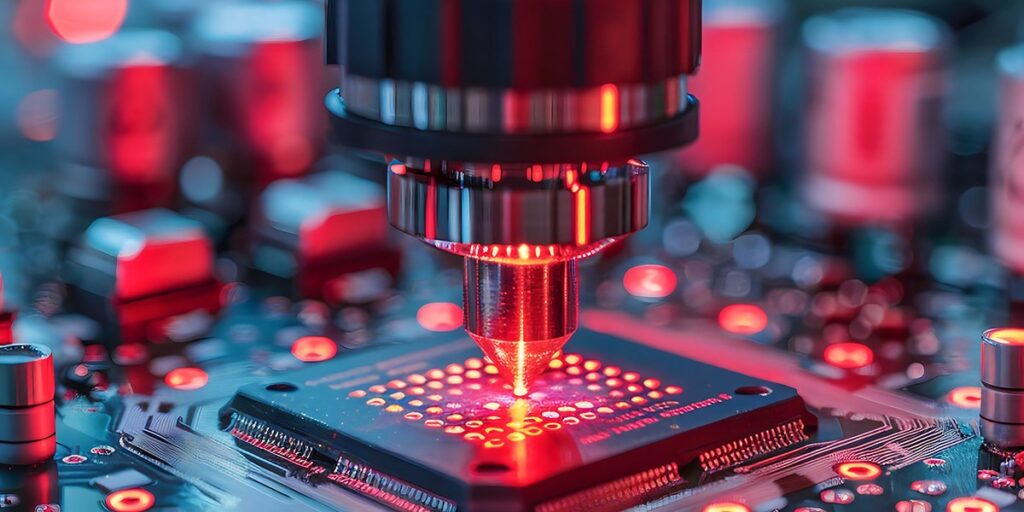
AI systems now require materials that withstand extreme heat, aggressive plasma, and higher voltages to function reliably.
Most discussions about artificial intelligence focus on algorithms, computing power, or the cost of building new data centres. However, these advances rely on a foundation of materials science. Every generation of AI demands more processing power and memory while requiring greater energy efficiency. As computing performance grows, the physical demands on the systems that run it increase accordingly.
Gains depend not only on chip design but on the materials that allow hardware to perform under harsh conditions. As semiconductors and data centre infrastructure push physical limits, advanced materials are no longer just supporting innovation; they define what is possible.
Performance first
Advanced materials solve performance challenges. As AI raises the bar, these challenges become more demanding.
Manufacturing a semiconductor chip today requires thousands of tightly controlled process steps with almost no room for error. Tiny variations in temperature or chemical instability can create defects that reduce yield and drive up manufacturing costs. With every new generation of chips, manufacturers seek materials that deliver greater purity and higher resistance to chemicals and plasma. They also need better stability under increasingly harsh operating conditions.
These are familiar engineering challenges pushed to new extremes. Continuous advances in polymers, elastomers, specialty fluids, and other advanced materials make each new generation of technology possible.
For materials companies, the goal is not to reinvent semiconductor manufacturing but to ensure the materials supporting the industry evolve alongside it. This principle applies beyond the fabrication floor. As AI workloads become more demanding, the physical infrastructure powering them is evolving rapidly.
Increasing computing density is transforming data centre design. This drives the need for more sophisticated thermal management, higher-voltage power architectures, increased data storage, and faster, more reliable data transmission. Every part of the system is under greater pressure, from cooling and power management to critical electronic components like connectors, capacitors, and hard disk drives.
At Syensqo, the company is building on expertise in electronic and electrical components alongside insights from other markets to meet these emerging needs.
For example, as data centres shift to higher-voltage architectures and greater power density, many of the materials challenges mirror those of electric vehicles. Fluid-circulation know-how from semiconductor and automotive coolant systems can be adapted to direct liquid-cooling designs for AI servers. By transferring knowledge across markets, the company accelerates new power and thermal management solutions while supporting the reliability required by next-generation AI infrastructure.
Whether talking about semiconductor fabrication or hyperscale server farms, the challenge for materials science companies is the same: enabling greater performance without compromising reliability.
A new definition of what performance means
While performance remains the first priority, the way performance is defined is changing.
In addition to meeting the increasingly demanding technical requirements of next-generation semiconductors and data centres, there is now an expectation that these materials are developed and manufactured more responsibly.
Perfluoroelastomers, for example, are used to seal semiconductor manufacturing equipment. These materials operate under extreme temperatures, aggressive plasma, and highly reactive chemicals.
To make the process more sustainable, at Syensqo, the next generation of perfluoroelastomers use a fluorosurfactant-free manufacturing process. The goal was to make a better-performing material produced in a better way. This ensures manufacturers no longer have to choose between higher performance and a more responsible way of producing the materials that enable it.
This approach reflects a broader reality across the industry.
New materials are not adopted simply because they are new. Qualification can take years, and manufacturers only make changes when a material solves a genuine engineering challenge or enables new technology.
Performance remains the price of entry. The difference today is that the definition of performance has expanded. Success increasingly depends on delivering technical excellence through more responsible manufacturing from the outset.
Accelerating the pace of discovery
As the performance bar rises, the way innovation must evolve with it.
Developing advanced materials has traditionally involved a lengthy process of hypothesis, synthesis, testing, and iteration. While this process remains unchanged, new digital tools are helping researchers move through these cycles faster. By helping researchers identify the most promising candidates earlier, AI can reduce the number of physical experiments required and accelerate the earliest stages of materials discovery.
AI is not replacing scientific expertise. It is helping scientists apply that expertise more effectively, allowing them to spend less time searching for answers and more time solving the industry’s toughest challenges.
At Syensqo, the company is putting this approach into practice through the use of several AI tools, including the Microsoft Discovery platform. These tools help researchers identify and evaluate promising molecular candidates for next-generation heat transfer fluids used in semiconductor manufacturing and data centres.
AI helps researchers rapidly identify and evaluate promising molecular candidates based on the properties they need to achieve. This allows the company to focus laboratory work where it has the greatest potential to deliver results. The result is accelerated discovery and reduced time needed to turn promising materials into solutions customers can qualify and deploy.
The journey from laboratory discovery to a qualified material will always require scientific expertise, rigorous testing, and close collaboration with customers. But by accelerating the earliest stages of discovery, AI can help materials innovation keep pace with the evolving needs of industries such as semiconductors, electronics, and data centres.
Progress is earned
The future of artificial intelligence will depend on better algorithms, more powerful chips, and larger computing infrastructure. But sustaining that progress will also require advances in the materials that make those technologies possible.
Whether in semiconductor manufacturing or AI infrastructure, progress is earned. Every new generation of technologies raises the bar, and every new material must prove it can deliver the performance, reliability, and efficiency needed before it earns its place.
For materials companies, that remains both the challenge and the opportunity.
This content was produced by Syensqo. It was not written by MIT Technology Review’s editorial staff.