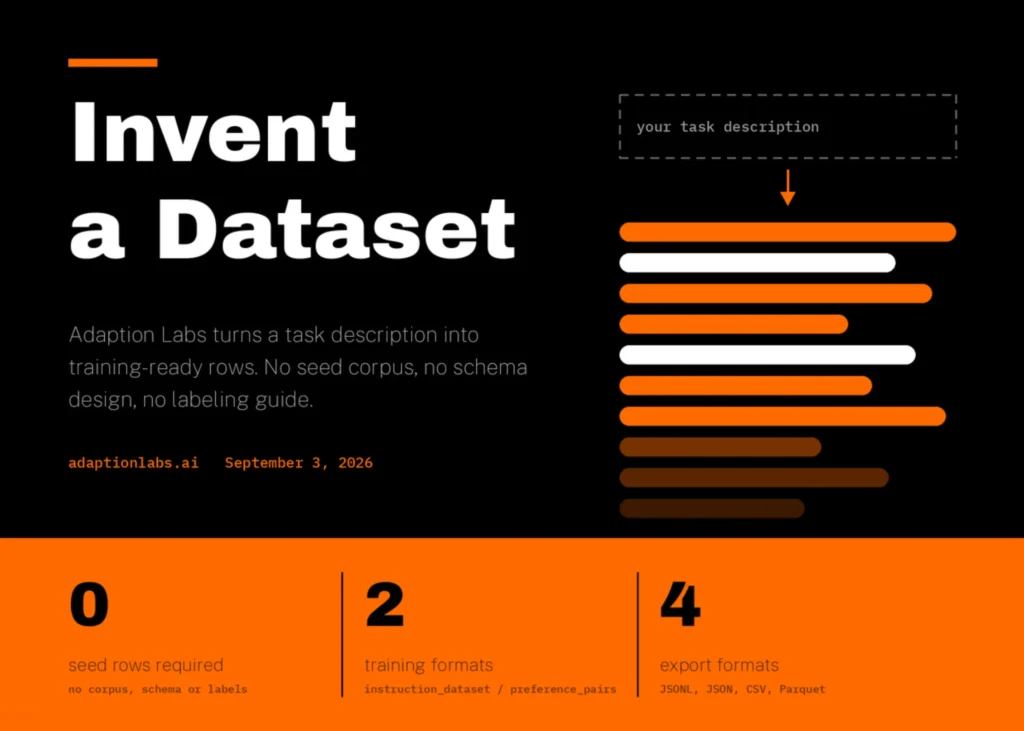
Adaption Labs has launched Invent a Dataset, a feature that creates structured training data from a simple description of desired model behaviour. The tool does not require a seed corpus, a predefined schema, or a labeling guide.
The service is live within the Adaption app and accessible via the Python SDK and REST API. Users can download generated rows as JSONL, JSON, CSV, or Parquet files. These artifacts remain portable for training on any infrastructure, though the generation process itself runs on Adaption’s hosted platform and consumes credits. There is currently no option for self-hosted generation.
The problem being targeted
Typical dataset workflows begin with existing data. Teams then spend weeks labeling, filtering, and reshaping it to approximate the target task. Adaption argues that this approach caps model quality at how closely the available data matches the intended behaviour. For proprietary and specialised tasks, the relevant signal usually sits in internal systems, unstructured text, or workflow logs. It rarely converts cleanly into a focused training set.
The research team also draws a line against existing synthetic-data tooling. Those tools automate generation after a human has already defined the schema, task distribution, and generation strategy. Invent a Dataset starts one level earlier, at the behaviour itself.
How the API works
The mechanics are documented and concrete. A single call to datasets.invent creates the dataset and starts generation, returning immediately with status running. You then poll datasets.get until the status reads succeeded or failed, and download the rows.
Domain codes are the primary control. You fetch current codes with datasets.invent_domains rather than hardcoding them. You then pass values such as medical, optionally narrowed by qualified subdomain codes such as medical.symptoms_diagnosis. At least one domain or subdomain is required. Multiple domains contribute to the same run. A domain passed without subdomains draws from its full scope.
Two output formats are supported. instruction_dataset is the default and produces prompt-completion pairs for supervised fine-tuning. preference_pairs produces chosen and rejected completions for preference-based training such as DPO.
Three parameters matter for production use. estimate=True prices the exact request and returns estimated versus available credits without creating or charging anything. prompt accepts up to 10,000 characters to steer what the rows are actually about. idempotency_key accepts up to 255 characters and makes network retries safe by returning the original dataset instead of launching a second run. Row counts are subject to a per-launch limit set by your plan.
Language and locale expansion
language_expansion runs in two modes. translate produces a new row variant for each target language. localize produces a variant for each country and language pair, using locale-specific wording rather than direct translation. A sample_rate between 0.01 and 1 controls what fraction of invented rows gets expanded, and credits are billed on the expanded output row count, not the original. Unsupported codes return a 400 with a sample of valid values.
The zero-data loop
Invent a Dataset is the first half of a loop. The dataset ID passes directly to autoscientist.create, which co-optimizes the data and the training recipe against your objective. AutoScientist launched in May 2026 and is the training-side counterpart to the Adaptive Data pillar.
Adaption reports that AutoScientist beats training configured by its own research staff, by an average of 35%. Win rates moved from 48% to 64%. Those figures come from in-house domain-specialized evaluations across eight verticals. Dataset sizes ranged from 5,000 to 100,000 rows, on architectures offered for fine-tuning by Together AI.
What it means
For teams building models, this removes the initial friction of gathering and cleaning raw data. Instead of spending time curating a corpus, you define the task and let the system generate the examples. The workflow then hands the resulting dataset directly to AutoScientist, which adjusts the training recipe to match the data. This intent-to-trained-model loop aims to reduce the manual configuration required to reach a working model.