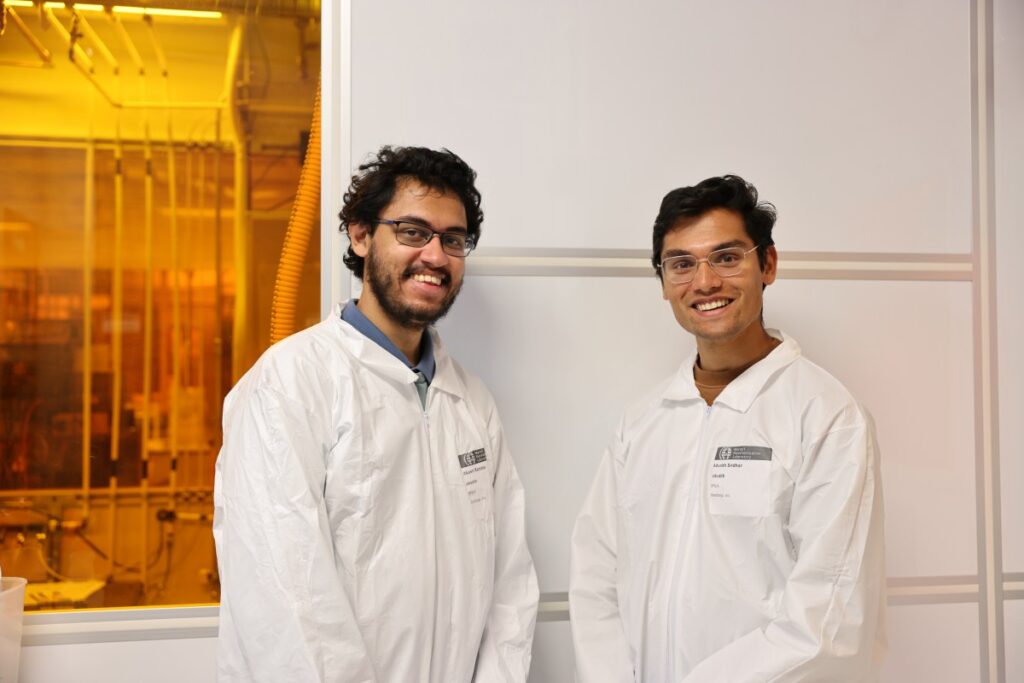
Discovered Materials, a San Francisco startup founded in the spring of 2026, has announced a $1 million challenge to solve five specific problems in materials science. The company, which uses AI to identify new substances for advanced chips, is offering this prize to test whether frontier models can handle the complex physics of materials.
While large AI models have recently solved difficult mathematics problems and made progress in biology, they have struggled with materials. Advaith Sridhar, co-founder of Discovered Materials and part of Y Combinator’s spring 2026 batch, noted the difficulty in defining these tasks.
“It’s more difficult to specify problems clearly in materials science because it’s not like math, where you have a very specific definition and can get to a yes or no,” Sridhar said. “We came to this discussion, wondering, what are the grand challenges in this field? How do we know AI is making progress?”
Because materials science lacks an equivalent to the Millennium Prize Problems, the company asked an advisory group of academics at leading global universities to define five open questions. The total prize pool is $1 million.
The five challenges
- A theory to explain cuprate superconductivity, or the ability of certain materials to have zero electrical resistance at ultra-low temperatures.
- A numerical method to predict the structures of interfaces between silicon and silicon dioxide, a material combination found in almost all semiconductors.
- A numerical method to map grain structure to thermal properties, enabling the design of better heat dissipation materials.
- A theory to predict why shining light on materials can change their behavior, particularly around superconductivity.
- A numerical method to improve Density Functional Theory, a key technique used in materials science to model the structures of atoms and molecules.
“Across materials science, there are phenomena we observe but cannot explain,” Felipe Jornada, a Stanford professor who helped develop the challenges, said in a statement. “Explaining these phenomena would improve our understanding of physics, and the answers would directly shape how we build electronics, store energy, and manufacture the materials of the future.”
Before launching the public challenge, Discovered Materials gave frontier lab models internet access and other resources to work on the problems autonomously for days. The models spent several days on each task without making much headway. It remains possible that OpenAI or Anthropic could solve them with significantly more compute or a newer model.
“It’s not particularly a concern to us whether we find it, or someone else finds it, or a professor finds it, or the frontier labs find it,” Sridhar said. “The reason we’re putting out these challenges is because we want them to serve as the goalposts. If you go and solve these challenges, we are deepening our understanding of materials and how things around us behave.”
Tracking progress on these problems will show “whether the models are climbing in this domain,” he added.
The initiative reflects a shift in scientific inquiry as AI proves capable of uncovering insights human researchers did not anticipate. With solutions appearing easier to find, the questions become more important.
“This is a new way of thinking about science, where we come up with the verification and the challenges first, and then we let somebody come up with the ideas that explain the problem,” Sridhar said. “Knowing what are the right questions to ask is not trivial and very difficult in this domain, so this is where the professors have really helped us shape what are the right questions we should be asking.”
Discovered Materials focuses on developing new materials for semiconductors. The startup partners with chip giants on research projects while also funding its own scientific efforts. When the company announced its seed round in August, Sridhar told TechCrunch he hoped to generate a useful material within a year.
“Those timelines have accelerated a little bit,” he says today. “I’m more confident now that we will be able to find these industrially useful materials in a timeline shorter than a year.”
What it means
For engineers and researchers working on chip fabrication, this challenge sets a clear benchmark for AI progress. Solving these specific problems would provide a verified method for designing better heat dissipation materials and predicting semiconductor interface structures. The outcome will determine if current AI agents can move beyond theoretical models to deliver practical solutions for physical manufacturing.