Newly filed court records show a Chinese national studying in Canada allegedly crossed into the United States earlier this year to photograph facilities near the Chicago airport. He acted on the instructions of a suspected Chinese government official.
The records state the official repeatedly told the student to destroy the SIM cards they used to communicate and to stick to a Huawei phone.
The case
Seamus Hughes of Court Watch first identified and posted the records on Wednesday. Weiheng Zeng is an undergraduate student at the University of Waterloo, Ontario, Canada. An affidavit from an FBI Special Agent says Zeng has crossed into the U.S. around two dozen times since 2022.
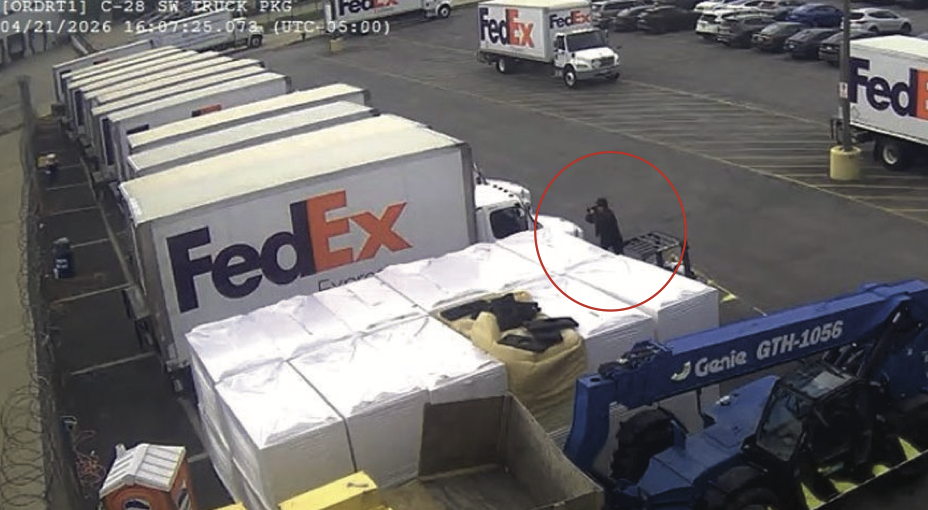
In April, an unknown person was seen inside the FedEx employee parking lot at O’Hare International Airport in Chicago, Illinois. The document states this person looked like they were taking photos of aircraft or other parts of the airport. They climbed onto a forklift to take photos in the direction of the aircraft, and tried to get into a FedEx truck. Authorities later figured out this was Zeng based on the dark blue Chrysler Town & Country vehicle that left the area and that he was connected to the incident.
When Zeng tried to enter the U.S. again last Sunday, Customs and Border Protection interviewed him repeatedly. At first, Zeng said he planned to travel with his sister and a classmate. CBP agents then reviewed his phone and found multiple photos of aircraft. Zeng told the agents he takes pictures of model aircraft being tracked for a flight radar website. He said he takes the photos as his hobby. Agents also found photos of Zeng and others in tactical clothing holding rifle-styled firearms. Zeng said this was an airsoft gun.
Images: screenshots from the court record.
Zeng changed his story repeatedly, before revealing taking the photos was more than a hobby. Instead, he knows someone referred to in the court record as his “Chinese Contact.” This contact assigned Zeng specific planes and their tail numbers to photograph, and then paid Zeng $20 to $30 per picture. Zeng said this Chinese Contact sent him SIM cards to communicate, and then told him to destroy the cards, their chats, and delete the photos he took. Later Zeng said the contact told him to use his Huawei phone to communicate, and never take that phone into the U.S.
Zeng claimed the Chinese Contact approached him through an aviation spotter website around a year and a half ago. He said he believed this person was connected to the Chinese Communist Party, and later told the FBI the person sent a photo of an official looking badge. The language the contact used was very organized and managed, not language typically used between friends. When the FBI later looked into this site, the agency found it appeared to not exist.
One of the photographed planes was an American United aircraft which had a unique, temporary paint job, of which photographs were highly desired. The contact wanted Zeng to go to places in Orlando, Las Vegas, and Los Angeles to take photographs of specific locations around airports. Zeng said he denied these requests and accepted two tasks over 18 months. One of those was to get the photos of the interior of the FedEx facility at O’Hare International Airport. In all, he made $500.
“ZENG stated ‘Chinese Contact’ was not satisfied with the photographs and the photographs were fine, but not what were ‘expected’,” the document adds.
What it means
This case shows how individuals posing as hobbyists can be recruited to gather sensitive imagery. The student was paid to photograph specific aircraft and airport facilities. He was instructed to use specific hardware and destroy digital evidence. The FBI notes the language used by the contact was highly managed, suggesting state involvement rather than casual interaction. The fact that the aviation spotter website the contact claimed to use did not exist further points to a coordinated effort.