“We are literally in a renaissance,” says the artist Refik Anadol when asked about the current state of art history. “We just don’t have a name for it yet.”
Anadol, who specialises in installations exploring the relationship between humans and machines, has cause for optimism. On June 20, Dataland, the downtown Los Angeles gallery he co-founded with Efsun Erkılıç, opened to the public. Billed as the first museum of AI arts, the venue welcomed more than 10,000 visitors to the opening exhibition in its first two weeks.
Machine Dreams: Rainforest
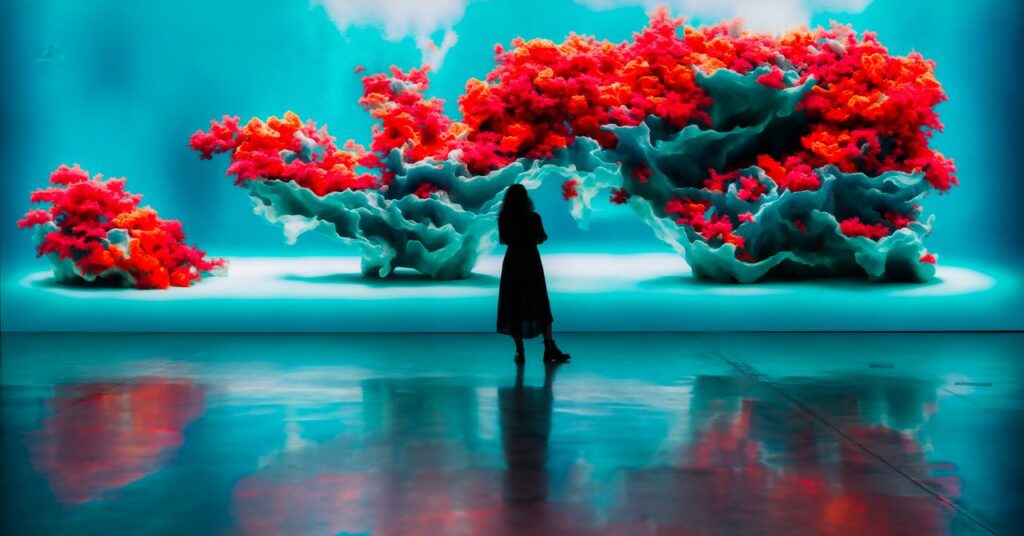
The set piece is his most ambitious project to date. Interactive displays respond to visitor movement and biometric data tracked by wearable devices, producing shifting images and soundscapes drawn from Anadol’s Large Nature Model. This AI system was built using natural science archives from research institutions like the Smithsonian.
“For three years, we started from scratch and trained our own AI models, and we worked with our own data sets,” Anadol says. He and his team travelled to the Amazon and other rainforests to capture raw material for the model’s hallucinated versions of those environments. “We have 5 petabytes worth of raw data that we collected by ourselves,” Anadol says. He is proud that Dataland sourced this data with the consent and participation of researchers, whereas major Silicon Valley firms have faced backlash and lawsuits over what many creators say is unlicensed, extractive use of content.
Anadol adds that Google DeepMind gave Dataland access to experimental low-energy resources, allowing the gallery to run on Google Cloud and maintain sustainable compute. Anadol has collaborated with the tech giant since becoming the first person awarded the Google Artists and Machine Intelligence Artist Residency in 2016.
Ethics and data
Ethics, environmental responsibility, and a commitment to producing a living ecosystem with artificial intelligence are crucial if Anadol and Dataland want to redefine AI art. The phrase is a nonstarter for many creatives and critics of the generative slop that has infested visual media. Anadol is aware of people rejecting that stuff and hardly blames them. “I mean, 100 percent, the majority is right,” he says, noting that when someone hears about AI art, “their first assumption is like, prompt engineering, or a bunch of eight-second clips.”
His new gallery aims to prove there are grand possibilities beyond all that. “The reason for Dataland is to understand and explain and explore—and tell the world that there is not only one option,” he says.
Machine Dreams: Rainforest makes an impressive case for AI as a tool to enable surprising modes of artistic engagement. Anadol claims that it is his first project where “it is impossible to record what it feels like,” and it is no exaggeration. After going through an entrance procedure involving a waiver and a specialised app, I receive a smartwatch and a U-shaped plastic collar to be worn over my shoulders. As these are calibrated, the shoulder harness emits the first of the exhibit’s many striking scents. Here in the heart of this hypermodern building, I can suddenly smell trees.
The largest gallery is empty but for a couple of pillars, with ultravivid fusions of nature scenes and computer-chip textures swimming across the walls and floor. There is a 40-minute cycle of varied effects that I quickly realise are partly dependent on the movements of everyone in the room. I enter during a sequence simulating heavy rain and thunder and see that each visitor has a watery circle around their feet that travels with them, becoming an aqueous streak when they walk faster. The paths of droplets in the downpour shift if you wave a hand in front of them. There is even the clean smell of a summer storm emanating from my biosensor.
Anadol says that while you have the option to move through his artwork as a ghost—that is, without the biosensors—the wearables, which are modified medical grade devices, offer a way to put your fingerprint on it, at least temporarily. “For almost 5,000 years, we as humanity, we look at artworks and we feel something,” he says. “At Dataland, as a laboratory of imagination, our first deep question is: Can artwork feel us back?”
Anadol laughs when I wonder aloud whether the gadgets tracked my trip to the restroom. “No, no, no, no, the restroom has zero connection,” he says. Moreover, he says, the museum “forgets” your data the moment you leave, though it remains available to the visitor by way of a personal token received at the exit. “Data is a form of memory,” Anadol says, and the gallery seeks to treat it with respect. “So it’s the opposite,” he notes, “of what we have in the whole world,” where invasive surveillance has become the norm.
Behind the curtain
Farther on lies the Infinity Room, which invites me to follow a glittery hummingbird as it soars over a fantastical neon forest. The flight puts one in mind of the aerial acrobatics in the Avatar movies, and at times I find myself a little off-balance when the POV careens one way or the other. I am more intrigued by an adjacent wing, the Latent Gallery, where I can take a peek behind the curtain of the Large Nature Model. At one console, for example, I can scroll through the training data by category. I click “Frogs,” and the wall in front of me turns into a massive grid of frog photos included in the model.
Anadol says he wanted people to have a glimpse of the profound wealth of information underlying the often surreal and impossible permutations of actual nature generated by the installation. The Smithsonian’s Encyclopedia of Life alone supplied data on more than 2 million species. “These are the places where we demystify our algorithms, demystify our data sets, demystify our training experiments,” he says. Anadol says he wanted to see “what happens if we go next-level and tell the audience and the visitors exactly the reason for that machine dream or hallucination.”
And hallucination is certainly the point, which also serves to differentiate Dataland’s debut show from the ultra-realistic AI-generated images and deepfakes that contribute to our culture of misinformation. “It’s about the idea of a machine that falls in love with nature—that’s the rainforest—and we enter the machine dreams as a concept where we smell the machine’s hallucinations, we taste the machine dreams, we hear millions of bird songs that are impossible to hear in a human world,” Anadol says. The model may incorporate scientific libraries and real-time weather data, but the place it constructs with these building blocks is, in most respects, totally alien.
The Sanctuary
Finally, you have the Sanctuary, based on a concept Anadol has been working toward for several years. As a group enters the room, the biometric information from each individual—everything from heart rate and skin temperature to the path they have taken through Dataland and the speed of their tour—is compiled to generate a swirling, abstract, 3D representation of the room’s collective energy, never to be seen again.
Anadol says that here and elsewhere, the gallery takes “emotion as an input.” He has been especially pleased to observe how frequently the biosensors pick up on visitors’ goosebumps, which he calls an “incredibly relevant” sign that the sensory biomes of the exhibit are having a pronounced effect on those who pass through them. “The artwork can feel this information,” he says. “I saw people with tears, I saw people with joy, I saw people with excitement,” Anadol adds. “And I think, if that’s not art, what is art?”
What it means
That kind of response is exactly what it will take to sway the skeptics unconvinced that the creative arts have anything to gain from artificial intelligence. Which, it is worth pointing out, Anadol regards not as some production shortcut but as a powerful means to rediscover ourselves. “This is all about being human at the end, not about AI,” he says of Dataland and his latest work. “It’s just an incredible tool, but the messaging and the context and the meaning is still all about being human.”