Thibault Schrepel’s two-year study shows banning AI from classrooms leaves students behind
A law professor at Vrije Universiteit Amsterdam split his “Law of AI” course into three groups to test how different levels of AI access affect student performance. The group forbidden from using ChatGPT finished last in both 2024 and 2025. Schrepel, who led the experiment, admits he was wrong to assume unguided AI use would cause more harm than good.
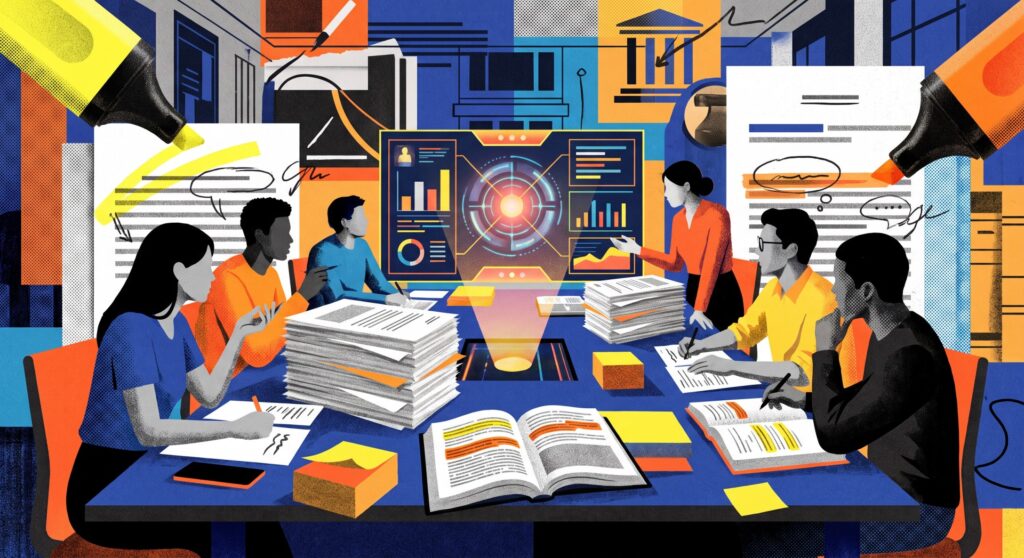
Students worked in teams of four or five for 20 minutes to improve a provision of the EU AI Act. Grading focused on substance, clarity, proportionality, and innovation. One group had no AI tools. The second received ChatGPT-generated revision suggestions embedded directly in the text without guidance. The third group received hands-on training in legal prompt engineering and checking AI suggestions for consistency and accuracy.
All students took identical multiple-choice and take-home exams reviewing another AI Act provision. The first round involved 66 students in 2024. The second round involved 164 participants in 2025.
The no-AI group ran out of ideas quickly
Students without AI made minor wording tweaks, rephrasing for clarity and cutting redundancies. Only a few subgroups attempted substantive legal improvements. After ten to fifteen minutes, many subgroups regularly ran dry, an effect Schrepel calls “idea exhaustion.” Going without AI did force deeper discussion among group members, though.
The second group accepted AI suggestions largely without question, often reasoning that they “sounded better.” Some students replaced the terms “shall” and “individual” with AI-suggested alternatives without showing they understood the legal implications. Every subgroup kept at least one misleading or legally extraneous term from ChatGPT’s output.
Only the trained third group engaged in genuine back-and-forth with the AI, testing different phrasings and digging into the substantive questions behind the assignment.
The training advantage nearly vanished by year two
The trained group scored well above the other two in 2024, especially on the more demanding take-home exam. A year later, that gap had almost closed. All three groups performed at roughly the same level in 2025.
Schrepel attributes this to growing chatbot familiarity. Many students already use these tools in daily life, so formal training delivered less of a boost in 2025 than it did a year earlier. Ethical use and legal responsibility still need to be taught, he adds.
One finding held constant across both years: the no-AI group finished last. Banning AI produces worse average outcomes than allowing it, Schrepel concludes. Whether the advantage comes from structured training or just hands-on experience remains an open question.
The author’s own assumption turned out wrong
The second group’s performance surprised him, Schrepel writes. He expected the uncritical errors from the classroom exercise to carry over into the exam. The opposite happened. The errors didn’t repeat, and the group actually scored slightly higher than the AI-free group. The most likely explanation, he says, is that students learn to spot AI weaknesses through their own use, especially when accuracy has real consequences.
That forced Schrepel to abandon his starting assumption. He had been convinced AI only helps with structured training and should otherwise stay out of the classroom. “I was wrong,” he writes. Skipping AI instruction is a missed opportunity, but it doesn’t cause the educational collapse some had predicted.
Universities should rethink bans
Department leaders should resist blanket AI bans and give instructors room to experiment, Schrepel says. Universities also need to invest in AI skills for faculty, many of whom feel poorly equipped.
The traditional master’s thesis needs rethinking, too. Its core value, the long struggle with research and argumentation, can now be handled in minutes with AI tools. Pure literature reviews should no longer count, Schrepel argues, and programs should require practice-oriented or empirical work where thoughtful AI use is part of the grade.
Not all universities are moving in this direction. UC Berkeley Law has banned AI from nearly all graded work, arguing that future lawyers need to build core thinking skills before using AI in any useful way. That position directly conflicts with Schrepel’s findings, which suggest keeping AI out of the classroom leaves students worse off regardless of the rationale.
Schrepel acknowledges his study’s limits: small sample size, students enrolled in an AI course who were likely more tech-savvy than average, and no way to verify how much AI students actually used on the take-home exam.
That last point matters because other research finds the strongest AI effects on unsupervised work. A UC Berkeley study covering more than 500,000 grades found that the share of A grades in writing- and programming-heavy courses jumped 13 percentage points after ChatGPT launched. Proctored exams showed no comparable shift. A longitudinal study from central China tracking more than 26,000 K-12 students told a similar story from a different angle: AI boosted homework grades while exam performance dropped by up to 24 percent. The damage was greatest where AI replaced independent thinking rather than supporting it.
What it means
For students and educators, the findings suggest that removing AI tools entirely does not protect learning quality. Instead, it stalls progress while forcing students to waste time on repetitive tasks. The data indicates that exposure to the tool, even without formal instruction, allows learners to identify and correct errors more effectively than isolation does.