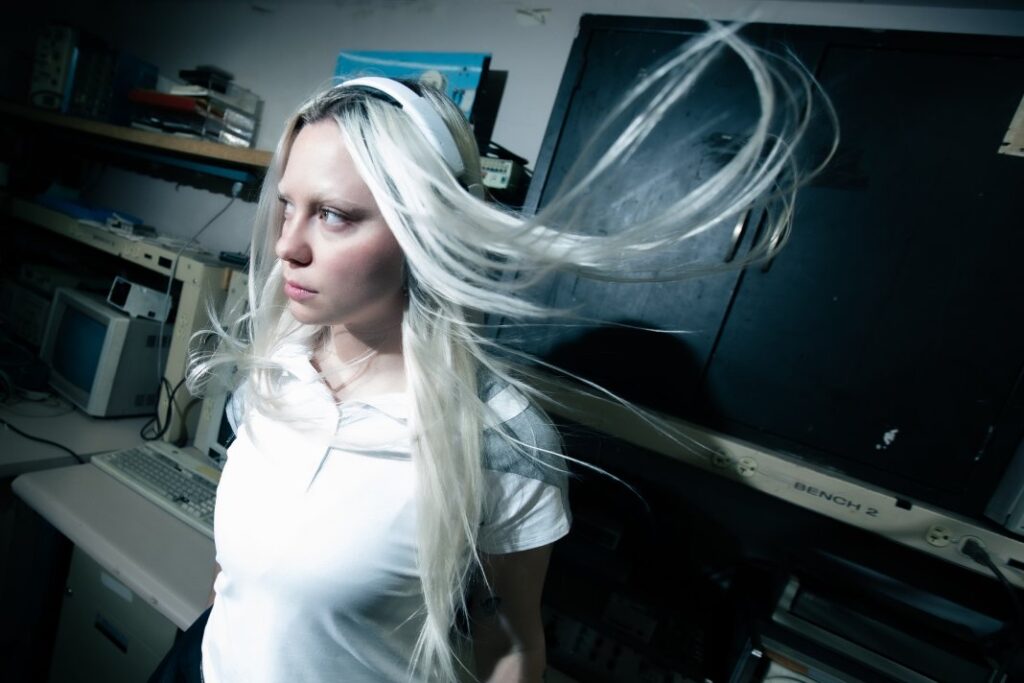
Sarah Davis, known online as DJ_Dave, began her career by writing code that generated music rather than pressing buttons on a synthesiser.
She describes the moment she discovered Strudel as a sudden realisation. The software interface displayed only lines of multi-coloured text. To a typical user, strings like “bd bd hh bd rim bd hh bd” look like a complex banking password. To Davis, they form a drum sequence. Text such as “c2, eb3 g3 [bb3 c4]” defines melody and harmony. This open source environment allows her to create airy synths, vocal chops, and heavy beats.
Based in Los Angeles, Davis is currently preparing to release her first full-length album. She will tour the US, Europe, and the UK later this year alongside horsegiirL.
What is live coding?
Many people are unfamiliar with the term. Until recently, the practice was limited to academic hubs and experimental gatherings known as algoraves. Practitioners would manipulate command line interfaces to make music in real time.
“It’s an environment where you write code and the output is sound,” Davis says. She notes that this method skips the graphical interfaces found in Ableton Live or Bitwig. Instead, written instructions generate everything from simple sine waves to complex arrangements. She states that any genre is possible, though her focus remains on dance music.
The technique emerged in the mid-1990s from Europe’s Demoscene. This subculture combines digital visual arts and computer music to produce unique results. Davis encountered the field by chance while studying fashion at college. She enrolled in a live coding class on a whim and became addicted to it.
“Screen-sharing is nerve-wracking… I don’t always remember to clean up my files before I perform!”
The pandemic prevented Davis from performing live initially. She eventually built a reputation as a skilled performer who pushed against scene norms. She recalls playing at random clubs in New York rather than staying within dedicated live coding spaces. This approach had not been done before.
The music she created was dance-oriented with pop sensibilities. She moved from small venues in New York City to multi-night stints at The Echo in LA and Grimes’ Met Gala afterparty. Davis began performing live vocals during sets. She also automated parts of her code to step away from the laptop and take centre stage.
One area where Davis adheres to traditional aesthetics is sharing her screen. She allows the audience to see the code as it is written.
“It is nerve-wracking,” she concedes. “My coding process feels intimate, similar to how anyone would probably feel about their music production process. And I don’t always remember to clean up my files before I perform!”
Despite the anxiety of having thousands watch her programme an algorithm on the fly, Davis emphasises that transparency is central to the appeal. “The way it’s performed is so direct,” she states. She cues sounds while people watch them trigger. Audiences hear the music being created in real time. They see the full production process from start to finish happening in front of them.
She previously experimented with visual art overlays atop her code lines. She has since stripped these back to give maximum insight into the music creation process.
“I make sure the code is visible as much as possible,” she says. She guarantees that some audience members have never seen live coding before. It has been an interesting learning process for her to explain what she is doing without speaking.
Education and recording
Davis does not limit her education efforts to the stage. In 2024 she co-authored an academic paper on live coding in pop music. She embarked on an Always Learning Tour of US college campuses. She gave coding classes and public lectures during the day followed by performances in the evening.
Most tools required are free and open source. The main obstacles to growth are a lack of public awareness and the need to master basic console commands. Davis has been trying to rectify this.
“There is so much room for improvisation. The random outputs, the mistakes – I’ve always embraced that”
“Not a lot of schools offer a class on live-coding music and I want to try to bring this to people where I can,” Davis explains. She was introduced to the field by someone sitting in front of her who told her the history and answered her questions. She describes that introduction as invaluable.
Live coding typically happens in the moment. Sounds and structures are often created or modified dynamically on the fly. This presented a challenge when Davis began recording and releasing music.
“There is so much room for improvisation,” she exclaims. “The random outputs that it’ll give me, the mistakes – I’ve always embraced that.” In the beginning, she recorded music as raw as possible. The first three songs released in early 2020 were recorded straight from her live coding environment. She did not structure them. There was no mixing. She bounced them and put them on Spotify.
These days, Davis leans more on DAWs for structuring song arrangements. She makes clear that everything still starts with code. She loves doing vocal chops in Strudel because every time it sounds amazing. She makes a vocal loop and runs that stem for a long time, perhaps three minutes. She takes that into Logic Pro and finds a section she likes. She does not cut things up too much because she likes when it sounds a little fucked up. Live elements are always present.
While working on her first full-length album, Davis is balancing a concerted effort to hone her sound with a desire to break new ground. She is working on high-energy dance songs for the album. She also wants to explore other sub-genres she has not been able to do before.
She is drawing from experiences as a producer and remixer. Having worked with Grimes and remixed Tove Lo and Channel Tres, Davis says a lot of what she loves about remixing has found its way back into her own production process. She loves taking pre-existing sounds and manipulating them to sound brand new. She was always drawn to remixing other people’s work. When creating the album, she asked herself why she did not just remix her own songs. She would finish a track and then take part of it to remix it into a new track.